Sunday, June 29, 2014

Hawai’ian Activists Come to San Diego to Protest BIO Convention

President of “Babes Against Biotech” Confronts Big Pesticide Makers on Kaua’i

by MARK GABRISH CONLAN

Copyright © 2014 by Mark Gabrish Conlan for Zenger’s Newsmagazine • All rights reserved

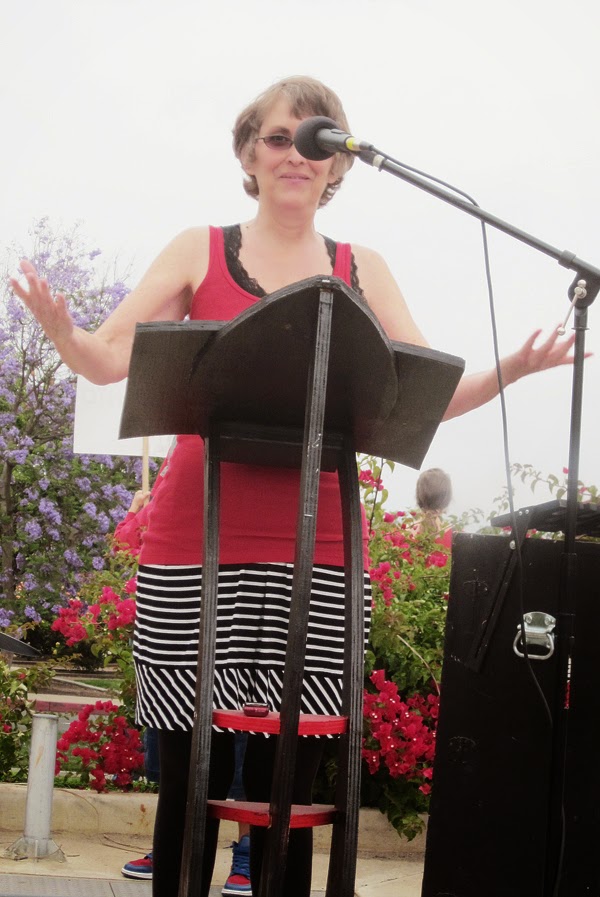
Nomi Carmona of “Babes Against Biotech”

The banner protesting the Kaua’i lawsuit (Nomi at left)

Protesters confront biotechies (Hendrik Jan Houthoff at right)

Chris Galloway

GMO’s = death (the banner Chris Galloway objected to is at right)

“Kill Monsanto Before It Kills Us”

“Monsanto Owns the FDA”

Mom and three kids came down from Temecula to protest

The demonstration against the Biotechnology Industry Organization’s (BIO) 2014 convention in San Diego June 23-26 was small. A hastily thrown-together action outside the San Diego Convention Center on BIO’s last day in town, June 26, attracted no more than about 20 people at any one time. But among those people were a delegation of activists from Hawai’i, which has become an unlikely ground zero in the battles over pesticides, genetically engineered crops and the future of farming in the U.S. and worldwide.
Led by Nomi Carmona, a Hawai’ian activist and president of Babes Against Biotech (BAB), the Hawai’ians particularly targeted three pesticide companies — Syngenta, Dow Chemical and DuPont Pioneer — for a lawsuit they’ve filed against the county government of Kaua’i, one of the Hawai’ian Islands. The suit, filed last January in federal court in Honolulu, seeks to throw out a law opponents of pesticides and genetically modified organisms (GMO’s) got through the Kaua’i county government in 2013 limiting the use of pesticides and GMO’s in experimental farms on Kaua’i.
According to Carmona, all six of the world’s major agricultural and chemical biotech firms — the three that are suing plus Monsanto, Bayer, and BASF — operate experimental farms on four of the five Hawai’ian Islands. “We passed a law to require buffer zones between the farms and schools, homes and hospitals, because we’re getting so many problems with pesticide poisoning,” Carmona explained. “The kids are having to leave school in ambulances, unconscious. Pesticides are being found drifting off the test fields and ending up next to schools. Pediatricians are freaking out because we’re showing 10 times the national average of birth defects in the neighboring fields.”
In addition to setting up buffer zones between experimental farms and residents, Carmona explained, “That bill also required disclosure of what they’re spraying on us and what genetic traits they’re experimenting with [in creating GMO’s], and to do environmental and health impact studies.” Getting the bill approved by the Kaua’i legislature was itself a tough struggle — Kaua’i Mayor Bernard Carvalho, Jr. vetoed it and the Kaua’i County Counsel passed it over his veto in November 2013 — and with the companies suing to have it invalidated, it’s become even tougher.
Why are the companies suing? Syngenta spokesperson Paul Minehart said in an interview that the ordinance is illegal because “it arbitrarily targets our industry with burdensome and baseless restrictions on farming operations by attempting to regulate activities over which counties in Hawai’i have no jurisdiction. These activities are already regulated by governmental agencies under state and federal laws.”
One thing the companies and the activists agree on is why Hawai’i in general, and Kaua’i in particular, have become ground zero for research in pesticides and the GMO crops designed to withstand them. Because Hawai’i is America’s only tropical state, it has an excellent growing climate and can generate three to four crop cycles per year — compared to only one or two on the U.S. mainland. And because it’s made up of five islands, the test fields for pesticides and GMO’s can be kept relatively isolated and free from cross-contamination with other forms of agriculture.
As a result, Syngenta and DuPont Pioneer each leased about 5,000 acres of land on Kaua’i, and Dow subsidiary Agrigenetics leased 3,500 acres. The companies use this land to grow a mix of GMO crops, including corn, soybeans, canola (rapeseed) and rice. The lawsuit states that Kaua’i’s climate gives the companies “the invaluable opportunity to triple or quadruple the pace of development of GMO crops,” which is “crucial” to their success.
That’s exactly what Hawai’i’s environmental and anti-GMO activists are trying to stop. In addition to Kaua’i, the government of Mau’i is considering a similar bill and the local government of Hawai’i, the largest of the islands and colloquially called “the Big Island” by locals so it isn’t confused with the entire state, just passed a bill banning the growing of any new GMO crops on their land. Supporters of these ordinances say the companies are using pesticides other nations have banned, and that they’re spraying restricted-use pesticides 10 to 16 times per day, 250 to 300 days per year.
According to Carmona, one reason she was protesting the BIO convention is that BIO itself has filed a lawsuit against the Big Island’s law restricting GMO crops. “Hawai’i is the last [island] without the chemical companies,” she said. “We’re protecting it by passing that law, and this organization is now suing to overturn it.”
Carmona said the companies agreed to voluntary disclosure under something called the Kaua’i Good Neighbor Project, but the “absolutely astonishing numbers” revealed in those releases led the companies to pull back and fight tooth and nail against any requirements for additional disclosure. She said the only way grass-roots activists know what chemicals are being sprayed is from the sales records for them, which are supposed to be posted online — but the online information is not complete, and “they’re legally fighting that, too.”
The tale of woe being told by Nomi Carmona has a familiar ring to progressive San Diegans still reeling from the defeat of the Barrio Logan Community Plan at the polls earlier in June. There, too, local activists had sought to set up buffer zones between toxic industries and people’s homes and schools. They won at the San Diego City Council, but industry fought back by putting the community plan up for a public vote by the entire city — and the plan was defeated by a 20-point margin. The campaign against it claimed that passage of the Community Plan would push the Navy out of San Diego, close the shipyards and cost the city 45,000 jobs.
Those are the same arguments Carmona hears when she debates the pesticide/GMO issue back home on Kaua’i. “I could give you their entire testimony,” she said. “Every time it’s always the same thing: ‘We provide jobs. We provide a valuable service. Over three trillion GMO meals have been served.’” She also said company spokespeople tell elected officials and ordinary citizens to “ignore all the other peer-reviewed science in the entire world, and just listen to the ‘science’ that they fund,” which says GMO’s are safe.
The biotech industry’s take-no-prisoners attitude towards its critics has allowed the food, chemical and pesticide industries to sneak GMO’s into Americans’ food with virtually no public debate. Elsewhere in the world, that hasn’t been the case. France, Germany and almost all other European countries have passed laws requiring that food containing GMO ingredients be labeled as such. “All we want are the kinds of laws your countries already have,” some of the anti-BIO protesters told convention delegates from Europe.
But U.S. industry leaders have raised millions of dollars to defeat ballot measures in California and Washington requiring foods containing GMO’s to be labeled. And they’re threatening a lawsuit against the state of Vermont for passing a labeling bill in their state legislature.

A Difference of 13 Years

The relative absence of organized protest to the 2014 BIO convention in San Diego — an event extensively ballyhooed in the local media because Hillary Rodham Clinton came to town to deliver the keynote speech — stood in stark contrast to what happened the first time BIO came to town. In the summer of 2001, opponents of biotechnology in general and GMO’s in particular organized an elaborate response, including hosting their own “Biojustice” convention two days before BIO’s opened and bringing in worldwide speakers, including Vandana Shiva from India and Canadian farmer Percy Schmeiser, whom Monsanto sued for patent infringement — and won — after their genetically modified canola seeds contaminated his crop. Opponents also tried to set up an elaborate series of street actions during the BIO convention itself.
Unfortunately, the San Diego police and business establishment were ready for them. Partly to ward off a riot similar to the one in Seattle in November-December 1999 at the World Trade Organization’s ministerial meetings, and partly to show the biotech industry that the city was on their side, the police mounted a massive presence, closing off much of downtown San Diego. Police also aggressively enforced traffic laws — including arresting people for stepping outside crosswalk lines when crossing streets — to lock up as many protesters as possible and discourage those left free.
The Centre City Development Corporation (CCDC), the now-defunct redevelopment agency for downtown San Diego, organized meetings of local property owners to make sure nobody rented temporary space to host anti-BIO demonstrations. As a result, the Biojustice organizers had to set up their “convergence center” miles away from the convention, in the parking lot of an alternative church in Golden Hill. The quasi-military tactics of the police put off not only Biojustice protesters but BIO delegates as well. Chris Holloway of the ERA Consulting Group in London attended both the 2001 and 2014 BIO conventions and was astounded that in 2001 he couldn’t get anywhere near the Convention Center without showing his delegate badge.
At least one activist who participated in Biojustice suggested that the heavy-handed police response to the 2001 anti-BIO protests discouraged local activists from mounting major challenges to later BIO conventions in San Diego. This may be why activists have paid so little attention to BIO in a city where the three Marches Against Monsanto in May and October 2013 and May 2014 have drawn large crowds. The last March Against Monsanto on May 24 drew over 3,000 people and featured a pre-march rally of local speakers urging anti-GMO activists to support community gardens, farmers’ markets and other alternative ways of obtaining freshly grown, organic and non-GMO food.
The relatively tiny size of the anti-BIO demonstration June 26 had one unforeseen result: protesters got to talk to BIO delegates one-on-one and found a number of them surprisingly sympathetic to their cause. Chris Holloway took exception to a sign that said “GMO’s = ” with a drawing of a skull and crossbones. But he told protesters he agreed with their opposition to GMO’s in agriculture. His concern was that medical researchers like himself be allowed to use genetic engineering to develop treatments for hereditary diseases. Holloway told protesters about the elaborate precautions medical GMO researchers take to ensure their GMO’s don’t contaminate the environment, including destroying all waste products excreted by their human research subjects — a far cry from the notoriously sloppy practices of agricultural GMO researchers.
In general, BIO delegates from other countries — including most of western Europe, where GMO’s are either banned outright or there are labeling requirements for foods containing them — were more sympathetic to the protesters’ cause than Americans. Hendrik Jan Houthoff, a delegate from LINXIS in Amsterdam, drew the same distinction as Holloway between medical and agricultural biotech research. “The way Monsanto does it doesn’t help mankind,” Houthoff said. He added that his daughter, who does biological agricultural work in France, is even more anti-Monsanto than he is.
Asked why his daughter doesn’t like Monsanto, Houthoff said, “Because they are using methods of agriculture that kill diversity in nature, that kill insects, and that don’t help farmers because they have to buy [seeds] from Monsanto every year.” Some of the demonstrators were astonished to hear a BIO convention delegate essentially repeating their talking points and attributing them to his own daughter.
Nomi Carmona did get into an argument with an African-American graduate student in biotech who conceded that “it is a legitimate concern when you’re talking about how people get food when it’s not grown in their area.” But the grad student basically took the industry’s point of view that GMO’s should be assumed to be safe and the burden of proof should be on those who want them banned to prove that they aren’t. “If you’re going to make an argument, there have to be a lot of facts with it,” she said.
“We can’t have the facts without the testing being done,” Carmona replied. “We’re not allowed to.”
The grad student, who had been in the auditorium when Hillary Clinton gave the keynote speech, asked Carmona, “If you remove GMO’s, what is the alternative to feeding the American population?”
It’s an argument that particularly incenses Carmona. “It’s a fantasy right now that GMO’s will help ‘feed the world,’” she told Zenger’s. “Spending $46 million[1] fighting labeling and disclosure of genetically engineered ingredients in your food in California is not ‘feeding the world.’ Denying and crucifying scientists like Tyrone Hayes for exposing the major health risks associated with Syngenta’s [pesticide] atrazine is not ‘feeding the world.’ Everything they’re doing, they’ve made a lot of promises and nothing’s come out. Where are the increased crop yields? They don’t exist.”


[1] — A Huffington Post article, http://www.huffingtonpost.com/2012/10/26/prop-37-opponents_n_2023719.html, published October 26, 2012, revealed that food and chemical companies had contributed nearly $30 million to defeat Proposition 37, which would have required labeling of foods containing GMO’s in California. This doesn’t count what was spent in the last week before the election, which could have brought the total closer to the $46 million Carmona claimed.

Saturday, May 24, 2014

March Against Monsanto Draws 3,000

San Diego One of Hundreds of Cities Protesting “Frankenfood” Giant

by MARK GABRISH CONLAN

Copyright © 2014 by Mark Gabrish Conlan for Zenger’s Newsmagazine • All rights reserved

March steps off

Something offensive …

Monsatan

Crammed on the bridge

Reclaiming Kate Sessions, Balboa Park’s founder, for natural agriculture

Occupying Our Food

For My Descendants

No GMO Cookies

The Bee Dog

March arrives downtown

The honeybee life cycle

Axis of Evil

Kill Me Naturally

Nancy Casady

Nick Bernabe

Earl Robinson

Quin Shakra

Susan McKenzie

Rick Trujillo

Ray Lutz

Thirteen years ago, San Diego’s lonely protesters against the biotechnology industry in general and genetically engineered foods in particular would have had a hard time believing that over 3,000 people would one day turn out in the streets of this city for a march demanding — depending on which signs you read and which slogans you heard — either the labeling or an outright ban on genetically modified organisms (GMO’s) in food. But that’s what happened on May 24, when as part of a worldwide day of action against Monsanto, the leading corporation in the GMO business, huge crowds turned out for a rally at the Balboa Park fountain, a march through the park and downtown, and a follow-up program of workshops on do-it-yourself farming and beekeeping at the World Beat Center, also in Balboa Park.
Marches against Monsanto have taken place in San Diego before, in May and October 2013, but this was by far the biggest. The organizers had planned to take the march across the park via the bridge over the canyon in which the 163 freeway sits, but construction blocked off parts of the bridge and forced the marchers to walk two or three abreast through a maze of chain-link fences designed to wall off walkers from the parts of the bridge being rebuilt. The mixup forced the march leaders to rest on the west side of the park before they turned downtown and allow the people in the back to catch up to those in front. Nonetheless, the marchers reunited and made it on the long loop the organizers had planned.
The rally before the march featured a wide variety of speakers with different backgrounds but similar messages. Their overall argument was that neither giant corporations like Monsanto nor government agencies can be trusted to protect us against potentially destructive or environmentally toxic foods. Rather, we have to learn to do that ourselves: by growing our own food, starting urban gardens, joining Community-Supported Agriculture (CSA) groups, buying only organic produce and making ourselves more aware of how food gets from a seed in the ground to a serving on our table. Many of the workshops after the march offered similar information, including juicing, aquaculture (a form of underwater farming that generates both produce and edible fish), homesteading, beekeeping, composting and testing your bodies for toxins produced by GMO’s, including the pesticides farmers who grow GMO crops use more of because the whole point of genetically engineering food crops is to sell more pesticide.
That’s the dark connection that has made Monsanto the principal villain in the demonology of those opposed to GMO food. Though other companies are involved in GMO’s — one sign at the rally identified BASF, Bayer, DuPont, Syngenta and Dow as other corporate members of the “Axis of Evil” — Monsanto became the poster child for GMO opponents because it developed so-called “Roundup Ready” soybean seeds to withstand massive applications of their patented herbicide, Roundup. In the late 1990’s, with the patent on Roundup about to expire, Monsanto hatched a scheme to keep farmers using it: they developed Roundup Ready soybeans and sold them to farmers under a contract that said they could use only brand-name Roundup, not any generic version that might come to market once their patent expired. What’s more, they patented the Roundup Ready seeds themselves — and successfully sued farmers whose crops were cross-contaminated with Monsanto’s GMO seeds, whether they’d intended to plant them or not.
Indeed, one of the big fears driving the movement against GMO’s is that, by spreading their genetically engineered versions of common crops so they cross-pollinate with non-GMO varieties, Monsanto may someday claim that all the world’s corn, soy or whatever contains their genes and is therefore their property. Once that happens, it will literally be impossible to grow those foods legally without paying Monsanto a royalty. Other fears driving the anti-GMO movement include the environmental impacts of the huge amounts of pesticides used by farmers who grow GMO’s and the shrinking of the number of varieties of common crops. The fewer varieties of a crop there are, opponents argue, the greater the chance that a pest which develops resistance to Roundup and the rest of the chemical industry’s products will wipe the crops out en masse and there won’t be other, more resistant varieties available with which to replace them.
But the most infuriating aspect of the GMO industry to its opponents is that they not only want to put their altered genes in our food, they want to do that without telling us. Monsanto and other companies in the GMO business have spent hundreds of millions of dollars lobbying against laws that would require food makers to label any products containing GMO’s. Huge donations from these corporations persuaded voters to defeat ballot measures in California and Washington that would have required GMO foods to be labeled. They were also able to stop legislatures in other states from passing GMO labeling laws — until recently, when a labeling bill got through the Vermont state legislature and was signed into law by its governor.
Not that a mere state law is going to stop industry from fighting hard for the right to conceal whether or not our food contains GMO’s. The May 10 Los Angeles Times contained a letter to the editor from Henry I. Miller, M.D., former head of the Office of Biotechnology at the U.S. Food and Drug Administration (FDA) and currently a fellow at the Right-wing Stanford Institution, which said, “The FDA does not require labeling of foods with genetically engineered ingredients because such information is not ‘material’ — in other words, related to safety or appropriate usage — and would be misleading.” Miller claimed that a previous labeling attempt by the Vermont legislature had been struck down by a federal court “because Vermont could not demonstrate that its labeling requirement was motivated by anything more than satisfying consumer curiosity,” and therefore “the court said it could not compel food producers to include that information on product labels.”
It’s that arrogance on the part of the food industry and its advocates both inside and outside of government — that they not only have the right to put genetically engineered ingredients in our food but they don’t even have to tell us, and we don’t have the right to make them — that the first speaker at the May 24 rally, Ocean Beach People’s Food Do-Op manager Nancy Casady, targeted. “I’m not happy if I don’t know what I’m eating,” she said. “Knowing what we’re feeding our children is a basic human right.” She shared both good news and bad news about GMO’s. The good news was that two counties in Oregon have gone beyond labeling requirements and forbidden their farmers from planting genetically engineered seeds.
The bad news, Casady said, was that “169 million acres — about half of all the acreage in the United States — is now planted in GE crops, mostly crops that are designed for the purpose of withstanding more and more herbicides.” She stated that glyphosate, the active ingredient in Roundup, “has been found in breast milk in the U.S. in concentrations that are 700 times higher than those allowed in the drinking water in Europe.” Casady also said that 80 million pounds of atrazine, an herbicide that was banned in the European Union in 2004, “is being sprayed on corn [in the U.S.] each year and is causing the feminization of male frogs, a harbinger of the effect in humans.” She called Monsanto “a corporation that is willing to poison and threaten all life on earth for profits.”
Nick Bernabe, a co-founder of the March Against Monsanto as well as an alternative media Web site called http://theantimedia.org/, said, “Millions of people around the world are marching today, but you don’t see any news cameras here. That’s because the media are part of big corporations, just like the GMO companies, and they don’t serve the people by coming to cover events like this.” But he also confidently predicted that “the whole corporate paradigm is shifting towards the grass roots.” Barnaby announced an Overpass Light Brigade (OLB) action later that evening at Clairemont Drive and a “Bee Against Monsanto” protest August 16.
The connection between use of pesticides in agriculture and the massive deaths of bee colonies worldwide since 2006 was a major issue for many participants in the march and rally. “Harvard University just released a study linking bee poisoning 100 percent to neo-nicotinoid insecticides,” said Bernabe — although the two insecticides mentioned in the report (a press release is available online at http://www.hsph.harvard.edu/news/press-releases/study-strengthens-link-between-neonicotinoids-and-collapse-of-honey-bee-colonies/), imidacloprid and clothianidin, were developed by the German company Bayer AG (best known for aspirin), not Monsanto.
Still, many participants in the rally either wore T-shirts or carried balloons targeting Monsanto products for causing the deaths of bees, some people dressed as bees, and one woman walked a black dog she’d dressed in a black-and-yellow striped vest to make it resemble a bee. The organizers invited Eric Robinson, co-founder of the San Diego Beekeeping Society, to speak, and he began his talk with a whimsical tale of how he got involved in beekeeping. It seems eight years ago a neighbor’s garage had become infested with bees, and Robinson offered to take the bees off his neighbor’s hands. He got several of them out, including the queen, and the rest of the bees followed her to Robinson’s property. So he ordered a commercial beehive for them and became an amateur apiarist.
Robinson displayed an elaborate chart showing the life cycle of honeybees, and rattled off a long list of crops — including strawberries, blueberries, celery, cherries, avocados, beans, apples, sunflowers, hazel nuts, cucumbers, turnips, flax, apricots, oranges, grapefruit and coconuts — all of which are dependent on bees to pollinate them. He pointed to hieroglyphics from ancient Egypt that indicate that even that early, people were raising bees. Robinson also told an anecdote about a village in China during Mao Zedong’s rule in which “they had a big problem with sparrows because they ate crops. So they poisoned the sparrows, and next year they had a huge infestation of insects because they’d killed the sparrows that ate the insects. So they poisoned the insects, and the next year they had no crops at all because there was nothing to pollinate them. Now they have to buy pollen from other parts of China and pollinate their crops by hand. When you try to tweak Mother Nature, you run into trouble.”
Quin Shakra from Ojai, an organic farmer who said he’d never been in San Diego before and had never spoken to so large a crowd, talked about how he branched out from running a one and one-half acre farm (“smaller than a big farm, but bigger than a garden,” he explained) to starting All Good Seeds, a seed company that encourages farmers to save their seeds and use seeds from the previous year’s crop in next year’s planting. People have been doing that since agriculture was first invented, but it’s a big no-no in the corporate world of Monsanto and its competitors. Monsanto’s contracts with farmers specify that they must purchase Monsanto’s seeds every year, and at one point Monsanto tried to develop a seed with a so-called “Terminator” gene so any seeds the plants produced would be sterile and therefore couldn’t grow if replanted.
Quoting writer Carol Depp’s argument that “crop varieties express the values of their creators,” Shakra said, “Roundup Ready soybeans are altered for fertilizers, herbicides and fertility for one season. But that has no value for an organic farmer. We don’t dump herbicides on crops. Our values are not production at all costs and patenting all life in the name of capitalism. We save seeds, keep heirloom varieties, and improve them through traditional crop breeding. We want varieties that taste good and resist pests, are resistant to erratic weather and drought, and thrive.” Shakra also cited a recent paper by the Rodale Institute — which has been promoting organic farming for over 75 years — which argued that organic farming could essentially end human-caused climate change.
“We could sequester more than 100% of current annual CO2 emissions with a switch to widely available and inexpensive organic management practices, which we term ‘regenerative organic agriculture’,” the Rodale paper argues. “If management of all current cropland shifted to reflect the regenerative model as practiced at the research sites included in the white paper, more than 40 percent of annual emissions could potentially be captured.  If, at the same time, all global pasture was managed to a regenerative model, an additional 71 percent could be sequestered.  Essentially, passing the 100 percent mark means a drawing down of excess greenhouse gases, resulting in the reversal of the greenhouse effect.” (For a press release about the Rodale paper, visit http://rodaleinstitute.org/reversing-climate-change-achievable-by-farming-organically/. For the full paper, visit http://rodaleinstitute.org/assets/RegenOrgAgricultureAndClimateChange_20140418.pdf.)
“Organic food sales in 2012 increased by 25 percent,” boasted holistic healer Susan McKenzie. “Before 2012 it was 11 percent or less. I don’t know what happened in 2012, but now the numbers [the percentage of food sold in the U.S. that is certified organic] are up from 11 percent to 35 percent. It shows that every choice we make in our lives is making a difference.”
Rick Trujillo, retired train operator from the Santa Clara Valley before it was first colloquially and then officially renamed “Silicon Valley,” talked about his work with United Farm Workers founders César Chávez and Dolores Huerta — though, surprisingly, he didn’t mention Chávez’s pioneering opposition to pesticides in the 1980’s, when it was considered improper for a trade-union leader to question whether consumers should buy a product his members produced on the ground that it might be unsafe. “Science is in the wrong hands, and for us Chicanos/mestizos and existing sovereign nations/tribes, science has been in the wrong hands since 1492,” Trujillo said. He did have nice things to say about one Anglo-American scientist — the late Rachel Carson, author of the pioneering anti-pesticide book Silent Spring (1962).
After Alicia Sachs gave a brief presentation promoting community-supported agriculture (CSA), the next speaker, Ray Lutz, brought the critique back to Monsanto and in particular to its CEO, Hugh Grant (“not the actor,” he joked). “Hugh Grant is a monster,” Lutz said. “Monsanto began in the 1920’s by making PCB’s (polychlorinated biphenyls), which weren’t banned until the 1970’s. They made DDT. They make All laundry detergent, Astroturf, Celebrex, Nutra-Sweet and saccharin — so don’t buy those products, and if you want something sweet, use sugar. Monsanto got into GMO’s in 1983 and made the Flavr-Savr tomato in 1996 (a failed product that incorporated flounder genes into tomatoes to make them more oblong and therefore easier to pack into boxes). They made Terminator seeds, and that’s evil. This company is the epitome of corporate insanity.”
Lutz was advertised as the last speaker, but the organizers squeezed one more in: a white-haired woman whose name appeared to be Bilabi Gas, who’s leading a campaign to get genetically modified food out of San Diego’s public schools. “If your child goes to private school, and you can afford $22,000 a year, you can have his or her food catered by an organic restaurant,” she said. “For the rest of us, our kids are being poisoned.”

Wednesday, May 07, 2014

Fight Back Against FCC's and ISP's Attempts to Censor the Internet!

This is the public input I have just sent to FCC chair Tom Wheeler on what he calls a proposal for an "open Internet" but is in fact the opposite: a plan to allow giant corporations to buy fast-lane access and freeze out anyone who disagrees with their big-business, pro-1 percent agenda. TODAY is the last day the FCC is receiving public comments on this proposal. If you haven't done so yet, PLEASE log on to www.fcc.gov and submit a comment in opposition today! Also, call U.S. Senators Dianne Feinstein at (202) 224-3841 and Barbara Boxer at (202) 224-3553 and tell them to ask the FCC to reclassify Internet service providers as common carriers, like phone and cable companies, which would keep them from censoring the Internet content their customers can receive.
 
-->
May 7, 2014

TO: FCC Chair Tom Wheeler

FROM: Mark Gabrish Conlan

RE: Follow-up comment opposing the so-called “fast-lane Internet”

Dear Chair Wheeler:

I am appalled at the “do not reply” reply I just received to my e-mail, CIMS00003865491, opposing your plan to allow Internet service providers (ISP’s) to allow content providers and other Web sites to pay for premium high-speed access to the Internet. What appalls me is you statement that “I’m a strong supporter of the Open Internet, and I will fight to keep the Internet open.” If that were true, you would never have advanced such a proposal and would instead be using your powers as chair to fight any attempt to allow ISP’s to charge Web site proprietors for faster access.

My previous comment on these matters was sent as an automated e-mail from a Web site advocating REAL Net neutrality. This one I am writing myself.

Any plan to discriminate against Web sites on the basis of their ability to pay for fast access fundamentally violates the principle of Net neutrality. It not only can but WILL lead to a system in which giant corporations are able to push their messages to the front of the line and all other interests are either silenced altogether or relegated to such slow, difficult-to-access connections that no one will bother.

This is exactly what’s happened to all other U.S. media, as corporate consolidation has reduced the number of outlets in print, radio and television. What’s more, America’s experience with increased corporate consolidation, not only in media but all other businesses as well, has demonstrated conclusively that consolidation does NOT encourage innovation. Quite the contrary; it hampers it. Innovations come from small companies aggressively competing for a foothold in the marketplace, not from risk-averse corporate giants anxious to keep what they’ve got and freeze out potential threats. Does the name “General Motors” mean anything to you?

What’s more, allowing ISP’s to offer differential level of access to different Web sites raises the likelihood that ISP’s will become censors, deliberately restricting the content choices available to U.S. Internet consumers. The CEO’s of AT&T (Ed Whitacre) and Comcast (Bob Roberts) have already referred to their customers’ Internet connections as “my pipes” and publicly questioned why they should be required to allow messages to go through them of which they do not approve.

Net neutrality can ONLY be protected by an absolute, no-exceptions requirement that ISP’s must treat all Web sites equally — no differential access and none of the censorship both Whitacre and Roberts have called for. To this end, I ask you to do the following:

1)    Immediately withdraw your proposal to allow ISP’s to charge content providers for fast-lane Internet access.

2)    Commit to reclassifying ISP’s as common carriers, like telephone companies, to protect consumers against attempts by ISP’s to proclaim First Amendment rights to control the content users will be allowed to access.

3)    Reject the proposed merger of Comcast and Time Warner.

Sincerely yours,

Mark Gabrish Conlan

Saturday, April 19, 2014

Chicano Democrats Ask “What the Heck Happened?”

They Say Low Voter Turnout Didn’t Sink Alvarez, But Their Numbers Say It Did

by MARK GABRISH CONLAN

Copyright © 2014 by Mark Gabrish Conlan for Zenger’s Newsmagazine • All rights reserved

City Councilmember and Mayoral candidate David Alvarez

Gabriel Solmer, Carmen Lopez & Dr. Isidor Ortiz

Georgette Gomez

Richard Barrera

“What the Heck Happened?” was the title of a forum the Chicano Democratic Association (CDA) of San Diego County held April 12 at the Centro Cultural de la Raza in Balboa Park. The aim of the meeting was to analyze the February 2014 special election for Mayor of San Diego and determine why Latino Democrat David Alvarez lost to white Republican Kevin Faulconer — and what’s more, why he lost by a much wider margin (almost 10 percent) than the last pre-election polls said he would. The presenters praised the determined grass-roots voter contacts CDA and other organizations supporting Alvarez had made on his behalf — but their own numbers showed those efforts hadn’t been enough: Latino and Asian voter turnout in the special election still lagged 10 percent behind whites.
The meeting was kicked off by Alvarez himself, who began by thanking “the CDA and all of you who were supportive in the race. I’m proud of how much we were able to move the ball on the minimum wage, economic and environmental justice, and how the city has not invested in our communities.” Alvarez argued that his campaign was so successful at setting the agenda that “the other candidate came out for all that.” Faulconer, Alvarez argued, felt compelled to claim the same goals of neighborhood empowerment as he did.
“This campaign showed a lot of potential,” Alvarez said. “We built a coalition, including Latinos, African-Americans, old people, young people.” Acknowledging that “most people care about the Presidency and the Senate but don’t pay attention to the Mayor’s race and other local races,” Alvarez argued that the efforts of CDA and other groups supporting him “got people who’d never cared about local politics before to walk precincts, make phone calls and host fundraisers. We got people to participate through social media. We tried to reach out or call to all potential voters. We just came up a bit short.”
Alvarez admitted some of the handicaps he faced in his campaign. “It was a special election,” he said, “and they tend to bring out older voters and Republican voters.” He also had to deal with primary opposition from Republican-turned-independent-turned Democrat Nathan Fletcher and fellow Latino Democrat Mike Aguirre — who endorsed Faulconer over him in the general election. Still, he said, the aggressive door-to-door campaign waged on his behalf was so effective that a Republican who sits with Alvarez on the City Council admitted to him that “the last week they were really scared.”
The opening remarks by Alvarez set the tone of the rest of the meeting. Speakers praised the intensity and effectiveness of the volunteer efforts for Alvarez and said that, even if they weren’t enough to elect him, they did point the way to electing a future mayor who’s progressive, Latino or both. “Working with David both in his city council office and on the campaign was a pleasure,” said Gabriel Solmer, Alvarez’ representative and advisor on environmental and land use policy. “We talked to a lot of voters who got five to six calls a day” — an indication of how many groups were mounting grass-roots campaigns for Alvarez, including the Democratic Party, organized labor and party clubs.
“What were our goals?” Solmer said. “To win, to build a coalition for the future, to hold fast with disenfranchised communities.” She argued that though they didn’t win, they accomplished the other two goals. “We focused on turnout south of I-8 and persuasion north of I-8,” she explained. “We were using very tested models: field, mail, TV and earned media.” “Earned media,” formerly “free media,” means getting mainstream media outlets to cover your candidate and thereby winning exposure for which you don’t have to pay for advertising. Not surprisingly, she hailed the “field” operation — the door-to-door precinct walking for Alvarez — as the most important part of the campaign.
Not that getting out potential Alvarez voters was easy. As part of her presentation Solmer showed a dizzying array of PowerPoint slides that salami-sliced the electorate not only by ethnicity but also by party registration and what political activists call “propensity.” Propensity simply means how likely the person is to vote, based on how often they’ve voted before: a “high-propensity” voter has cast a ballot in all five of the most recent elections, a “mid-propensity” voter has voted in four of the last five, a “low-propensity” voter in just one or two and a “no-propensity” voter hasn’t voted in any. A key part of the Alvarez campaign effort, Solmer explained, was getting low- and no-propensity voters to turn out and vote for him.
“We identified 83,000 supporters” in those “low-propensity” and “no-propensity” groups, Solmer said, “and 60 percent actually voted for David. That’s much higher than in most campaigns.” The key to getting these voters out, Solmer added, was repetition. “We touched these people two to four times.” Solmer showed a graph comparing the turnout in February 2014 with the general election from 2010 — chosen because it was a non-Presidential year and turnout is always lower when the presidency isn’t at stake — and noted that in the areas where they contacted voters and got them excited about the Alvarez campaign, the “drop-off” in turnout between November 2010 and February 2014 was less than it was where they didn’t have a field campaign doing multiple voter contacts.
But despite the efforts the Alvarez campaign and groups like CDA put into the effort, it still wasn’t enough to close the turnout gap between voters of color and whites. Perhaps the most important table in Solmer’s blizzard of statistics and graphs was “Turnout in 2014 by Ethnicity,” which showed that among Latinos and Asians turnout was more than 10 percent lower than among whites. (African-Americans weren’t included in Solmer’s analysis.) Here are the numbers Solmer presented, showing that despite the herculean efforts made by Alvarez’ supporters, much more needs to be done to get Latinos and Asians to turn out at the same rates as whites:

Description
Total Registered Voters
Voted in 2014 Special Election
Turnout Ratio
Total
659,308
286,227
43.41%
Latino
117,891
41,828
35.48%
Asian
58,106
19,892
34.29%
White
464,650
217,502
46.81%

Dr. Isidro Ortiz, political science professor at San Diego State University and a San Diego resident for 22 years, continued with the meeting’s main theme: that even though Alvarez didn’t win, his campaign advanced the progressive agenda for San Diego and helped the Latino community in particular. “What was this election about, and what was at stake?” he said. His answer: it was the latest step forward for the Chicano movement, which as early as 1972 committed itself to electing Latino officeholders and challenging laws that made that more difficult.
According to Dr. Ortiz, District 8 — the City Council district Alvarez represents — “was formed as part of a lawsuit by the Chicano Federation” and was “made possible by the [Latino] insurgency of the late 1960’s and early 1970’s.” He also noted that the election featured two Latinos among the four major candidates: Mike Aguirre, from what Dr. Ortiz called the “Chicano generation,” and Alvarez, from what he called the “post-Chicano generation.” While various theories have been offered for why Aguirre endorsed Faulconer over Alvarez in the general — including Aguirre’s ongoing battle with the city employees’ unions, which heavily backed Alvarez and were the principal source of independent expenditures on his behalf — Dr. Ortiz suggested it was as much a generational split as anything else.
Dr. Ortiz, who said he registered as a Democrat in 1970 but quickly changed to “decline to state” — the circumlocution you have to adopt if you want to register in California without affiliating yourself with a political party — also quoted the Republicans’ explanations for why Faulconer won: “a superior candidate, a stronger team and a more inspiring message.” Though the orthodox opinion among San Diego’s media outlets has been that Alvarez lost because his potential voters didn’t turn out, Dr. Ortiz said that’s not how the Republicans explain their victory. His own view? Alvarez lost “because of the conditions that existed,” not only because it was a special election but because Faulconer and Alvarez were running to replace Bob Filner, a Democrat who had been driven from office in disgrace and had therefore tarnished the Democrats’ political brand in San Diego.
Carmen Lopez, who was hired in 2004 as an outreach coordinator for the San Diego County Registrar of Voters as part of the settlement of a lawsuit alleging violations of Latinos’ voting rights, said part of the problem is that Latinos in San Diego are “not voting correctly.” She discussed one of the most powerful pieces of data available to chart the ethnic vote: the way people register at citizenship ceremonies where they’ve just taken the naturalization oath and are thus eligible to vote for the first time.
While the percentage of new citizens who sign up to vote by mail is steadily increasing — from 70 percent in 2011 and 72 percent in 2012 and 85 percent in 2013 — Lopez said new voters who choose to vote by mail don’t always do it right. “A lot of them turn in their ballots late,” Lopez said — reflecting the common error that their votes will be count if the ballots are postmarked the date of the election. In fact, they’ll only be counted if they’re mailed far enough in advance that they’re received by election day. Another common mistake is they forget to sign their name to the outside of the ballot envelope.
“A lot of them come from countries where votes by mail and write-in votes don’t exist,” Lopez explained. “We have to educate people to get their ballots in on time.”

Barrio Logan and the Minimum Wage

The April 12 program continued with two presentations on upcoming issues San Diegans will have to vote on, which the meeting’s organizers see as the next big test for San Diego’s Latinos and the progressive community in general. Georgette Gomez of the Environmental Health Coalition told the sad tale of Barrio Logan, a neighborhood formed when a state freeway bisected it from Logan Heights. In 1978 the city created a community plan for Barrio Logan that called for turning it into a total industrial zone and forcing out all its residents. The residents protested, and over the last five years they worked with the city to create a new plan that would allow residents and industries to coexist and create enough buffer spaces so the people living there wouldn’t be poisoned by industrial pollution.
But that wasn’t good enough for the owners of the companies, especially shipyards, that operate in Barrio Logan. They circulated signatures to have the new Barrio Logan Community Plan put on the ballot to be voted on, not just by Barrio Logan’s residents but the whole city. What’s more, said Gomez, they got the signatures they needed by flat-out lying about the community plan, saying it would drive the Navy and the shipyards out of San Diego and cost the city jobs.
“All of that is untrue,” said Gomez. “The reality is these people are challenging the plan because they want to control the way the city makes policies. It’s about the Republicans wanting to control what goes on throughout the city. … We supposedly have a Democratic-majority City Council, but [the Republicans and the business interests they represent] are trying to change the dialogue and take everything to the voters.” Already, said Gomez, they were able to get the Council to cancel an increase in the fees paid by developers to fund affordable housing by circulating petitions to place it on the ballot — and instead of going ahead with the vote, as with the Barrio Logan plan, the Council wimped out and backtracked on the fee increase.
The Barrio Logan Community Plan will come before voters throughout San Diego — most of whom, Gomez said, don’t know anything about Barrio Logan — in June 2014 as Propositions B and C. Gomez asked people to vote yes on Propositions B and C to protect Barrio Logan as a mixed-use area and allow people to live there in relatively healthy conditions. If B and C lose, she warned, the 1978 plan comes back into effect and the city will have the authority to drive all Barrio Logan’s residents out.
“We ran a campaign for Mayor and came within three percent of electing David Alvarez,” said Richard Barrera, recently appointed secretary-treasurer of the San Diego/Imperial Counties Central Labor Council and an elected member of the San Diego Unified School District Board of Trustees. He was there to promote an initiative campaign, aimed at the November 2014 ballot, to increase the minimum wage in San Diego to about $13 per hour. But, in what was probably the most powerful and dramatic speech on the program, he held off on advancing that proposal and “worked the crowd” with an emotional appeal to community solidarity and advancing the overall progressive political agenda.
“We did a lot of work that is positioning us to go forward and win,” said Barrera. “We did the right thing. When Bob Filner fell apart, there were choices. We could have stayed home and capitulated — and a lot of people were arguing for it. We didn’t. We could have made a second choice, to let political expedience determine what our agenda is. We said no, because if we’d made either of those choices, none of us would be here. If we’d made either choice, Kevin Faulconer would still be Mayor, and we would have nothing to build on. Instead we made the third choice, to dig in and find extra money, extra energy, and get people involved who weren’t involved in 2012. All of us became organizers, and now we’re able to push forward on the issues that matter to our people.”
Barrera referred to the latest edition of Making Ends Meet, a report by the progressive San Diego think tank the Center on Policy Initiatives (CPI), which said that four out of every 10 families in San Diego can’t pay their rent and all their bills on the money they earn from working. For Latinos, according to CPI, it’s six out of 10. “This is not an issue of people not having jobs,” Barrera stressed. “It’s about people working and not making enough to make ends meet. So what’s our agenda? Working families need to be able to support themselves and create better opportunities for their kids. Many of them are children of immigrants who came to the U.S. for better opportunities.”
But Barrera’s critique of the way things are in the U.S. in general, and San Diego in particular, went far beyond that. “We continue to disinvest from public schools and reinvest in prisons,” he said. “Public schools have to be places that democratize our society.” Like Gomez, he said progressive San Diegans have an obligation to defend the Barrio Logan community plan and the health of its residents against the corporate attack at the ballot box. “The polling is pretty clear,” he said. “If voters understand the choice, they’re on the side of the Barrio Logan community. They’re going to spend a lot of money; we’re going to beat them with a lot of people.”
Then, and only then, did Barrera get to labor’s main priority in this year’s elections: a ballot measure they’re working to qualify for November which will raise the minimum wage in San Diego to $13 per hour and give workers at least five guaranteed days of paid sick leave per year. “Eighty percent of people in our restaurant industry don’t have earned sick days,” Barrera explained. He added that this forces restaurant workers with communicable diseases to come in to work, thereby exposing customers to those illnesses. As for the minimum wage increase, Barrera said the $13 figure was picked because “you have to make at least $13 per hour in San Diego to make ends meet.” He said they plan to put the initiative on the ballot in Chula Vista and National City as well.
“The other side will tell us all hell will break loose if working people can pay their bills,” Barrera said. “What we need to do going forward is to say who’s got the power, and to use our power to do right by our families and our kids.”

Thursday, April 10, 2014

Claire Joysmith: Bringing Mexican-American Literature to Mexico

by MARK GABRISH CONLAN

Copyright © 2014 by Mark Gabrish Conlan for Zenger’s Newsmagazine • All rights reserved

Claire Joysmith is a woman on an 18-year mission. It’s taken her that long to publish an anthology of Mexican-American literature, particularly poetry written by Chicana women authors, called Cantar de Espejos: Poesia Testimonial Chicana de Mujeres. She recently presented the book at the Centro Cultural de la Raza in Balboa Park April 4 after stops at the Centro Cultural in Tijuana and the University of California at San Diego (UCSD) campus. Indeed, her mini-book tour (from which she made no royalty income since she doesn’t get any money from the book) did so well that most of the copies she had with her sold out at UCSD and only a few were left over for the Centro.
Contrary to what you might think from her name, her Anglo appearance and her flawless American-accented English, Joysmith is actually a native-born Mexican, the daughter of immigrants from Great Britain. “I’m a first-generation Mexican, though I don’t look it,” she said. “I identify as Tepostista, from a small village outside Mexico City where I live. It becomes an alternate way of identity-building, especially in the state of Morelos, a major area of violence, where looking like a gringa can be dangerous. I have narco neighbors. We say hello and are polite to each other.”
For years Joysmith has made her living as a professor at the Autonomous University of Mexico City (UNAM), and her idea behind Cantar de Espejos was to introduce Mexican readers to the best writing, especially poetry, by Mexican-American women. That meant that their poems, originally written in English — albeit sometimes the mash-up “Spanglish” dialect that incorporates a lot of Spanish words, idioms and sentence structures — needed to be translated into Spanish. That was Joysmith’s job, though she admitted she made the controversial decision to leave English words in some of the poems to preserve the bilingual mash-up aspects of the originals.
“This is the first anthology of Chicana poetry in Spanish to be published anywhere, in Latin America or in Spain,” Joysmith said. Though she would want to introduce Mexican readers to Chicana prose as well, she added, “I began by translating poetry because of its immediacy. Poetry goes back to our roots in every way. The 23 poets [represented in Cantar de Espejos] are a testament to our lives and their rich and oral poetic experiences, and heritage of mestizaje” (a word referring to the interracial blending of Spanish and Native people that produced most modern Mexicans). A few of the poems in Cantar de Espejos are presented in both English and Spanish, but the principal audience for the book is Spanish-speaking; Joysmith’s introduction is in Spanish and most of the poems appear only in her Spanish translations.
“This volume is meant as building a bridge” between Mexican and Mexican-American cultures, Joysmith explained. “I decided to look for poems representative of Chicana literature and poetry, and poems that would speak to Mexicanos and Mexicanas. They kind of fell together. Some got left out, some got brought in.” Joysmith said that her criterion for whether or not to include a piece was, “If I were reading Chicana literature and poetry for the first time, how would I feel if I read this?”
Her first big problem was securing the rights to republish the poems from their American authors and publishers. “Permissions to reproduce and translate U.S.-published material are very costly,” Joysmith noted. “I had to e-mail people saying there’s no money, this is Mexico, this is UNAM, can you waive the fee?” Her third step — after selecting the works she wanted and negotiating for the rights — was actually doing the translations. The fourth step — and, it turned out, the most difficult — was getting the book published.
“I found a small independent press,” she recalled, “and Yolanda Lopez was willing to illustrate, and then the press closed down during the economic crisis. Then I tried to get a U.S. publisher, and they all said they couldn’t do it. It was too expensive. So it sat in the drawer for over 15 years. … In 2011 I finally found a home for the book at the Centro del Mesoamerica Norte. It’s the only place in Mexico City where you can find a good collection of Chicano/a writing.”
Joysmith said that part of the problem getting the book published was that her translations, particularly her attempt to reproduce the linguistic clashes and mash-ups of the original texts even while turning them from (mostly) English to (mostly) Spanish, kept confounding Mexican copy editors. At the small press that first accepted the book and then went out of business, she recalled, her copy editor was “very much a purist. He gave me back the manuscript full of red markings. He must have had a dictionary in one hand and a red pen in the other. He marked up not only the translations but the originals as well for ‘misuse’ of Spanish.”
Understandably upset that the copy editor had missed the whole point of her work, Joysmith wrote a response that “practically became an exegesis of Spanish writing in purple ink. I explained all the cultural-literary identity markers. I also pointed out that already published work cannot be changed — and he still wouldn’t work with it.”
Even when the Centro del Mesoamerica Norte agreed to publish the book, Joysmith’s struggle to preserve the binational and bicultural integrity of the material continued. “I found myself working with a team,” she said, “and some of them asked me why Chicanos use Spanish in this part and not in others. The next question they had was, ‘Wouldn’t this be confusing for the reader? Why do you, as a translator, leave this word in English when there’s an acceptable word in Spanish?’”
Fortunately, Joysmith found allies at the Centro, a group of women that were enthusiastic about the book and paved the way for it to be published as Joysmith and the original authors would have wanted. “The cover was done by a Mexican designer,” she recalled. “I gave her the books I had on Chicano/a art, and they inspired not only the cover but the nice drawings inside. Working with these women, I found they were open to new experiences and visions. It was so interesting that we’d got beyond all these barriers and all the explanations in the text. But the computers and their spell-correction features went berserk.”
Cantar de Espejos contains 56 poems by 23 authors; 12 poems were originally in Spanish, while the other 44 were translated by five other women as well as Joysmith. In her own translations, she said, she drew on Chicano/a literary theory and in particular the concept of “bilingualism.” “When a Chicano/a text is translated from English to Spanish, it begins to speak in a different voice with intriguing realism,” she explained, adding that the two languages “coexist into a new life” even though, in her versions of the poems, Spanish is the main language and “the Chicano/a markers of difference disappear.”
Much of Joysmith’s appearance consisted of readings of some of the poems in her collection. Instead of reading all of them herself, she called on various guests — including Abel Macias, who introduced her on behalf of the Centro and joked about his bad “pocho Spanish.” Joysmith explained that for some of the poems in the book, including Gloria E. Anzaldúa’s “Vivir en the borderlands quiere decir que,” she had used different typefaces for some of the lines to reproduce some of the linguistic mash-up effects of the original.
Joysmith said that for a book that took 18 years to produce, Cantas de Espejos has been surprisingly successful. “This is the second printing,” she said. “For a book of Chicana poetry, that’s amazing. It has been really well received by different audiences, not only in Mexico City. In Durango, the reading room was packed by an audience mostly of high school students, youngsters who asked the most revealing questions. I asked them why they were so interested in reading about Chicanas, and one man said this book grounded for them what their relatives in the U.S. were experiencing.”