Saturday, February 10, 2007


Over 1,000 Turn Out in San Diego for Jan. 27 Anti-War Protest

Pentagon Papers Leaker Ellsberg Speaks at Rally, Later Church Meeting

by MARK GABRISH CONLAN

Copyright © 2007 by Mark Gabrish Conlan for Zenger’s Newsmagazine • All rights reserved

Over 1,000 protesters crowded into the park in front of Horton Plaza Saturday afternoon, January 27, as part of a nationwide mobilization against the war in Iraq and President Bush’s decision to add over 20,000 troops to the U.S. forces there. The action started at 2 p.m. with a vigil in which participants lined both sides of Broadway between Third and Fourth Streets and waved signs in front of passing cars. Many of the drivers honked their horns to signal their approval of the action as they went by — far more than had done so in previous actions — and the diners at sidewalk eating areas at restaurants and bars in the Gaslamp Quarter were also more supportive than they’d been before. Only one woman heckled the protesters as they staged a march through the Gaslamp at 3 p.m.

In between the vigil and the march, the crowd was addressed by Daniel Ellsberg, veteran anti-war activist who became famous for leaking a top-secret history of the Viet Nam war to the media in 1971. The release of this study, which became known as “The Pentagon Papers,” caused then-President Richard Nixon and his advisers, including Henry Kissinger, to go ballistic and order a series of illegal activities, including burglarizing the office of Ellsberg’s former psychiatrist and attempting to bribe the judge in Ellsberg’s criminal trial with an offer to head the FBI. Ellsberg also spoke in the evening at the First Unitarian-Universalist Church in Hillcrest, where he noted ruefully that just about everything Nixon and his minions did during Watergate, including the burglary of his psychiatrist’s office has now been made legal by the USA PATRIOT Act, passed by overwhelming bipartisan majorities in both houses of Congress six weeks after the 9/11 attacks.

The local protest was sponsored by the San Diego Coalition for Peace and Justice and featured wide-ranging participation by groups including the International Socialist Organization and the International Action Center/A.N.S.W.E.R. (Act Now to Stop War and End Racism) group. Though anti-war protests took place throughout the country on January 27, the main event was on the National Mall in Washington, D.C., where over 100,000 people participated and the rally speakers included celebrities Jane Fonda (making her first appearance at an antiwar event in 34 years), Sean Penn, Tim Robbins and Susan Sarandon; anti-war Congressmembers Dennis Kucinich, Lynn Woolsey, John Conyers and Maxine Waters; and veteran activists Rev. Jesse Jackson, Medea Benjamin and Michael Lerner. The D.C. event was organized by the United for Peace and Justice (UFPJ) coalition, which set aside its previous decision not to work with A.N.S.W.E.R. in view of the urgency of the situation.

Perhaps the most important aspect of the D.C. event is who didn’t speak. Aside from Kucinich, who’s running a long-shot Presidential campaign for 2008 similar to the one he staged in 2004, none of the declared candidates for the 2008 Democratic nomination for President showed up. Linda Shade and Kevin Zeese of the activist Web site democracyrising.us called the front-runners for the Democratic nomination — Hillary Clinton, Barack Obama, John Edwards, et al. — “out of step with many Americans who are calling for bringing the troops home now.” Shade and Zeese called for “a larger and more organized anti-war movement” to pressure the politicians into taking tougher stands against the war.

Ellsberg Compares Nixon, Bush

Ellsberg’s speech at the First Unitarian-Universalist Church on the evening of January 27 attracted an overflow crowd, taking up all 700 seats in the church’s main chapel and spilling over into the choir loft. It was preceded by a screening of a 10-minute film clip from a documentary on Ellsberg and the Pentagon Papers that is still in production, and which Ellsberg said later had never been shown publicly before. The film included excerpts from actual tape recordings of President Nixon and his advisors, including Henry Kissinger, debating what to do about Ellsberg and the Pentagon Papers leaks in June 1971. Ellsberg recalled that Nixon and his men had mixed feelings about the leaks of the Pentagon Papers, fearing setting a precedent that it as O.K. to leak government secrets but also rejoicing that most of the Presidents embarrassed by the revelations in the Pentagon Papers were Democrats.

Most of Ellsberg’s speech compared Nixon’s actions on Viet Nam with the current President Bush’s prosecution of the war in Iraq. Indeed, the parallels between the two were so striking that at one point Ellsberg misspoke and said the name “Nixon” when he clearly meant “Bush,” then corrected himself. He cited the case of former U.S. foreign service official Joseph Wilson, who was sent to the small African country of Niger at the behest of vice-president Dick Cheney to document that Saddam Hussein had tried to buy uranium ore from Niger for his alleged nuclear-weapons program. When Wilson found out that no such thing had happened, and went public in the New York Times in 2003 that the administration’s claim that it had were bogus, “they punished him through his wife,” Ellsberg noted, “outing” Mrs. Wilson, Valerie Plame, as a CIA agent.

“Nixon wanted to destroy me in the press,” Ellsberg recalled. “He said, ‘Get everything out.’ When he realized I had other documents from Nixon’s National Security Council (NSC), they were worried about it, especially about the illegal bombing of Cambodia and the threats to use nuclear weapons against North Viet Nam that Nixon had made through Kissinger since 1969.” Ellsberg recalled that five people suddenly left the staff of Nixon’s NSC in late 1969 but didn’t go public with their reasons for doing so until decades later. One of them, Roger Morris, “said he saw the nuclear-target folders Nixon prepared on North Viet Nam in November 1969, but that information didn’t come out until this year. I knew about that but I didn’t have the documents because they didn’t give them to me. They hoped the press would come to them and ask why five people had left the National Security Council staff at once, but [the media] didn’t, and Roger Morris later said it was the biggest mistake of his life.”

When Ellsberg criticized people for leaking information too late to make a difference in policy, he included himself. “I wish I had [leaked the Pentagon Papers] in 1964 or 1965 before the escalation,” he said. “That’s why I’m asking people currently in the government to do it now and not after the U.S. drops 100 nuclear weapons on Iran.” Ellsberg noted that New Yorker reporter Seymour Hersh, UCSD professor Jorge Hirsch, and others have received anonymous information from government officials on the Bush administration’s plans to nuke Iran, and Bush has publicly refused to rule out the option of a nuclear strike against Iran if it doesn’t give up its uranium-enrichment program.

“The incentive is being used against Iran,” Ellsberg said. “If Iran backs off under a threat of nuclear weapons, that’s the optimum outcome for Bush. But this is also an incentive for Iran to get nuclear weapons because they would rather be in the position of North Korea [which actually did develop nuclear weapons, and which the U.S. did not attack] than that of Iraq. If we do use nuclear weapons against Iran, every country will get the message that they need a nuclear weapon. Proliferation will be unstoppable, and tests and use will follow once we set the example [of using nuclear weapons in combat against a non-nuclear state]. The stakes are enormously serious.”

Ellsberg recounted the story told by Bush’s first treasury secretary, Paul O’Neill, that at Bush’s very first Cabinet meeting in January 2001 — eight months before the 9/11 attacks — “he said he wanted to stop being an intermediary between Israel and Palestine, and go totally on Israel’s side. He also said he wanted to attack Iraq and bring down the regime of Saddam Hussein. [Then-Secretary of State] Colin Powell warned him of the possible consequences, and Bush said, ‘A little violence will clarify things.’” Ellsberg gave O’Neill credit for revealing that story in 2004, before Bush ran for re-election, but said he should have put out the story three years earlier right after it happened.

According to Ellsberg, Bush’s so-called “surge” of 20,000 additional troops, many of them to be stationed in Baghdad, isn’t just a peacekeeping force (as the administration is trying to sell it to the American people) but part of a major escalation of the war. “We’re asking [Iraqi premier Nouri] al-Maliki not to get in the way of our assassination of Muqtada al-Sadr, even though al-Sadr’s people are Maliki’s principal political supporters,” Ellsberg said. “We’re about to attack al-Sadr and his militia with the 20,000 additional troops from Bush’s ‘surge,’ which will give the 60 percent of Iraq’s population who are Shi’a Arabs just as much of a reason to hate us as the 20 percent who are Sunni Arabs have now. Already 61 percent of the Iraqi people say it’s appropriate and acceptable to kill Americans. The war is about to get more deadly for both sides. The U.S. soldiers will have air support, including napalm and phosphorus dropped directly into heavily populated urban areas. Americans are going to die and from 10 to 50 times as many Iraqis will die.”

Recounting the history of the Viet Nam war, Ellsberg argued that it will be difficult but not impossible for a popular movement to stop Bush’s escalation of the Iraq war and its likely extension into Iran. “Nixon was elected in 1968 with the promise of ending the war with honor,” Ellsberg said. “The war didn’t end until May 1, 1975, four years after the Pentagon Papers came out, and it could have gone on much longer and bigger. It took 10 years to get the U.S. out of Viet Nam, and Viet Nam had no oil. It will be hard to get the U.S. out of Iraq and avert the expansion of the war into Iran.”

Ellsberg argued that the only reason the Viet Nam war ended when it did was because the Watergate revelations and Nixon’s stonewalling the Congressional investigations into them angered enough Congressmembers to create a veto-proof two-thirds majority in both houses against further funding for the war. On May 10, 1973 — while Ellsberg’s criminal trial was still going on, before charges against him were dropped due to Nixon’s heavy-handed and illegal tactics against him — “the House of Representatives voted for the first time to cut off all money for fighting in Indochina,” Ellsberg said. “No legislature anywhere had ever done that in the middle of the war. But the Senate hadn’t acted, and under normal circumstances even if they had passed it the President would have vetoed it.”

What changed, Ellsberg said, was that the burgeoning Watergate scandal made impeachment a realistic possibility and directly threatened Nixon’s job. At first, Ellsberg said, Nixon wasn’t worried about being impeached because the next person in line for the presidency was vice-president Spiro Agnew, whom Nixon actually referred to as “my impeachment insurance.” But when Agnew pled guilty to corruption charges of his own and resigned in October 1973, “Nixon lost his impeachment insurance,” Ellsberg said. He’s hoping history will repeat itself and vice-president Cheney will be driven from office as the perjury trial of his former top aide, I. Lewis “Scooter” Libby, continues. “I’m betting Cheney will perjure himself and that [special prosecutor Patrick Fitzgerald] will be able to nail him,” Ellsberg said.

“If not for the crimes against me and all the people heard on his surveillance, Nicon wouldn’t have resigned and the war would have gone on at least one more year,” Ellsberg argued. “But since Nixon was facing an impeachment fight, he could not veto any of the bills that were going up. House Speaker Nancy Pelosi has said ‘impeachment is off the table’ and ‘cutting funding [for the war] is not our priority.’ Cutting funds is the only way our troops will get out of Iraq. Without our pressure, Congress will be content with letting the war get bigger and Bush take all the blame. Unless they’re willing to stand up against the funding and risk being called traitors, as Barbara Lee was [for casting the only Congressional vote against the resolution authorizing Bush to use military force after 9/11], the war will go on and get bigger.”

Nor does Ellsberg think that the war will finally end if a Democrat gets elected President in 2008. Indeed, according to his analysis the election of a Democrat will make it more likely that the U.S. military involvement in Iraq will actually continue. “I don’t think a Democratic President — certainly not the ones likely to get the nomination, like Hillary Clinton or Joe Biden, both of whom have talked about expanding the war — will withdraw unless they’re forced to by public opinion. In the next two years, with a Congress controlled by the opposition party and a President more impeachable than any in our history, that gives us a window of opportunity we won’t have after 2008. If Congress doesn’t have the courage to hold this President accountable for high crimes and misdemeanors, they will be complicit. If they don’t see the light, they’ll feel the heat. Let’s be part of that fire.”

Queer Democrats Endorse Black for Port Commission

Break with their Usual Environmentalist and Labor Allies

by MARK GABRISH CONLAN

Copyright © 2007 by Mark Gabrish Conlan for Zenger’s Newsmagazine • All rights reserved

Breaking with their usual allies in the labor and environmental movements — including their endorsed candidate for mayor in 2004 and 2005, City Councilmember Donna Frye — the predominantly Queer San Diego Democratic Club overwhelmingly endorsed Laurie Black, community activist and wife of developer Bob Lawrence, for appointment to the San Diego Port Commission. If appointed, Black would replace Republican Steve Cushman, who has been on the Port Commission for two terms and would ordinarily have to relinquish the seat this year — but an unusual coalition of local business leaders, conservative Republicans and environmental and labor activists is mounting a full-court press to get the San Diego City Council to waive the term limit and appoint Cushman to a third term.

“Being a mother of four never stopped me from advocating for issues of right and wrong,” said Black, who has been a member of the San Diego Democratic Club for 17 years. “I haven’t ever supported a Republican. I got involved in 1977 with the defeat of Evonne Schulze [who lost a City Council race she was favored to win because a radical-Right publication called The Church News Queer-baited her for accepting the San Diego Democratic Club’s endorsement] and I remember [former San Diego Democratic Club president] Brad Truax because he knocked me out of being a delegate to the 1980 Democratic convention. I also remember when Brad died of AIDS. I was at the mike with the club before the City Council on the Boy Scouts’ lease in Balboa Park, and I am proud to say none of my three boys ever were or wanted to be a Boy Scout. I went to San Diego State University rather than some more prestigious colleges because they offered a women’s studies minor — and now it’s a major and a masters’ degree program.”

The strange-bedfellows aspect of the Port Commission battle was underscored when Black named the pair of City Councilmembers who are nominating her — moderate Democrat Scott Peters, the Council president, and conservative Republican Jim Madaffer — and also the ones who are nominating Cushman: conservative Republican Brian Maienschein and progressive Democrat Donna Frye. Most of the questions from the audience dealt with the controversial Broadway Pier development proposal by Doug Manchester, which the City Council recently approved by a 5-3 vote, along with downtown’s homeless population, her position on privatizing city services and whether the wife of a developer could really take environmental issues seriously.

Black said that once Petco Park became such a successful economic driver — “It brought in $1.5 billion of redevelopment money, five times the $300 million we expected during the campaign for Proposition C in 2002,” she explained — the city should have renegotiated the development agreement with Manchester for Broadway Pier and implemented a master plan for the entire waterfront instead of parceling it out piece by piece to individual developers. “Lane Field and the Broadway complex should be married to each other as a gathering place for art and music, a Hollywood Bowl for San Diego,” Black said. “The Tidelands property is our land. We’ve made a lot of money but we haven’t served the public.” She added that her own children don’t want to settle in San Diego because they’d rather live in cities like Boston that respect art and culture and give it prime waterfront space; according to Black, her kids call these “adult cities” and tell her that, by comparison, “San Diego is still in puberty.”

Asked how she felt about the more recent Proposition C — Mayor Jerry Sanders’ successful drive last year to get city voters to authorize the privatization of city services — Black said, “I believe in prevailing wages and living wages, and for that reason I opposed the proposition. I’m a strong supporter of labor, which is difficult because labor is not supporting me.” She boasted that she donated her office for the meetings that settled the downtown janitors’ strike in 1998.

Regarding the large number of homeless people downtown, Black said the issue was personal for her because “I have a schizophrenic brother who is on the streets of San Diego. I led the program to help the police, the city and the county deal with dually diagnosed homeless people. We got 321 people off the streets, but the county stopped their $4 million share of the funding for this program in 2003.”

Black also questioned the born-again environmentalist credentials of Steve Cushman. She said she never saw him appear before the Regional Water Quality Board once she joined it in 1998. “My environmental credentials speak for themselves,” Black said, “and if it costs my husband a little more money to use a unionized workforce and have storm drain mitigation, so be it.”

“I strongly support Laurie Black,” said club member Ann Wilson. “I develop affordable housing in San Diego. Laurie Black is a good person and the Port is one of the most corrupt parts of the San Diego old-boys’ network. It’s important to put someone like Laurie on that board.”

“Besides Laurie’s qualities, Cushman has served two terms and he is now looking for loopholes to continue,” said former San Diego Democratic Party chair Maureen Steiner. “This is about breaking up the Republican power bloc on the Port Commission board and putting on a good, strong Democratic woman.”

But activist and former City Council candidate Lorena Gonzalez defended Cushman and said that San Diego’s labor and environmental communities had “unanimously” endorsed keeping him on the Port Commission because “he has donated more money to Democrats than Laurie has. He has every single environmental organization in San Diego, and there are 100 hotel maids who are supporting him personally because he has always worked only with union hotels. That isn’t true of Laurie’s busness. Steve Cushman has created jobs for people who work 40 hours a week.”

“When Laure Black was head of the Downtown Enhancement Corporation, she hired city employees and then fired them and contracted out,” said Ed Leamon, who had asked her the question about privatization and had been disappointed with her answer. “I’m not a cheerleader for Cushman, but he shouldn’t be painted as part of the white boys’ network. He serves on the board of Sharp Hospital and shamed them into giving the janitors health insurance.”

“I applaud the comments Lorena and Ed made about Cushman’s support of working people, and that’s commendable for a Republican,” said Alex Sachs, the club’s legislative director. “But Cushman is there because he was a crony of [former mayor] Susan Golding, and if we want a fresh face and some new ideas, and someone who has stood with this club since the 1970’s, someone who made sure her husband provided affordable housing in Mission Hills and someone who’s hosted events for Chris Kehoe and Toni Atkins in her home, we need to endorse Laurie Black.”

Eventually, a solid majority of club members agreed. Black won the endorsement with 41 votes out of 60 cast, well above the 36 she needed, with 18 opposed and one abstention.

The club also elected new officers January 25 and had a contested race for vice-president for political action. Michelle Krug challenged veteran club activist and former club president Jeri Dilno, making the point that the San Diego Democratic Club should be reaching past its base in the heavily Queer areas of Hillcrest and North Park and organizing in South Bay. Thanks to club members voting absentee before the meeting began, Dilno beat Krug by an overwhelming margin of 97 to 27, but according to the statement from Dilno read at the meeting (she couldn’t attend due to a family emergency), Krug made her point: Dilno pledged a major outreach drive to the South Bay.

The other candidates for club office proposed by its nominating committee all won election by acclamation: Andrea Villa, president; Larry Baza, executive vice-president; Mike Kirkeby, vice-president for development (fundraising); Brad Jacobsen, secretary; and Christopher Ward, treasurer.

In addition, the club endorsed a slate of five for the board of National Stonewall Democrats, the nationwide federation of Queer-oriented Democratic clubs to which the San Diego Democratic Club belongs. The slate included club members Gloria Johnson, Craig Roberts and Mark Kvare, veteran Sacramento Queer lobbyist and organizer Laurie McBride and Nevada activist Bill Jacobs. The club also heard from Peter Zschiesche and Marty Block of the San Diego Community College District Board.

CARLY DELSO-SAAVEDRA and LEA CAUGHLAN:

The Women Behind the “Rubber Rose” on Sexuality, Politics and Porn

interview by MARK GABRISH CONLAN

Copyright © 2007 by Mark Gabrish Conlan for Zenger’s Newsmagazine • All rights reserved

This isn’t going to be your ordinary interview with the proprietors of a store that sells adult videos, novelties and sex toys. But then Rubber Rose, the store Carly Delso-Saavedra and Lea Caughlan opened five months ago at 3812 Ray Street in North Park, one block east of 30th Street and one-half block south of University Avenue, isn’t your typical sex shop. It’s the product of two passionate, committed activists in what’s been called “third-wave feminism,” “sex-positive feminism” and “womanism,” a political, social and sometimes even spiritual movement of young women who have grown up taking their own equality as given and don’t see any contradiction between being “feminine,” wholeheartedly enjoying sex and committing themselves to protecting and expanding the rights women of the “second wave” in the 1970’s fought so hard to win.

Rubber Rose hosts a wide variety of events, including fundraisers for local community organizations, political meetings, art shows (the store includes a gallery just off to the side of the main room), workshops on positive sexuality and sexual health, mother-daughter meetings and even a nude yoga class for men most Wednesday nights. They also offer an excellent selection of revealing clothes, sexual aids, videos, books, magazines (including a particularly compelling publication called $pread that defines its mission as “illuminating the sex industry”), candles, incense, batteries and what have you. They can be contacted by phone at (619) 296-7673 or online at www.therubberrose.com

Zenger’s: Why don’t you each tell me a little about your background and how you got into this business?

Carly Delso-Saavedra: My background is in social services and working primarily either with youth or in the field of domestic violence and working with survivors of sexual assault. I did that for about eight or nine years, mainly for nonprofits. I got politically involved here in San Diego about 3 1/2 years ago, just before the war in Iraq began. In running around the streets and taking pictures, I started running into circles of people who were working on some pretty amazing radical things, in addition to their anti-war stuff. And in that I found Lea. I definitely noticed her at the protests as somebody who would just grab the mike and was already fired up and ready to talk to the masses, and also doing some radical woman-positive, sex-positive, Queer-positive activism within the anti-war movement. That’s how I found Lea.

Lea Caughlan: During that same time period, running around with Carly, I was finding a camaraderie with other female activists. My background has always been very female-centered. I was always working on women’s rights issues without explicitly being part of any feminist group. I had always been kind of the odd one out, always being the female in a mostly male-dominated situation. Over and over and over again I sort of put myself out there into more and more male-dominated territory.

During the buildup to the war in Iraq, like almost everybody else in the activist community, I dropped out of my other projects. All my energies went towards trying to stop the war. But even then, within activist circles, over and over again I found myself mostly in male-dominated territory, being one of the few female voices speaking out. As the anti-war activism died down, I and quite a few others shifted our focus back to women’s-rights issues, Queer-rights issues, and specifically to women’s and Queer-rights issue activists’ role within that movement.

We all have individual groups and our own agendas that we’re working on, so in my move back to Queer issues and feminist issues is where the idea for this store came about. We were really seeing a need to create a woman-centric space where women would feel comfortable, where anyone could feel comfortable in this space, and fulfill their dreams and have positive sexual health. And this store has space for all of that.

Zenger’s: One of the things you touched on was the whole idea of sex-positive feminism. People have the stereotype — and there’s some basis for it in some of the writings and statements of feminists in the 1970’s — that feminism was not just an attack on women’s sexual objectification and sexual exploitation, but an attack on sex itself, trying to create a model for women in which sex would not be such an important part of their lives. How would you define the term “sex-positive feminism,” and have you had any problems with other women activists you’ve worked with over those issues?

Caughlan: The term “sex-positive feminism” came out of the third-wave feminist movement. Like you said, the feminists of the 1970’s really took sex away from any attitude of being feminist or whatever. They were drawing that line so hard that a lot of people started referring to sex as a violent patriarchal act.

A lot of third-wave feminism came out of the early-1990’s punk-rock scene and the Riot Grrrl scene. Third-wave feminism came about among younger women who were inherently feminists, due to societal things around them and the ways the second-wave and first-wave feminists had already paved for them, the things that had already been fought for and won, so to speak. That wasn’t really the issue for them as much as just being female, being respected and still being strong.

Also, along with third-wave feminism came the term “womanist” as an alternative to “feminist.” Alice Walker’s daughter Rebecca came up with that term because, along with “feminism” becoming like the big “F-word,” like “female,” like “militant activist,” like the bra-burning and all the negative stereotypes a lot of feminists had come under, it was also very much an upper-class and upper-middle-class white women’s movement. Women of color felt really ostracized from this movement , and chose the term “womanist” to describe women-of-color feminists.

Third-wave feminists and womanists all come into this category of reclaiming our bodies, our sexual selves, our sex, our sexual health, our sexuality, our centralness, our eroticism. And by reclaiming that, taking back the ownership of that allows a woman to determine her own worth as far as a sexual human being. So that’s where the politics behind the store are, too, because you be a strong woman and a sexy woman. You don’t have to be either-or. You can be vice versa.

Being a sex-positive feminist involves going even beyond that. It involves taking notice of the sex industry and the females that are in it, and asserting that women in the sex industry can also be feminists. You can be a sex worker and be a feminist. You can work in the adult industry. You can work in a mostly male-dominated industry and still own your own sex. We’ve hosted an art show that’s literally based on activist-feminist criticism of the sex industry. It’s a sex-positive sex workers’ art show, done by people in the sex industry that see their work as sexual expression. They see themselves as poets and artists, and see their work as a form of activism. By being sex-positive feminist sex workers, that in itself is an act of protest and an act of changing the stereotypes, especially within the activist community.

Delso-Saavedra: The focus here is on creating a space where it would be comfortable for women to explore their sexuality, where they can feel free to ask questions and bring their partners. There’ve been a lot of women coming into the space with their partners, and feeling comfortable enough to ask questions.

Caughlan: There are different sections in the store, so if you’re uncomfortable with one you can start focusing that way or slowly ease yourself into another area. There’s always something here that you can feel part of.

Zenger’s: How well have you done so far, just in terms of how many customers and how many sales? And what’s been the mix of your customers: women, men, straight, Queer?

Delso-Saavedra: I think it’s been about a 40/60 split as far as men and women coming into the space. And it’s been about the same split in terms of sexual orientation, which I find incredibly fascinating. That speaks a lot to the work that we’ve done and to the background of our trying to make this space as gender-neutral as possible in terms of the toys that we offer and the different items we sell. We’re not making assumptions about someone’s sexuality or sexual orientation or gender identity or all of that.

Zenger’s: I know some other adult-oriented businesses have struggled with the city and its elaborate rules and what you can and cannot do, what you can stock, where you can locate and all of that. Have you had any of those kinds of problems?

Delso-Saavedra: Yes. In doing our research to open up the store, we ran into all of that. We were faced with the decision whether to open up the shop with the original idea of having it be a porn shop with more sexually-explicit merchandise, carrying more of the videos that we’d selected and like that, or to choose the neighborhood, to really focus on being here in North Park. In this location, we need to keep all our “sexually explicit” merchandise, or at least what the city defines as such, down to 15 percent or less. So as a result, we have a small section for all of that. It’s also given us room to expand into other areas.

Caughlan: It allows us to be in the neighborhood and attract people who are browsing around in the other shops around here. It becomes part of the shopping experience, part of the neighborhood-walk experience, an educational experience. For whatever reason they come into the store, it’s not simply because it’s a sex shop. It’s broadened what we can offer people, and it makes the different conversations about sexual health and sex that much easier, because we are very focused on the clothes and the books that are here, not just the other stuff. It also allows us to have our doors wide open, and have huge windows in the front, where if we were specifically an “adult store” the doors would have to be closed and the windows blocked up — which could have worked, too, but that’s not the way we envisioned it.

Delso-Saavedra: It’s really more kind of like a private area, like there are sections in our store. We can provide feminist-theory books to people that are 16 and 17 years old. This can be a store where a mom and a daughter can walk hand-in-hand and introduce a little talk about birds and bees, so to speak. Had we been exclusively a sex-toy shop, we wouldn’t have been able to do some of the things that we’ve gotten to do in this space, like have all ages in our gallery. We plan to have a mother-daughter day where we can invite women who have daughters who are 10 to 14 and need to start talking to them about developing bodies and body image and introducing them to how to talk about sexuality to their daughters. We couldn’t have that in a space that was in the middle of nowhere on the outskirts of San Diego, which would have been where we’d have had to locate if we were specifically an “adult store” as the city defines it.

Caughlan: To answer the question that you had before, how are we doing, how are our sales and stuff like that: really amazing. We did our estimated projections and budgets, and thought about how much we’d have to make per day in order to survive, and for the most part we’ve done it. We’ve done it since the day we opened our doors. For our first event, three days after opening, we had 75 people. From when we opened, and even before, we’ve had friends coming to help us out. We’ve actually piqued their interest in what we were doing: construction stuff, painting, doing the fixtures and stuff like that.

We’ve had that interest, that support and that customer base, and I think that is really a testament to how needed a store like this was: a safe space to discuss all the things that go on here. It’s exciting to be able to feel like that, especially coming from an activist background. Going into business is an interesting experience for anti-capitalist feminists, but making a successful and lucrative business out of this allows us to have the community space next to it. By making the store successful, we can offer 1,600 square feet of space to nonprofit groups for fundraisers, to bands to come and play, whatever. That’s exciting, because it ties us back to our activist roots.

Zenger’s: Tell me something more about the events that you do here: the art shows, workshops, etc.

Caughlan: We always envisioned having the space so we could do workshops and host authors and speakers, whatever. The workshops that we’re having now include a kissing workshop that’s happened a couple of times. The first one was women-only, but the next one was all genders, all orientations, whatever. And the next one will be an all-women event again, and then we’ll have another mixed one. March 3 is the next one.

We’ve had a workshop called “The Great G-Spot Expedition: Charging Unlimited Territory,” led by Metis Black, owner of Tantus, Inc., the company who makes most of our toys. We also have Laura Jane from Fish on a Stick Talent coming in to do a fundraiser every month for some organization. We’re raising money for the San Diego Indie Music Fest, which is in its third year on March 3, and we’re also hosting one of the stages as well. Then we’ve had a fundraiser the women’s Leather group called “Sugar and Spice.”

Delso-Saavedra: The ORGANIC Collective is having their second annual Menage à Coup d’Êtat on February 11 to raise funds to work on border issues. There’s a class in Male Nude Yoga on most Wednesday nights. The instructor is Tracy Keane. We’ve had five or six people show up from the flyer, and I think it’s going to go to where it’s a full class soon. Any time someone wants to do a female nude yoga class, we’ll be up for it. We’ve already had offers from women who would pay just to observe. We also have the Nutterbuckets Prom, which is a lot of fun, on February 18.

Caughlan: It’s their “Happy Fucking Valentine’s Day Ride.” They’re an all-girl bike gang, one of a number of different biking groups that have started up for the social thing of going out, having fun and riding bikes. The others are the Cretins, the Kutters, the Saurs and Electric Warriors. They’re going to be getting together and doing a big bicycle ride and dance after. The ride starts at 5:30 p.m. in Balboa Park, and then the prom is here from 8 to 10 o’clock. (For more information about this event visit blog.myspace.com/nutterbuckets.)

Delso-Saavedra: I think it’s “Trashy-’80’s” attire. Also on that same day, February 18, we’re going to have the Mother-Daughter Teatime “Let’s Talk About Sex” talk.

Zenger’s: One thing I’ve noticed is that you guys are open during Ray at Night [an event the second Saturday evening of every month during which art-oriented businesses on or near Ray Street stay open later than usual]. I was wondering if you’ve had any interesting experiences of people strolling in here as part of Ray at Night and what they thought about this space and what you do.

Delso-Saavedra: Ray at Night is an event that can bring up to 700 people into our space. We get that pretty much on a monthly basis, which is really amazing. Our experiences have been overwhelmingly positive. We’re really explicit about having expressive material in our store. There’s a sign posted before you walk into the space warning that you’re going to find some stuff here that you might find offensive if you take offense to sexually explicit material. So people check themselves at the door, or whatever.

We have the advantage in this space of being able to have the retail end of it be really separate from our gallery space, so we can have all-ages openings for the the gallery shows every month, with D.J.’s and music and people hanging out. They can be out there for the entire event, while in the meantime we’re cycling people through and they’re getting exposure to the space for the first time.

Zenger’s: How do you see the future of this store and your activities in general?

Delso-Saavedra: As our store grows more stable, I definitely see being able to turn around and support a lot of activities in the community where we were once more hands-on activists, like the Menage à Coup d’Êtat; and also being able to have our gallery space as something to offer to the community for them to have like a comfortable meeting space, something that’s always open and that supports the different groups politically. To be able to expand on that is really important, because there are a lot of activist non-profit groups out there — maybe not even non-profit — whom we want to be able to use our space for fundraisers and that.

Caughlan: I’d also like to see us continue to push the envelope as far as the radical edge of being sex-positive and sexual health, keeping involved in those issues like we are currently. This has become our form of activism. This has become what we can give back to the community, as far as our radical thought processes, and what we can do as far as changing the society in that sense. So we want to continue to stay on the other level and continue to push those issues. That’s really important to us. Of course, we want to make our store as successful as we can so we can continue to have that community space we can offer to other organizations.

Delso-Saavedra: Also, I think we’re beginning to be an educational resource for people who are curious about different sexual communities that are out there but maybe have never had a place to get their questions answered or to have some positive exposure to those communities. Being able to connect people who are interested in Leather to the Leather community or whatever community that’s out there, in order to connect them to the BDSM community and have that exchange happen. Be a space where people can connect with ways and realize that there’s more out there, and connecting them to those communities.

Tuesday, January 23, 2007


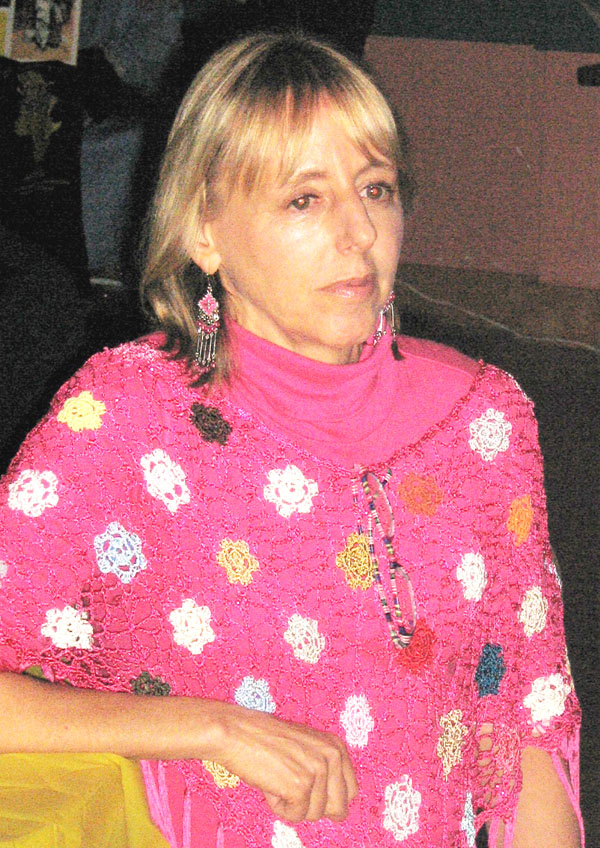
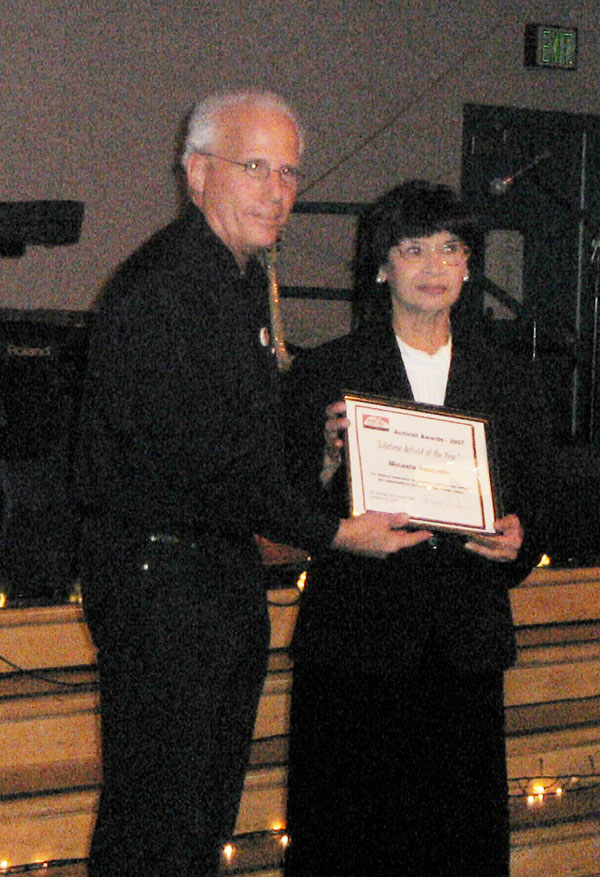
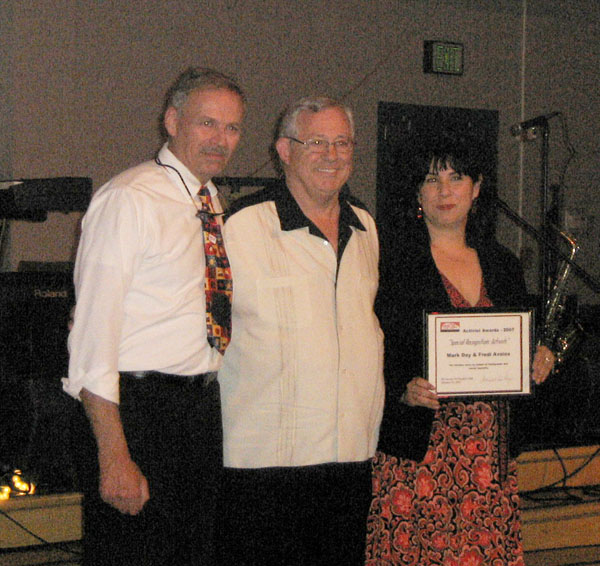
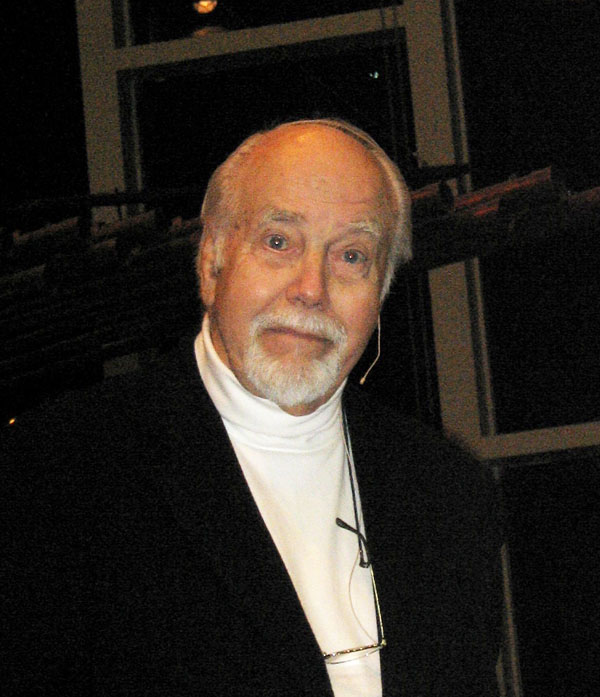
Photos, top to bottom: Medea Benjamin, Rich Harness, Puppet Insurgency’s Snail, Micaela Saucedo (right), Mark Day and Fredi D’Avalos, TranscenDANCE

Medea Benjamin the Hit of Activist San Diego Ball

Fifth Annual Event Honors Wide Range of Community Activists

by MARK GABRISH CONLAN

Copyright © 2007 by Mark Gabrish Conlan for Zenger’s Newsmagazine • All rights reserved

Anyone who saw Medea Benjamin’s speech in San Diego in August 2000 — when she was running for U.S. Senate as the Green Party nominee and appeared as essentially the opening act for Green Party Presidential candidate Ralph Nader — would have found it hard to believe that the same person was speaking at the Activist San Diego (ASD) fifth annual “People’s Ball” in the Balboa Park Club January 20. Where the Benjamin of 2000 blasted politicians from both the Republican and Democratic parties as essentially the same, the Benjamin of 2007 couldn’t have been happier that the Democrats won back control of Congress from the Republicans after 12 years in the November 2006 election.

Benjamin, a San Francisco-based activist, founded both the Global Exchange human-rights group and Code Pink, a direct-action women’s group opposing the Bush administration in general and the war in Iraq in particular. Her short but energetic speech at the ASD ball discussed her trips to Guantánamo Bay in support of the detainees held there indefinitely under U.S. custody, and her lobbying efforts to get the new Democratic majority in Congress to hold the Bush administration accountable for its mistakes in Iraq. The Guantánamo detainees have been depicted by the U.S. government and media as “the worst of the worst,” the most hardened terrorists the U.S. could locate on the battlefields of Afghanistan — but, according to Benjamin, almost none of them were terrorists at all.

“The U.S. government was offering $5,000 to $25,000 a head for anyone suspected of being Taliban or al-Qaeda,” Benjamin explained. Holding up a photo of one of the detainees, she said, “This young man fled Afghanistan and was sold by a Pakistani to the U.S. military for $5,000. He has suffered psychological torture, sexual assault, attacks with pepper spray until he became blind in one eye, and solitary confinement lasting more than eight months. This man has done nothing, and imagine the pain his mother has gone through. She’s not even asking for her son to be released, but only that he be given a fair trial. Is that too much to ask for a society that calls itself a democracy?”

Benjamin said that her group held a rally on Cuban soil in front of the U.S. base at Guantánamo — and that her event was the first many residents of the town of Guantánamo knew about the detainees being held there by the U.S. Before she came, she said, most Guantánamerans thought their town’s image abroad had been shaped by the 1960’s song, composed by Cuban folksinger Joséito Fernandes to a poem by Cuban revolutionary hero José Martí. “We showed them the film The Road to Guantánamo,” Benjamin recalled. “They used to be so proud of being from Guantánamo, and now they’re known for torture and an infamous prison. The people hugged us and kissed us, and pleaded with us to petition our government to close that prison.”

Not that closing Guantánamo hadn’t already been one of the top priorities of Benjamin and her organization, but the reception they got in the town helped fuel the fire under them that’s been propelling their lobbying effort. Her top priority with the new Congress has been to seek the repeal of the Bush-sponsored Military Commissions Act of 2006, which eliminated the right of habeas corpus for U.S. detainees in the so-called “war on terror” and set up a system of rump military commissions to “try” them based on secret evidence and without access to legal counsel.

Benjamin’s speech also touched on the war in Iraq and President Bush’s determination to escalate it with a so-called “surge” of over 20,000 troops despite the overwhelming majority of Americans that now oppose the war and want to see an orderly, phased withdrawal of U.S. troops. “There was an election two months ago that was an overwhelming mandate for us to get out of Iraq, and that guy in the White House has chosen to send more troops instead,” Benjamin said. “He is blind to the will of the people, to the troops themselves, to the Iraqis and to the reality that more troops in Iraq just means more bodies coming home in bags.”

One optimistic sign for Benjamin is that the Democrats in Congress are already starting the aggressive investigations of the Bush administration they promised during the campaign. “In the last Congress, the Democrats couldn’t even get a hearing going,” she said. “Now there are two to three hearings a day. I was at the hearings where attorney general Alberto Gonzalez and the generals in charge of the war were being grilled. There is legislation being introduced to stop the surge, stop the funding for it, repeal the Congressional resolution from October 2002 that authorized the war in the first place, and defund the entire Iraq occupation. Congressmember Lynn Woolsey has introduced H.R. 508, a bill to bring the troops home in six months, prevent the U.S. from establishing any permanent military bases in Iraq, and take the money we are spending on contractors and give it to the Iraqi people.”

One of the signs of the turning tide, Benjamin said, is that Democrats with Presidential ambitions — even ones like Hillary Clinton who enthusiastically supported it in 2002 and 2003 — are starting to turn away from the war. “Hillary Clinton, who just a few months ago was calling for more troops, is now introducing resolutions calling for bringing the troops home,” Benjamin said. “She’s being pushed by Barack Obama, who’s being pushed by John Edwards, who’s being pushed by Dennis Kucinich. The pundits, who used to say that coming out against the war and for a troop withdrawal was the kiss of death for any Democrat with Presidential aspirations, are now saying there’s a ‘bidding war’ among Democratic Presidential candidates for the anti-war vote.”

Benjamin closed her speech by making the blunt point that America has to choose to be a democracy or an empire; it can’t be both. “Our immediate task is to bring our troops home and hold those who got us into the war in the first place accountable — and that means impeachment,” she said. “It means stopping the next war now, and there are even Congressional Republicans like Walter Jones introducing bills to stop the President from an attack on Iran without prior Congressional approval. Our long-term task involves making the U.S. military defensive instead of offensive, which means closing the hundreds of U.S. military bases throughout the world and using the resources now being spent on an offensive military to fight the wars against poverty, AIDS and global climate chaos.”

Rich Harness, a Tennessee-born activist with Iraq Veterans Against the War, also spoke during the ball. Much of his speech was about the culture shock that he faced when looking for an outlet for his own feelings of frustration about his service in Iraq, particularly his sense that the government lied to him and all the other servicemembers there when it said Saddam Hussein had weapons of mass destruction.

“I didn’t want to join a group against the war because I’m from Tennessee, and we thought all peace activists were tree-hugging hippies,” Harness said. “But how would you feel if you were lied to and all your friends got their legs blown off for a lie?” Harness asked people attending the ball to contribute to Iraq Veterans Against the War, saying that the donations would go directly to help veterans in need.

“We need you-all’s help to get the troops home now — not next month, not when we get a new President, but now,” Harness said. “We need more people to stand up and say we want our troops home, we were lied to and we’re tired of it.”

The ASD ball was also an occasion to honor local activists with awards. Jim and Sharlene Hamilton were named “Activists of the Year” for their work to ensure secure and accurate elections. Micaela Saucedo of the Border Angels, Gente Unida and La Otra Campaña was given the “Lifetime Activist of the Year” award for her efforts to protect the rights of undocumented immigrants to the U.S. and indigenous people in Mexico. The “Activist Organization of the Year” was the Center on Policy Initiatives (CPI), an economic-justice organization affiliated with organized labor that led the successful battle for a living-wage ordinance in San Diego.

“Special Recognition” awards were given to the World Beat Center in Balboa Park for its programs on behalf of the cultures of indigenous Americans, African-Americans and the African diasporas; and to California State University-San Marcos instructor Frederica “Fredi” D’Avalos and journalist and filmmaker Mark Day. The citations mentioned D’Avalos’s work against the Minutemen and other anti-immigrant vigilantes, and the efforts she and Day have both engaged in to build activist organizations’ capabilities to use new media for social, political, cultural and spiritual emancipation. Ironically, the “Media Award/People’s Advocate Award” went to this writer as editor/publisher of the “old-media” print publication Zenger’s Newsmagazine.

Other awardees included Rev. Art Cribbs of Christian Fellowship Congregational Church as “Racial Justice Organizer of the Year” for founding the Coalition for Justice in response to violent attacks on civilians by local police officers. Antonia Davis of the Puppet Insurgency was named “Arts & Cultural Activist of the Year” — and she and other members of her group pushed in a giant papîer-maché snail as a sample of the work for which they were being awarded. The “Activist Youth Organization of the Year,” a City Heights-based company of energetic young dancers called TranscenDANCE, showed off their skills in two spectacular numbers that proved to be the high point of the evening’s entertainment, which also included Spanish-language folksinger Angel Lita and 1970’s-style funk band ¡Society!

Wednesday, January 17, 2007


Don McEvoy Remembers Martin Luther King

Close Friend Speaks About King’s Life at U-U Church in Hillcrest

by MARK GABRISH CONLAN

Copyright © 2007 by Mark Gabrish Conlan for Zenger’s Newsmagazine • All rights reserved

You’ve got to say one thing about Don McEvoy: he’s got a great sense of theatre. Instead of coming forward to the stage and speaking from the podium of the First Unitarian-Universalist Church in Hillcrest January 13, he began his talk about his close friend, Dr. Martin Luther King, Jr., from a seat in the audience. He identified himself as “Don McEvoy from Oklahoma City” and asked the same question he’d asked King the first time they ever met, at a public forum on the nascent civil rights movement in January 1956. Then, and only then, did he come forward, ascend the stage and give his recollection of King’s response.

The question had to do with whether King felt any responsibility for “Negroes” (though that was the term of King’s time for his people and the one King himself used, now that the rules of political correctness have burned through “Black” and now settled on “African-American” the word itself dated McEvoy’s presentation) who committed acts of violence against whites and claimed to be inspired by the civil rights movement. King’s answer — typical of the wry sense of humor McEvoy recalled in him that’s almost disappeared from the official portrait now that King has become a martyr and virtual saint — was that he’d take responsibility for Black people’s violence against whites as soon as whites started taking responsibility for all white people’s violence against Blacks.

McEvoy, then also a minister, first met King when he went to Montgomery, Alabama to check out the civil rights movement and this eloquent preacher who had emerged as its principal spokesperson. He reviewed the familiar history of the Montgomery bus boycott that started it all, but threw in a few fresh facts. Among them was that the Montgomery chapter of the National Association for the Advancement of Colored People (NAACP) had already decided, a year and a half after the national NAACP had won the Brown v. Board of Education case declaring school segregation unconstitutional, to file a lawsuit against racial segregation on Montgomery’s buses.

“They were looking for a test case, and in November 1955 they thought they had one,” McEvoy recalled. “When they found out the woman who’d agreed to be their test case was 16 years old, unmarried and pregnant, they decided they wouldn’t use her.” As all the world knows, the woman who finally did emerge to lead the challenge was Rosa Parks, who was everything the 16-year-old hadn’t been: 42, quiet, serious, a graduate of Tuskegee Institute, who hadn’t been in trouble with the law before December 4, 1955, when on her way home from work she was accosted by a white bus passenger who invoked his legal right to demand that she get up from her seat to make room for him. She refused; the bus driver stopped the bus and threatened to call the police; the police duly arrived and Parks was arrested — and, McEvoy noted, “the world hasn’t been the same since.”

According to McEvoy, the leaders of Montgomery’s African-American community knew that if they could call a boycott of the bus system and make it stick, they could cripple the city’s transportation system since 90 to 95 percent of Montgomery’s bus riders were Black. What they couldn’t agree on was who should lead the call. “The community leadership was fought over by two people; E. D. Nixon, a 60-year-old Pullman porter who was head of the Montgomery NAACP; and Ralph Abernathy, minister of the largest Black Baptist church in Montgomery,” McEvoy recalled. “They decided to call a mass meeting but couldn’t agree on a featured speaker. Abernathy said it had to be a minister, and Nixon said, ‘If it has to be a minister, it has to be mine,’ and that was Martin Luther King.”

McEvoy stressed that King’s emergence as the most visible leader of the Montgomery bus boycott — and, for the next 12 years, the broader African-American civil rights movement that emerged from it — was pure happenstance. “There was nothing in his background to indicate that he was destined for greatness,” McEvoy said. “There’s almost a mystical sense I have that if Rosa Parks hadn’t chosen that particular night to refuse to give up her seat, we might never have heard of Martin Luther King.”

King and McEvoy didn’t see each other again until 1961. “He had moved to Atlanta, his home town, and I had left the ministry to work for the National Conference of Christians and Jews, which sent me to Atlanta on assignment,” McEvoy recalled. “The first Sunday we lived it Atlanta, we made our way to Ebenezer Baptist Church, where King was the minister, and it was thrilling to hear that great pulpit orator preach in his own church. That was also my first meeting with Martin Luther King, Sr., an even more unforgettable character than his son. While his son was preaching, he sat in a pulpit chair and carried on a conversation with him through the whole sermon. The playful byplay between the two men was a joy to behold. His dad would say, ‘You know, that boy shows signs of becoming a pretty good preacher if he’ll just do what I tell him.’”

As exciting as it was to hear Martin Luther King preach from the pulpit of his own church, McEvoy said, “It didn’t compare to hearing him at a freedom rally.” McEvoy had that experience in 1963, during the campaign to integrate public facilities in Birmingham, Alabama — where sheriff Eugene Connor, appropriately nicknamed “Bull,” turned fire hoses on peaceful civil-rights demonstrators and, along with Alabama governor George Wallace, became the worldwide public face of white resistance.

“The first week I was in Birmingham, I went to the 16th Street Baptist Church for the rally and watched the crowd, many of whom were dressed in a way that showed they were coming in directly from laboring jobs,” McEvoy recalled. “There was a half-hour of gospel music and then the speakers, including every minister in attendance and the staff members of the Southern Christian Leadership Conference (SCLC, King’s organization). Then Ralph Abernathy, King’s closest friend, took half an hour to introduce the man everyone had already been waiting 3 1/2 hours to hear. When Martin Luther King finally came out everyone chanted, ‘Black Moses! Black Moses!,’ except for one old woman with a voice I’ll never forget, who said, ‘Jesus! I knew you’d come back and I knew you’d be Black!’ That’s when I realized I’d never know King as well as his own people did.”

Not that they didn’t get to know each other as one suburban family to another, dipping their toes into integration at the most basic levels. “Our children played together,” McEvoy recalled, “and when the Canadian Broadcasting Company came to do a documentary on King, the McEvoy family were the token whites invited to dinner. On our daughter Melanie’s ninth birthday, the guests at her party were her friends from school and Yolanda, Martin and Coretta King’s daughter. Melanie’s best friend at school was Kathy, and at eight she had already decided to be a missionary to Africa. The morning after the party, Kathy told Melanie they could no longer be friends because her parents had forbidden her to play with her. Melanie’s trauma didn’t last long, but I’ve often wondered how Kathy ever reconciled wanting to be a missionary to Africa with the scandal.”

When a new, moderate mayor took office in Atlanta and ordered the reopening of the city’s public swimming pools — which the previous mayor had ordered drained rather than comply with a court order that Black as well as white people be allowed to swim in them — the King and McEvoy families were the first people in town to use the pools. “We took Martin Luther King III and Yolanda, Ralph Abernathy’s daughter and our three kids, and we were the only people who went there to swim that day,” McEvoy said. “There were police to provide security, and white people who were looking on not so much with hatred as with disorientation. Black folks had always been there, but they’d always been part of the background, like trees — and now the trees had begun to move.”

McEvoy told a number of anecdotes to put some flesh on King’s bones and show that he was a multidimensional human being, not a plaster saint. He recalled that King was “a real pool shark,” and when he was worried that some Blacks in a community he was doing civil-rights organizing in might get drunk and disrupt the demonstrations, he would go to the beer halls and pool halls, impress them with his pool-playing skills, “and try to get them to go to the demonstration — or at least not do anything to interfere.” He also told some of King’s jokes, including one incident in which he and King ate at Atlanta’s fanciest hotel the day after the Civil Rights Act of 1964, which banned segregation in public places. “The manager gave us the menus himself,” McEvoy recalled, “and King said, ‘I see they have cornbread, but I don’t see turnip greens and chit’lin’s. I thought you white folks were ready for integration!’”

When Martin Luther King, Jr. was awarded the Nobel Peace Prize for 1964, McEvoy said, “A group of us were determined that the city would do something official to honor him” — an idea easier said than done, especially in a city most of whose white leaders still considered King “a radical, a troublemaker, a Communist and a pariah.” The person who finally put the dinner together was Helen Bollard, a close friend and advisor to Atlanta’s mayor, who got the city’s largest ballroom for the event and got the choir of King’s alma mater, Morehouse College, to perform. At first the choir was supposed to sing Morehouse’s school song, but Atlanta’s leading rabbi, who was on the dinner committee, and the choir director secretly worked out a change in the program and the choir sang “We Shall Overcome.”

Bollard also nipped in the bud a threat by Atlanta’s white business community to boycott the dinner and blacklist anyone who dared attend. She got the New York Times to do an article about the boycott threat, and while the article didn’t name names, it did say that “a prominent Atlanta banker” was its principal organizer. The article got David Rockefeller, whose Chase Manhattan company owned the bank the “prominent Atlanta banker” ran, to get him to call off the boycott — aided by an even more bizarre bit of persuasion. Haiti’s notoriously brutal dictator “Papa Doc” Duvalier also read the New York Times story and told the banker that if he went ahead with a boycott of a dinner honoring Martin Luther King, he could forget about being allowed to dock his yacht in Port-au-Prince on his next yachting trip through the Caribbean.

The mood of the evening turned more somber as McEvoy talked about the last three years of King’s life — between “the last great victory of the civil rights movement” in Selma, Alabama in 1965 and his murder in Memphis, Tennessee three years later. “King came to Chicago and found out it could be as racist as the South,” McEvoy said. “He began to speak out against the Viet Nam war and about economic issues and poverty. Many of his white liberal supporters turned away and said he should just stick to civil rights and leave those other issues alone.”

McEvoy recalled being summoned to Memphis, Tennessee in April 1968 to help King set up a meeting with the mayor of Memphis to settle a strike of African-American sanitation workers. By then the National Conference of Christians and Jews had reassigned him to their home office in New York, but his wife and children were still in Atlanta. McEvoy had called the Memphis mayor on April 3 to arrange a secret meeting between the mayor and King. “At noon the next day, I boarded a flight to Memphis, and 30 minutes from our destination the pilot announced that Martin Luther King had been shot,” McEvoy said. “The passengers erupted with jubilation and rebel cheers.”

The presentation concluded with McEvoy’s recollection of the service at King’s home church, Ebenezer Baptist in Atlanta, the first Sunday after King’s assassination. “Nothing in their bulletin said anything about Martin Luther King having been shot,” McEvoy said. “His brother, A. D. King, came from his own church in Louisville and preached in his stead. Their father said, ‘I guess you folks are surprised to see me here. I came here to say just one thing only: be careful what you pray for. I prayed to the Lord for Him to use my boys in any way He felt would be of service, and now I want to take that back.”

McEvoy said that the quip from King’s father had “rescued me” and fulfilled his own grief at the death of his friend. He decided not to stay in Atlanta for the official funeral, and instead head back to his organization’s office in New York, where, he said (quoting Robert Frost), “There was work to do, promises to go, and miles and miles to go before we sleep. And there still are.”
Pan’s Labyrinth: Del Toro’s Great Horror-Fantasy

by MARK GABRISH CONLAN

Copyright © 2006 by Mark Gabrish Conlan for Zenger’s Newsmagazine • All rights reserved

Like the title character(s) of Dr. Jekyll and Mr. Hyde — which would actually make a good story for him to film — Guillermo del Toro is two personalities in one body. The American Guillermo del Toro knows what’s required of a modern-day horror-film director, and methodically churns it out: steel-grey Gothic imagery, teenagers in peril and blood, blood, blood spurting everywhere. But get him out of this country — either to his native Mexico or to Spain, where he’s made his two best films, The Devil’s Backbone and Pan’s Labyrinth — and he turns into a different director altogether, filling his films with human emotion and genuine terror, and creating legitimately frightening sequences instead of just freaking out his audiences with the modern-day de rigueur blood and gore.

Like The Devil’s Backbone, Pan’s Labyrinth is a horror fable set against the backdrop of the Spanish Civil War, with a child as the central character. In The Devil’s Backbone the child-hero was a boy who discovered a dark secret associated with the building in which his school was housed, which was simultaneously under regular bombing raids at the height of the war (in which Nazi Germany and Fascist Italy, allies of the right-wing “Phlangist” movement of Francisco Franco which ultimately won, tried out the “Blitzkrieg” tactics they later used in World War II). In Pan’s Labyrinth the year is 1944, Franco’s forces have taken over the country and established their dictatorship, and while Franco was smart enough to stay out of World War II (thereby ensuring that when the Allies won they’d let him stay in power and, indeed, the U.S. would support him as a bulwark against Communism), his forces are working the Spanish countryside bent on exterminating the last remaining anti-Franco partisans mounting a resistance.

Pan’s Labyrinth opens on the road to an isolated town in the mountains, with Ofelia (Ivana Baquero), a girl on the cusp of teenagerhood — del Toro’s script doesn’t specify her age, but the actress was 12 when she made the film — being taken by her mother Carmen (Ariadna Gil) to join her current husband, Captain Vidal (Sergi López), who’s leading a company of Franco’s feared secret police, the Guardia Civil, against the remaining rebels in the mountains. Though Carmen says she’s too old to be reading them, Ofelia is still obsessed with fairy tales in general and one fairy tale in particular: a story about an underground kingdom whose reigning princess escaped to the surface world, was blinded by its light and ultimately forgot who she was and where she was from, accepting an identity as an Earth person.

At a stop in the road, Ofelia finds a chunk of sculpted stone and the idol it got chipped off from. She puts the chunk back where it initially belonged, and that’s her entrée into the underground fairyland of her dreams. Not that it turns out anything like the way she thought it would, and here the English title of the film is deceptive. The original Spanish is El Laberinto del Fauno — not “Pan,” usually depicted these days as a cute, mischievous little godlet playing on a set of reed pipes more recently used by Zamfir and other New Age musical bores, but a more sinister “faun,” played via motion-capture technology by gangly actor Doug Jones. The faun leads her into an underground realm featuring giant toads, sinister insects, slime (it wouldn’t be a del Toro film without slime!), a “pale man” (also played by Jones) with a Raiders of the Lost Ark-style taste in food and a sumptuous spread which Ofelia, living her “normal” life in a war-torn country under heavy rationing, is solemnly instructed not to eat or drink from, setting up a temptation obviously evoking a parallel with the story of Adam, Eve, the apple, the serpent and the origin of sin.

It’s indicative of this movie’s curious appeal that the “normal” story going on above ground is a good deal bloodier and more violent than the horror fantasy taking place beneath it. Captain Vidal is a typical unsmiling fanatic, like all too many figures on both sides of the current “war on terror,” describing his enemies as vermin or infections that need to be exterminated for the health of the overall country. His main concern at the moment is the fact that his store of supplies is being raided by the rebels to sustain themselves, and his growing conviction that there’s a “mole” in his base, someone who’s helping the rebels with food, ammunition and information. He’s also impregnated Carmen and is convinced their child is going to be a boy (even though in 1944 there was no way to tell in advance), and in one chilling scene he makes his priorities clear when he tells the camp doctor that if it comes down to a choice, he’s to let his wife die so the child can be born healthy and continue the name of Vidal and the family’s military reputation. Vidal’s most prized possession is a wristwatch with a broken face (though it still tells time); it was formerly owned by his father, and dad smashed in the face just before he was killed so his son would remember exactly when he died.

Del Toro meshes his two stories effectively and not always in the ways you’d expect. Rather than a source of liberation, the fairy kingdom Ofelia descends into is just a reflection of her above-ground reality, with a faun commander who in his own way is just as authoritarian, just as obsessed with “obedience,” as Vidal. Though it’s an oddly claustrophobic and physically dark film — even in the above-ground sequences the sky always seems gloomy and overcast, and one aches for the sight of some of the fabled Spanish sun — it’s photographed by Guillermo Navarro in a way that avoids both steel-grey and brown clichés. The gritty reality of the rebels’ existence and the only slightly better-off camp-dwellers (there’s a grimly amusing sequence in which a Franco official holds bags of some unpleasant-looking flour-based substance and announces that the regime has won the war against starvation and can now provide all its citizens this wonderful bread) play off the dank abundance of the faun’s world. Even the plot’s magical elements, notably a piece of chalk with which one can create a doorway just by drawing one on a wall, are handled in a matter-of-fact fashion instead of the look-what-we-can-do-with-computers showing-off we’re used to in American films.

Pan’s Labyrinth is effectively acted, especially by Ivana Baquero as Ofelia. Not since Kirsten Dunst out-acted Tom Cruise and Brad Pitt and created a chillingly controlled portrait of evil in Interview with the Vampire has it been so easy to predict adult stardom for a child performer. Sergi López is equally intense, making Vidal an all-too-believable macho fanatic who seems to have stepped out of today’s cable news shows instead of inhabiting a movie set in 1944. So is Maribel Verdú as Mercedes, a servant with a secret of her own. Ariadna Gil is less impressive, but that’s more a function of the character than any limitations on her as a performer; del Toro’s script gives her little to do but suffer, and in an otherwise well plotted film he never quite tells us what happened to Ofelia’s father or why Carmen should have chosen to remarry someone as obviously awful for her as Vidal. Still, Pan’s Labyrinth is a great film, well worth watching, rich in allusions and mythic metaphors while at the same time managing some genuine scares that are all the more frightening because del Toro has made us care about these people instead of just setting them up as cardboard victims.

Pan’s Labyrinth is now playing at the Landmark Hillcrest Cinemas, 3965 Fifth Avenue in Hillcrest. Please call (619) 299-2100 for showtimes and other information.
Iraq War Kills U.S. Democracy

by MARK GABRISH CONLAN, Editor

Copyright © 2007 by Mark Gabrish Conlan for Zenger’s Newsmagazine • All rights reserved

Originally published as the “First Word” editorial in Zenger’s Newsmagazine, January 2007

One of the basic rules of representative democracy is that elections are supposed to matter. When the voters indicate, through their choice of candidates and/or parties, that they want their government to change its course on a major policy question, they’re supposed to get what they voted for. On November 7, 2006 a clear majority of the American people voted to give the Democratic Party control of both houses of Congress in a repudiation of the policies of President Bush in general and the war in Iraq in particular. What these voters apparently wanted was some kind of date-certain by which our open-ended commitment in Iraq would finally end and our servicemembers and support personnel would get to come home instead of putting their lives at risk trying to keep members of Iraq’s various religious and ethnic groups from killing each other.

Instead, President Bush has rejected the demand of the electorate and repudiated the “out” the commission headed by James Baker (who ran his legal operation during the Florida recount in 2000 and therefore probably has more than any other person to do with Bush’s being President in the first place) had given him for a face-saving acknowledgment of the reality of Iraq. Sounding even more like a spoiled, petulant child than usual, Bush sneered at the will of the people as he said that he would consider any alternative on Iraq that resulted in “victory” — a will-o’-the-wisp not only because nobody can define in clear terms just what would constitute “victory” for the U.S. in Iraq but because the Iraqis are currently killing each other over racial, religious, ethnic and tribal issues that go back thousands of years and no outside power is going to stop them from doing it.

What Bush is now pressing on an American people who are tired of wasting their youths’ lives and their nation’s money on a futile crusade (a loaded word in discourse about the Middle East, but in this case it fits) to remake Iraq in the image of a Western capitalist republic is not less, but more. More troops: a so-called “surge” in U.S. boots on Iraqi ground despite the fact that even the military commanders who’d be in charge of deciding what those troops would do haven’t the foggiest notion of how to use them. More money. More corrupt deals benefiting Halliburton and other politically well-connected corporations. More combat missions in a war that’s already lasted longer than the U.S. fought in World War II. More young Americans coming home in bags, flown back in the dead of night lest someone actually shoot some pictures or videos that might remind Americans that their fellow countrymen, their best and their brightest, are still dying in this immoral, pointless war.

America is at a crossroads many other nations — superpowers with worldwide military ambitions — have faced in the past: whether to preserve their democratic institutions or become empires. The simple truth is democracy and empire are not compatible. Maintaining an empire requires keeping a large standing army and spending an enormous amount of the country’s gross domestic product on war and the preparations for war. It means extracting enormous sacrifices from the people to finance the war machine, either taxing them to fund it on a pay-as-you-go basis or (the course Bush has chosen) borrowing it from the rest of the world and leaving future citizens to pay the tab. It also means enormous sacrifices in terms of human life, which can be extracted in only three ways: direct compulsion via a draft, hiring foreign mercenaries or (as the U.S. is doing now) creating a permanent underclass and so totally smashing any other opportunities for upward mobility that working-class people see the military as their only avenue for economic advancement.

In practice, empires become rigidly hierarchical societies, with a tiny entrenched aristocracy living off the labor power of enormous numbers of impoverished people both at home and in the foreign territories the empire influences or controls. They also become politically repressive, partly because imperial policies provoke resistance both at home and abroad and partly because people don’t willingly make the sacrifices needed to maintain an empire for very long. In an empire, human rights quickly become a thing of the past. Political “freedom” and meaningful elections fade into history as the imperial elite dictates what sacrifices the rest of us will be forced to make to maintain them in the style to which they have become accustomed. Eventually, empires collapse not from internal dissent but because the elites running them overreach themselves and no longer have the money, the environmental resources, and/or the cannon fodder needed to keep their power.

President Bush’s attitude towards Iraq — that, regardless of the will of the American people as expressed at the ballot box last November, he’s going to keep the war going until it achieves “victory” as he and only he defines it — shows how far the U.S. has gone down the primrose path of empire and turned its back on its democratic heritage. The U.S. got into the empire business in the first place in the 1890’s,when it first projected military power beyond its own borders to “liberate” the Philippines and Cuba from Spain … and then to fight genocidal wars against Filipinos and Cubans who wanted to determine their own destiny instead of having the U.S. rule them either directly or through puppets. Through the first half of the 20th century, the U.S. elites went back and forth between imperialism and isolationism as the best way to maintain their power. But the attack on Pearl Harbor, America’s involvement in World War II against not only Japan but Germany as well, and the postwar emergence of the Soviet Union as the world’s second superpower ended America’s isolationist tendency once and for all and placed the U.S. firmly on the course of empire.

Not that the American people have always been happy about the imperial ambitions of the elites that rule them. In 1920 they voted the Democrats out of office to put an end to Woodrow Wilson’s far-reaching vision of a pax Americana and “return to normalcy.” In the 1960’s they got a hard look at the cost of maintaining U.S. control of South Viet Nam and turned against the Viet Nam war en masse. Though there have been times when America’s ruling elites have convinced its people that only imperialism stands between them and utter subjugation — like the time of anti-Communist hysteria in the early 1950’s or the years between 2001 and 2006, when the terrorist attacks of September 11, 2001 scared them into accepting Bush’s Manichean rhetoric and seeing imperialism as the only way the country could be kept safe from the crazy ambitions of radical Islamists — for the most part the U.S. people have had little stomach for long-term sacrifices to maintain an empire abroad and the hierarchical society an empire requires at home. The 2006 election was, more than anything else, a vote by the American people to steer their country away from the open-ended military commitments and suppression of dissent at home needed for an imperial policy in general and the subjugation of Iraq in particular, and to reassert their faith in democracy and human liberty.

But at this point it doesn’t appear that the American people will be allowed to make that choice. Bush has already served notice that he will continue this insane war until either it achieves his notion of “victory” or his presidency ends. The Democrats who benefited from America’s disillusionment with empire in general and empire-building in Iraq in particular are already turning their backs on the people who voted them into power. They’re insisting that they’re not going to invoke the one power Congress actually has to stop a presidential war — cutting off the funding for it — and leaning towards acceptance of Bush’s call for more troops either out of endorsement of the imperial goal or out of fear that once the war ends they’ll be accused of “losing Iraq” the way previous generations of Democrats were accused of having “lost China” and “lost Viet Nam.” The grim irony of the war in Iraq is that it was first sold to the American people on a promise that we would “bring democracy” to Iraq; instead, the war against Iraq, like Bush’s Orwellian ideological construct of a “war on terror,” is tearing apart what little democracy was left in the United States.

STUART TIMMONS:

“Gay L.A.” Author Researches SoCal Queer History

interview by MARK GABRISH CONLAN

Copyright © 2007 by Mark Gabrish Conlan for Zenger’s Newsmagazine • All rights reserved

In late 2006, veteran Queer authors Lillian Faderman and Stuart Timmons published Gay L.A.: A History of Sexual Outlaws, Power Politics, and Lipstick Lesbians. The book is a quite striking historical account of 110 years of Queer life and activism in California’s largest city, and one which made a case for Los Angeles as rivaling or even surpassing New York and San Francisco in the sheer number of community achievements that took place there, including the formation of the first ongoing Queer political organization in the U.S. (the Mattachine Society, founded in 1950) and the first openly Queer-run, Queer-welcoming church (Metropolitan Community Church, founded in 1968).

Among the book’s achievements is its documentation of how early Queer consciousness and Queer activism began — as early as the 1890’s there were Queer bars, social clubs and cruising grounds — and how, through most of that period, Queer activism consistently provoked Queer repression. Gay L.A. shows, for example, how California’s law making oral sex a felony — passed in 1915 and not repealed until 1975 — was a direct response to a notorious scandal in the L.A. area the year before. It specifically discusses the role of the Los Angeles Police Department, which used its virtual autonomy from the rest of the city government (until the early 1990’s, when the fallout from the 1992 riots led to a change in the city charter) to monitor political and social dissidents in general and Queers in particular.

Gay L.A. also embraces the touchy subject of Hollywood, generally (though not always) avoiding the ”were they or weren’t they” guessing games about the major stars and instead showing how actresses like Greta Garbo, Marlene Dietrich and Katharine Hepburn deliberately projected ambiguous gender images in their films and thereby let the rest of America know there were alternatives to strict “masculine” and “feminine” sexual identities. It documents not only the ongoing police repression of L.A.’s Queer community but the community’s willingness to fight back, including an account of one riot at a doughnut shop in 1959 where the Queer customers resisted a police raid much the way the denizens of New York’s Stonewall Inn bar would 10 years later in the event still generally (inaccurately) considered the touchstone of U.S. Queer activism.

Though the later chapters of Gay L.A. tend to drag — Faderman and Timmons seem bent on chronicling not only every major Queer organization in L.A.’s history but also the internal politics and feuds that broke up the ones that didn’t survive — that’s partly inevitable. The “good news” about the history of Queer L.A. is the growing involvement of middle- and upper-class people in community organizations and the values they brought in terms of professionalism and funding — and as such people crowded out the raffish countercultural activists who had started the community’s major organizations, the story necessarily becomes less compelling as it shifts from the heroic resistance of a community under siege to the consolidation and expansion of the resisters’ hard-won gains.

One interesting aspect of Gay L.A. is the way the collaborators worked together. Faderman interviewed most of the women and Timmons most of the men, though there were some people they considered so important they interviewed them jointly. Faderman wrote the final text to ensure a unified author’s voice, but only after the two had agreed on what the book would contain and how it would present the material. Faderman came to San Diego November 8 to promote the book and show slides of some of the images of L.A. Queer history she and Timmons had discovered (see “Lillian Faderman Speaks at Center November 8,” Zenger’s, December 2006, online at http://zengersmag.blogspot.com/2006/11/lillian-faderman-speaks-at-center.html); two weeks later, we called Timmons in L.A. and interviewed him by phone.

Zenger’s: What was your background and how did you come to work on Gay L.A.?

Stuart Timmons: I began writing about Gay matters in the 1970’s in college at UCLA. There was a Gay student newspaper called 10 Percent, which may have been the first Gay student newspaper in the country. That path of journalism, in what was then a very new field, continued for me for many years. In the late 1980’s I wrote a biography of Harry Hay, who’s often considered the founder of the Gay movement through his role in starting the Mattachine Society in 1950. In Gay L.A. we have a group photo of the five Mattachine founders.

Having done that book, I was aware that there was an enormous amount of work that had been done in Los Angles that rarely got mentioned in Gay history, and this gap needed to be filled. I was approached three years ago by Lillian Faderman, a Lesbian historian who lived and came out in Los Angeles in the mid-1950’s. She’s about a half a generation older than I am. We teamed up and got a publisher, and went to work.

Zenger’s: How did you and Lillian actually collaborate on the book? Did you interview all the men and she interview all the women? Did you each write separate sections or did you work together on the writing?

Timmons: She interviewed the women and I interviewed the men. We did a few interviews together. We each interviewed about 150 people. It’s a very sweeping story, from 1880 to 2005. We hammered out drafts and worked together on the parts of the story in which men and women had worked together — which wasn’t always the case. She lives in Fresno and I live in Los Angeles. I did a lot of the archival research, and with the help of a few meetings and a lot of e-mails, we finally put together the book.

Zenger’s: What was the most surprising single fact you learned when you were researching the book, the most unexpected piece of information you uncovered?

Timmons: Without a doubt, it had to be how far back a Gay underground went. The incidents described in the “Social Vagrants” chapter were cause for an actual investigation at the time in the Sacramento Bee and the investigation notes survive in the Sacramento city archives. They talked about bars and dance halls where Gay men gathered, only they didn’t say “Gay men.” They said “social vagrants” or “perverted sexualists,” or in one case even “professional perverted sexualists.” There was a sense of a professional society that had covered its tracks very well. A lot of men I interviewed who had been young in the 1930’s, 1940’s or 1950’s knew nothing of this, but there always seems to have been something of what we would call a “Gay community,” at least on a social level.

MGG: Personally, I found the earlier parts of the book, dealing with a community that was so strongly under siege, more interesting and inspiring than the later parts of establishment and triumph. Did you feel that way about the material?

Timmons: Certainly I found the early material the most fascinating. Part of it is the awe I felt in finding something so unexpected. This is radical territory. It’s only been in the last few years that people have been willing to be open and public about being Gay or Lesbian. Those who survive from the most recent period are still somewhat sensitive about the risks they’ve taken. There’s still a more measured sense about writing about someone who’s still alive, rather than someone who’s no longer around to be hurt.

The other thing is that the story has changed from absolute persecution to organizing, political activism and achievement, and that’s not so dramatic. Perhaps it means more to people who have lived in Los Angeles and watched, for example, the Los Angeles Police Department change from being totally oppositional to actually recruiting Gays and Lesbians to be police officers.

Zenger’s: One of the recurring themes in your book is that there’s been a high amount of separatism in the Queer community. You describe how frequently Lesbians have formed their own organizations because they felt uncomfortable trying to work with men, and how Lesbians of color have formed their own organizations because they felt uncomfortable trying to work with white women, and how often it’s taken some sort of exterior crisis, like the AIDS epidemic or an anti-Queer ballot initiative, to bring the community back together.

Timmons: I think that’s a very fair observation. You can’t escape that when you look at the historical pattern. There was a pattern of unity in the 1950’s to some degree, but the uniting external environment at that time was the homophobia of the entire world. It’s inevitable that when there is such a threat, there will be a coming together. One Lesbian activist said it was clear when the Briggs initiative [a 1978 ballot measure to ban people from being teachers if they were Queer or publicly “advocated” for Queer rights] was on the ballot that if we didn’t come together we would all be crucified.

The term “Gay/Lesbian community” has always had a bit of a good-natured propaganda idea to it that hasn’t always reflected the reality in which we’ve lived. That’s when we’ve had a lot of these splits, or at least a recognition that we don’t fit quite so neatly under the same umbrellas.

Zenger’s: So do you think there’s an ongoing basis for unity in the Gay/Lesbian/Bisexual/Transgender/Queer/Questioning/whatever, whatever, whatever community, or are we doomed basically to go our separate ways and only come together when we absolutely have to?

Timmons: Well, just to preface that answer, boy, were we happy that there wasn’t a firestorm over the choice of our title. We didn’t go with the “whatever, whatever, whatever.” We just called it Gay L.A., and so far no big attacks. We found that it was historically accurate, that that was the sort of preferred term going back in time.

There are certainly clear urgencies for continuing to pull together in unity. There’s not the kind of federal job protection that’s been a goal of the movement for many years, just as one example. And, whether you want to call it “marriage equality” or anything else, there’s still a terrible vulnerability and injustice around the whole issue of Gay couples.

But I also believe, because this is some sort of an opinion question, that the “Gay agenda,” so to speak, has been driven by crisis and reaction for decades now. The idea of stepping back and evaluating what are the legitimate difference between Gay men and Lesbians, what are differences between Transgender people and Gay people, and what are similarities: those questions have been often shied away from. Instead of feeling that we’re always forced to work together by crisis, we need to be following a natural process and building self-awareness of how different parts of all these communities work together in reality. Once that’s gone through, I think we’ll let go of some of the other differences.

Zenger’s: One thing I noticed about your book is there seems to be a tremendous optimism about it. For example, even though you called your chapter on AIDS “Devastation,” the focus seemed to be much less on the devastation and much more on the community’s ability to react to it, to come together, to form organizations, to lobby the government for more funding, faster drug approvals, etc . Was it a deliberate decision on yours and Lillian’s part to, shall we say, accentuate the positive?

Timmons: I’d say yes. After some real concerned and considered discussion, we did include a major segment on disagreements and difficulties and all those splits you mentioned earlier. That was often repeated, even in later sections of the book. People who worked in the movement, by the time it was a movement, often had very legitimate historic disagreements. But airing all of those out would be impossible, and the point might often be for just one or two individuals to feel sort of vindicated. So I think the tactic of accentuating the positive is a reasonable one.

Zenger’s: In fact, regarding the sections you just talked about, at times I felt it might just be a little insider-baseball, of having just who got mad at whom in which organization and what they did after they left.

Timmons: Well, believe me, there was plenty of that that we didn’t chronicle, partly because there wasn’t room for it and partly because it would have been insider-baseball. But the total story has been a story of real success and triumph. It’s often been agonizing along the way. Really good people who stepped way out on a limb, and were absolutely heroic, were sometimes at each other’s throats because they disagreed about what was the best way to go and who should be in charge. So it’s not always tidy or easy, creating these kinds of movements and successes.

It’s also a very personality-based community. There’s passion and sexuality and politics, all wrapped up in one thing, to a large degree. And it packs possibly a bigger wallop than a lot of other kinds of struggles.

Zenger’s: That’s an interesting point. You are dealing with a group of people that are defined as a community by who they have sex with and who they’re attracted to and how. How do you think the fact that our commonality is based on our sexuality affects the kinds of issues that come up in our community, and how does that make us differ from a community based on gender, race, religion or some of the other things people have organized around in our era?

Timmons: Again, there are two answers to that. One is that it really does take a kind of boldness to break through these kinds of taboos, that are probably a little more American than, at least, European about sexuality. Talking about your “lifestyle” and who you “sleep with,” to use two different euphemisms for what your sexual drive and orientation and preference is, takes some guts. I think that’s one of the reasons we often have these gutsy, strong personalities who wind up having some of these divisive battles in the leadership.

The other answer is that there may not be complete agreement about sexuality being the one defining thing. Back in the 1930’s, the older men that I have talked to really did discuss sensibility. I can’t speak for Lesbians, but I think to some degree Lillian’s work reflects this as well. Sexuality often wasn’t overtly discussed, but groups of Gay people, whether they were men or women, would often make friends, and make friends for life. Sometimes Gay men and Lesbians, we go on at length about, would make friends for life.

Men in the 1930’s would not talk in terms like, “Is someone Gay?,” because they were so on guard about not getting arrested and not phrasing things as a liability. They lived a very artful way and talked a very artful game. They would use terms like “temperamental” and “sensitive.” When I asked one man in his 80’s if a certain actor in Hollywood was Gay, he said, “Oh, do you mean was he giddy?” And then he said, “If you couldn’t tell that boy was giddy, you didn’t have an ear for music.”

So he was using a double euphemism to talk about a sensibility instead of saying, “Yeah, he sleeps with guys.” “In the life” was the other term, from the African-American Gay world. And “the life” is a lot bigger than just sex acts. This seemed to come into better focus during and after the AIDS epidemic. It became a necessity to define oneself around a little bit more than simply sex.

Zenger’s: Exactly how do you mean that? Are you saying the AIDS epidemic required people to define themselves in more than just sexual terms?

Timmons: Sex became a thing that had to be limited by necessity. People had to pull back from how free everyone had been earlier, and how much that was part of the program, part of the movement. The culture began to shift from “Dig it, do it,” as we quote from a Gay Liberation poster from around 1970, to, “Don’t do it indiscriminately. Do it safely. Limit your partners. Know your partners.” The ideas of “sex addiction” and “sexual compulsiveness” would have been joking terms before HIV. They were suddenly more widespread after the epidemic started.

It was no longer the constant affirmation of a healthy Gay personality to run around like crazy, having as much sex as possible. And to a degree there were people who did define a healthy Gay personality before 1980 as running around like crazy having as much sex as possible. So a definition of Gay culture, and the idea of Gay classes held in places like the Center, the idea of Gay churches and a Gay spirituality which doesn’t necessarily exclude sex but it’s based on a little something else, a little something more, all of those things have really grown steadily.

You can never be absolutely sure, because you can’t go back and separate things in time, but it seems to me fairly clear that the AIDS epidemic required growth that might at least have happened slower in those areas.

Zenger’s: Of course, it was also part of a trend that people writing about other civil rights movements have also discussed, and that is that it’s the radicals, the people at the lowest end of the socioeconomic spectrum, the people that have the least to lose, who pioneer a movement for civil rights and social change; and then it’s the more affluent people in the community who, once the trail has been blazed and they feel safer, come out and move the movement away from its radical origins and put it on a more professional basis. This is certainly one of the major stories in your book. Is that, too, a process you think AIDS accelerated, or would that have happened anyway?

Timmons: It’s like that Twilight Zone episode where you go back and step on the moth, and everything is upside down. You can’t know, and you can’t know. But I think you can say without too much going out on a limb that the AIDS epidemic did revitalize a sense of activism, a sense of purpose, a sense of community that transcended the very ephemeral sort of sex culture of bars and baths that had represented so much of Gay life.

A lot of parts of Gay life that we take for granted today were not so much thought of before HIV. One example is the acceleration of nonprofit institutions, which certainly do have those sorts of institutional qualities of being more conservative and in some ways less visionary. But at the same time they have that sense of permanence that has been historically absolutely lacking. There’s nothing like seeing your life flash before your eyes, individually or on a group level, which to a degree HIV/AIDS has done, to give you more drive to do something a little more meaningful and lasting.

Zenger’s: Going back a ways historically, one thing that struck me in your book, as a big fan of classic Hollywood and the movies it made, your discussion of the film industry in the 1920’s, 1930’s and 1940’s and its effect on how it put some quite unmistakable, albeit coded, Gay images out in the popular culture. One thing I noted is that, despite your stated intentions, you did kind of wade into a few of the arguments about, “Was he?,” “Wasn’t she?,” were some of the major stars in Hollywood actively homosexual or Bisexual; including Katharine Hepburn, where the source you cited was A. Scott Berg’s memoir, where he was saying very definitely she wasn’t; and you were saying, “No, read between the lines, he certainly wrote as if she was, or had been.”

Timmons: That’s something you’d have to ask Lillian about in terms of her having made a more firm conclusion. However, we had multiple sources for everything that we delved into, and information that we read from original sources. Lillian and I spent several days at the Motion Picture Academy library and read hundreds of original “Rambling Reporter” columns in the Hollywood Reporter and Daily Variety, those daily gossip columns. There was a good amount of “she said” that Hepburn went on record about in the newspapers at the time, that later she tried to mask, especially about an early relationship with a woman, Laura Harding, who had come out with her as some sort of a companion, whom she referred to as her “secretary.” The new biography by William Mann seems to be holding up very well, and that’s an entire book just on that one performer.

We used a really exhaustive amount of sources; and we were fairly conservative, as you mentioned, about not getting into an outing game, but really trying to discuss the life back then. We also talked about the changing wasy of describing sexuality and sexual orientation. You really did have people in those days — and still today — who, as actors, kind of perform a life role. Their deepest desires may not mean quite so much as their big opportunities for major stardom. So we talked about people who were so-called “unstraight,” who you can find Gay traces of and a certain amount of circumstantial evidence but couldn’t necessarily call one way or the other.

Zenger’s: One other point I noticed was that the Hollywood section seemed to be the only place in the book where you seriously discussed Bisexuals. Through the rest of it, as much as you tried to give voice to and tell the story of virtually every other subgroup in the Queer community, there didn’t seem to be much about bisexuality. Why is that?

Timmons: We were always worried that we would be giving short shrift to anybody. I’m glad we had in as much about Transgender people as we did, although I was also worried that we were giving short shrift to that really fascinating and underreported community. Bisexuality is often something that is not well marked in the tracks that people leave, so, especially when you’re looking in an historical kind of a way, you don’t always see evidence of a Bisexual life. You see pretty clearly good evidence of a Gay male life, or a Lesbian life, or a Drag or Transgender life, but bisexuality can often be more easily hidden by people who have many reasons to hide it.

Zenger’s: Yes, because it’s often amused me that many of the people on those lists of so-called “Famous Gay and Lesbian People” through history were actually Bisexual, and probably, especially if they lived before the 20th century, would not have thought of themselves as having a Gay or Lesbian or Bi identity the way we think of such things.

Timmons: I agree with you more on your second point. It’s impossible to know whether people were more Bisexual, or whether even married couples might have both been pretty much either exclusively Gay. I think there’s also probably many people who were much more repressed and never expressed themselves or developed that kind of sexual and emotional identity that we take more for granted. But that’s just one more of those historical questions. You weren’t there, and people really didn’t leave much evidence.

A really sad aspect of the 19th century and turn-of-the-century research I did on men was that so much of it was in the criminal justice records. These really tragic cases: I would jokingly say to myself during that period that I was “searching for sodomites,” but you would find these people and only be sure of this activity when there was a so-called “crime” and a scandal. There are many people who were sort of likely prospects. We looked at letters and diaries and correspondence, and couldn’t find it. It doesn’t mean it wasn’t there. It means they didn’t help.

Zenger’s: I remember once talking to a friend about the movie Brokeback Mountain and thinking of how differently it would have read if it had been set in 1863 instead of 1963. One could readily imagine that story happening 100 years earlier, but the movie would have played very differently.

Timmons: In some ways yes, but in other ways not so much. That one memory of the character remembering seeing a guy who’d been murdered and castrated because he’d been in a Gay couple, probably in the 1930’s when he was a child, that’s something that think is age-old. I certainly found evidence of that kind of almost public, almost like a lynching of a Gay person, a Gay man, in order to make a big social statement of “we don’t tolerate queers.” That kind of thing, I think, you could have found in 1863 or 1763.

Zenger’s: As we talked about earlier, the book is largely a narrative of steady progress. Even a setback as disastrous as the AIDS epidemic you seem to treat as, “Well, let’s look for the silver linings. It was really tragic that a lot of people died, but it helped the community get together. We grew as a people, we got beyond it.” Do you think the Queer community is going to continue to grow in power and influence, or do you think that the rise of the radical Right, and the fact that 30 percent of the U.S. population now identifies as evangelical Christians, is that going to set up a major backlash where we’re going to lose a lot of the gains that we’ve won in the last 30 years?

Timmons: Well, anything is possible, sadly. There have been horrific backlashes before. At the same time, there is enormous reason for hope. The fact that the AIDS epidemic did not destroy the Gay Center or other Gay institutions; the fact that more of them grew and flourished: it’s not that we stressed the silver lining. That’s what happened, and that is kind of astonishing. The historic struggle in the recent era is for people to put their daily lives out there in terms of being out and affecting the world with the ripple effect of the thousands of people who’ve come out, which has an enormous impact; and putting their resources behind these community institutions. That has a huge influence.

So, as much as you’re seeing the political football of Gay-baiting continue, and often being successful, you’re also seeing it fail to a degree. Thank God the war in Iraq and the lies and the bloodshed that surrounded it were a bigger political issue for a majority of the public [in the November 2006 election] than whether or not two guys can do something, or two women can do something, as tame as get married. You know, that’s a big political commentary.

Zenger’s: Last question, and one I hope specifically speaks to you as Harry Hay’s biographer. When he was writing the founding documents for Mattachine, Harry Hay coined the phrase that one of the purposes of his organization had been, if I remember it correctly, to “create an ethical homosexual culture.” Have we done it?

Timmons: I think all humanity is always struggling with creating an ethical culture. The Gay world, I think, has a long way to go, quite frankly, in terms of creating a truly ethical culture. But those words, I think, still serve a wonderful purpose in terms of calling people to evaluate what’s right and wrong in their daily life, and how they do or don’t create to a culture at all, let alone an ethical one.

You know, the point in time from which Harry Hay was writing those words was a time in which Gay men, especially, often became terribly embittered over the horrible persecution that they suffered, and had a certain, not just tragedy but hardness, and even selfishness. So the call in the middle of all of that to go from thinking of oneself as one embattled person who would just take whatever he could, to having a sense of knowing there was a better way to live, with a community instead of every man for himself, is a lovely vision that was actually foreseeing something I think is coming to pass, But I don’t think you can ever quite have enough of an ethical culture.