Tuesday, January 23, 2007


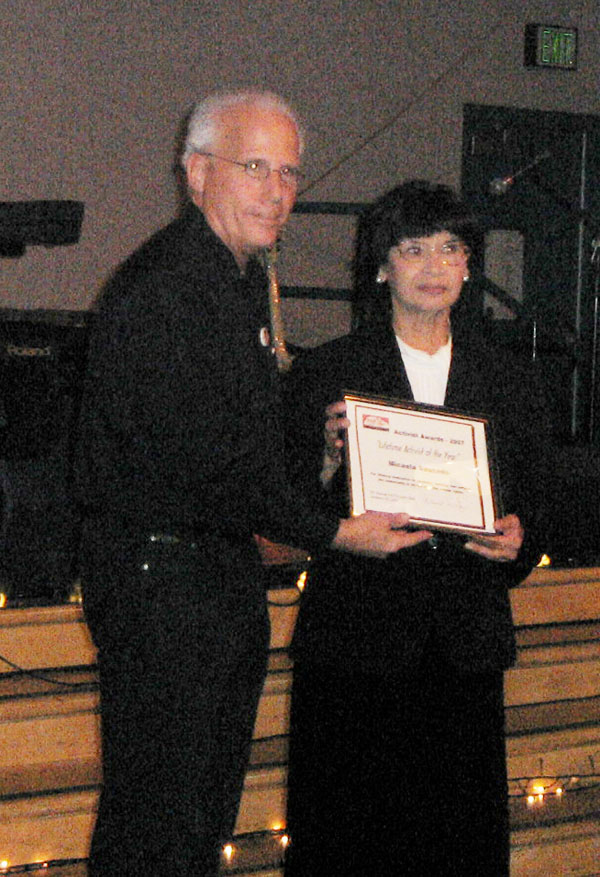
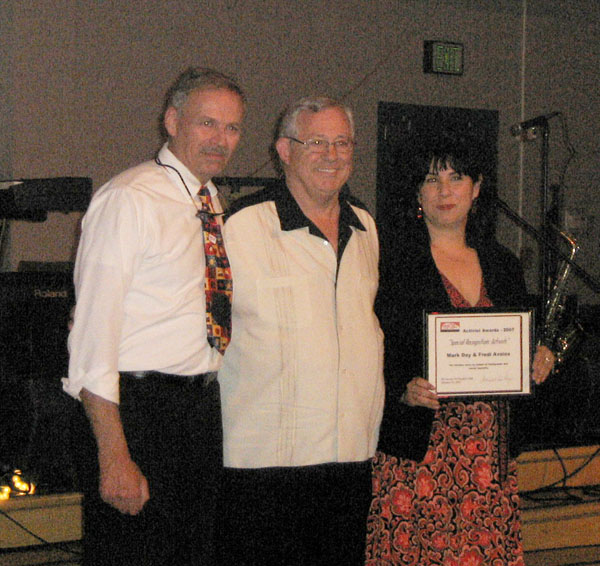
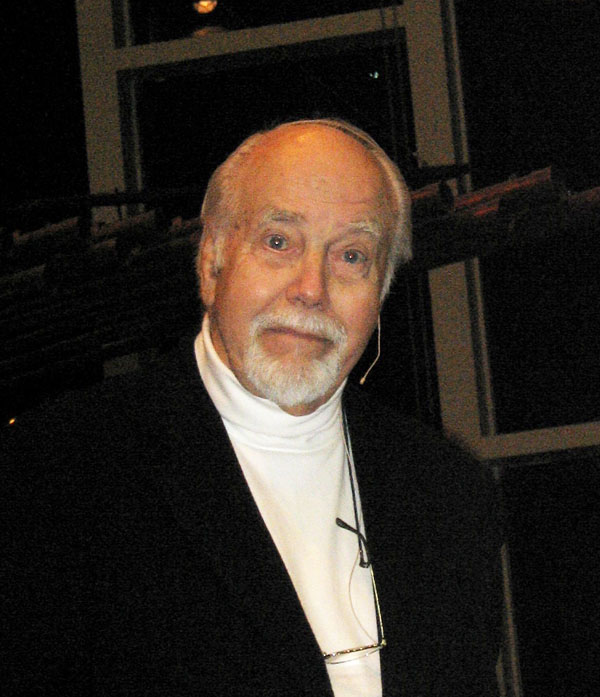
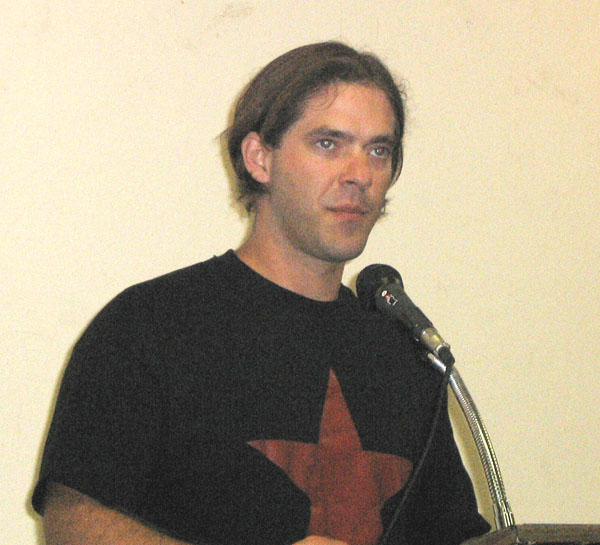
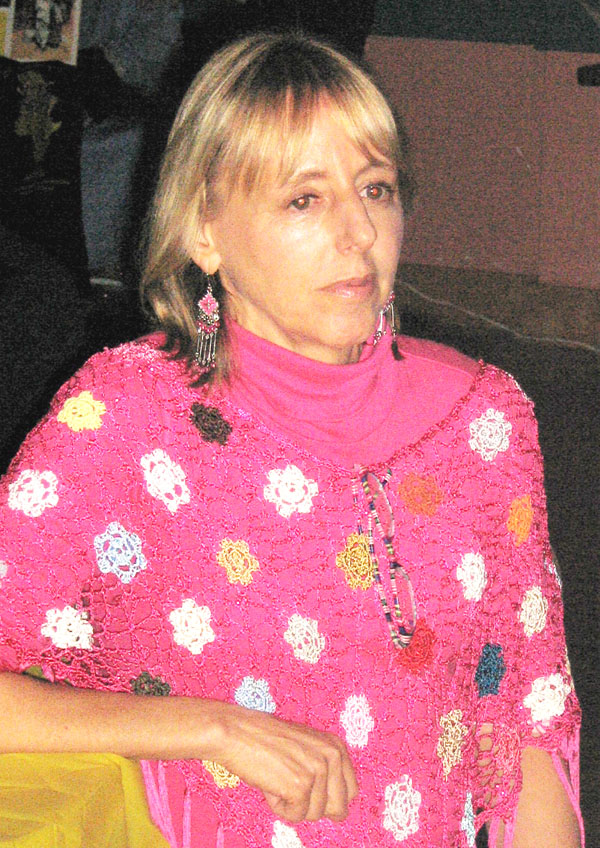
Photos, top to bottom: Medea Benjamin, Rich Harness, Puppet Insurgency’s Snail, Micaela Saucedo (right), Mark Day and Fredi D’Avalos, TranscenDANCE

Medea Benjamin the Hit of Activist San Diego Ball

Fifth Annual Event Honors Wide Range of Community Activists

by MARK GABRISH CONLAN

Copyright © 2007 by Mark Gabrish Conlan for Zenger’s Newsmagazine • All rights reserved

Anyone who saw Medea Benjamin’s speech in San Diego in August 2000 — when she was running for U.S. Senate as the Green Party nominee and appeared as essentially the opening act for Green Party Presidential candidate Ralph Nader — would have found it hard to believe that the same person was speaking at the Activist San Diego (ASD) fifth annual “People’s Ball” in the Balboa Park Club January 20. Where the Benjamin of 2000 blasted politicians from both the Republican and Democratic parties as essentially the same, the Benjamin of 2007 couldn’t have been happier that the Democrats won back control of Congress from the Republicans after 12 years in the November 2006 election.

Benjamin, a San Francisco-based activist, founded both the Global Exchange human-rights group and Code Pink, a direct-action women’s group opposing the Bush administration in general and the war in Iraq in particular. Her short but energetic speech at the ASD ball discussed her trips to Guantánamo Bay in support of the detainees held there indefinitely under U.S. custody, and her lobbying efforts to get the new Democratic majority in Congress to hold the Bush administration accountable for its mistakes in Iraq. The Guantánamo detainees have been depicted by the U.S. government and media as “the worst of the worst,” the most hardened terrorists the U.S. could locate on the battlefields of Afghanistan — but, according to Benjamin, almost none of them were terrorists at all.

“The U.S. government was offering $5,000 to $25,000 a head for anyone suspected of being Taliban or al-Qaeda,” Benjamin explained. Holding up a photo of one of the detainees, she said, “This young man fled Afghanistan and was sold by a Pakistani to the U.S. military for $5,000. He has suffered psychological torture, sexual assault, attacks with pepper spray until he became blind in one eye, and solitary confinement lasting more than eight months. This man has done nothing, and imagine the pain his mother has gone through. She’s not even asking for her son to be released, but only that he be given a fair trial. Is that too much to ask for a society that calls itself a democracy?”

Benjamin said that her group held a rally on Cuban soil in front of the U.S. base at Guantánamo — and that her event was the first many residents of the town of Guantánamo knew about the detainees being held there by the U.S. Before she came, she said, most Guantánamerans thought their town’s image abroad had been shaped by the 1960’s song, composed by Cuban folksinger Joséito Fernandes to a poem by Cuban revolutionary hero José Martí. “We showed them the film The Road to Guantánamo,” Benjamin recalled. “They used to be so proud of being from Guantánamo, and now they’re known for torture and an infamous prison. The people hugged us and kissed us, and pleaded with us to petition our government to close that prison.”

Not that closing Guantánamo hadn’t already been one of the top priorities of Benjamin and her organization, but the reception they got in the town helped fuel the fire under them that’s been propelling their lobbying effort. Her top priority with the new Congress has been to seek the repeal of the Bush-sponsored Military Commissions Act of 2006, which eliminated the right of habeas corpus for U.S. detainees in the so-called “war on terror” and set up a system of rump military commissions to “try” them based on secret evidence and without access to legal counsel.

Benjamin’s speech also touched on the war in Iraq and President Bush’s determination to escalate it with a so-called “surge” of over 20,000 troops despite the overwhelming majority of Americans that now oppose the war and want to see an orderly, phased withdrawal of U.S. troops. “There was an election two months ago that was an overwhelming mandate for us to get out of Iraq, and that guy in the White House has chosen to send more troops instead,” Benjamin said. “He is blind to the will of the people, to the troops themselves, to the Iraqis and to the reality that more troops in Iraq just means more bodies coming home in bags.”

One optimistic sign for Benjamin is that the Democrats in Congress are already starting the aggressive investigations of the Bush administration they promised during the campaign. “In the last Congress, the Democrats couldn’t even get a hearing going,” she said. “Now there are two to three hearings a day. I was at the hearings where attorney general Alberto Gonzalez and the generals in charge of the war were being grilled. There is legislation being introduced to stop the surge, stop the funding for it, repeal the Congressional resolution from October 2002 that authorized the war in the first place, and defund the entire Iraq occupation. Congressmember Lynn Woolsey has introduced H.R. 508, a bill to bring the troops home in six months, prevent the U.S. from establishing any permanent military bases in Iraq, and take the money we are spending on contractors and give it to the Iraqi people.”

One of the signs of the turning tide, Benjamin said, is that Democrats with Presidential ambitions — even ones like Hillary Clinton who enthusiastically supported it in 2002 and 2003 — are starting to turn away from the war. “Hillary Clinton, who just a few months ago was calling for more troops, is now introducing resolutions calling for bringing the troops home,” Benjamin said. “She’s being pushed by Barack Obama, who’s being pushed by John Edwards, who’s being pushed by Dennis Kucinich. The pundits, who used to say that coming out against the war and for a troop withdrawal was the kiss of death for any Democrat with Presidential aspirations, are now saying there’s a ‘bidding war’ among Democratic Presidential candidates for the anti-war vote.”

Benjamin closed her speech by making the blunt point that America has to choose to be a democracy or an empire; it can’t be both. “Our immediate task is to bring our troops home and hold those who got us into the war in the first place accountable — and that means impeachment,” she said. “It means stopping the next war now, and there are even Congressional Republicans like Walter Jones introducing bills to stop the President from an attack on Iran without prior Congressional approval. Our long-term task involves making the U.S. military defensive instead of offensive, which means closing the hundreds of U.S. military bases throughout the world and using the resources now being spent on an offensive military to fight the wars against poverty, AIDS and global climate chaos.”

Rich Harness, a Tennessee-born activist with Iraq Veterans Against the War, also spoke during the ball. Much of his speech was about the culture shock that he faced when looking for an outlet for his own feelings of frustration about his service in Iraq, particularly his sense that the government lied to him and all the other servicemembers there when it said Saddam Hussein had weapons of mass destruction.

“I didn’t want to join a group against the war because I’m from Tennessee, and we thought all peace activists were tree-hugging hippies,” Harness said. “But how would you feel if you were lied to and all your friends got their legs blown off for a lie?” Harness asked people attending the ball to contribute to Iraq Veterans Against the War, saying that the donations would go directly to help veterans in need.

“We need you-all’s help to get the troops home now — not next month, not when we get a new President, but now,” Harness said. “We need more people to stand up and say we want our troops home, we were lied to and we’re tired of it.”

The ASD ball was also an occasion to honor local activists with awards. Jim and Sharlene Hamilton were named “Activists of the Year” for their work to ensure secure and accurate elections. Micaela Saucedo of the Border Angels, Gente Unida and La Otra Campaña was given the “Lifetime Activist of the Year” award for her efforts to protect the rights of undocumented immigrants to the U.S. and indigenous people in Mexico. The “Activist Organization of the Year” was the Center on Policy Initiatives (CPI), an economic-justice organization affiliated with organized labor that led the successful battle for a living-wage ordinance in San Diego.

“Special Recognition” awards were given to the World Beat Center in Balboa Park for its programs on behalf of the cultures of indigenous Americans, African-Americans and the African diasporas; and to California State University-San Marcos instructor Frederica “Fredi” D’Avalos and journalist and filmmaker Mark Day. The citations mentioned D’Avalos’s work against the Minutemen and other anti-immigrant vigilantes, and the efforts she and Day have both engaged in to build activist organizations’ capabilities to use new media for social, political, cultural and spiritual emancipation. Ironically, the “Media Award/People’s Advocate Award” went to this writer as editor/publisher of the “old-media” print publication Zenger’s Newsmagazine.

Other awardees included Rev. Art Cribbs of Christian Fellowship Congregational Church as “Racial Justice Organizer of the Year” for founding the Coalition for Justice in response to violent attacks on civilians by local police officers. Antonia Davis of the Puppet Insurgency was named “Arts & Cultural Activist of the Year” — and she and other members of her group pushed in a giant papîer-maché snail as a sample of the work for which they were being awarded. The “Activist Youth Organization of the Year,” a City Heights-based company of energetic young dancers called TranscenDANCE, showed off their skills in two spectacular numbers that proved to be the high point of the evening’s entertainment, which also included Spanish-language folksinger Angel Lita and 1970’s-style funk band ¡Society!

Wednesday, January 17, 2007


Don McEvoy Remembers Martin Luther King

Close Friend Speaks About King’s Life at U-U Church in Hillcrest

by MARK GABRISH CONLAN

Copyright © 2007 by Mark Gabrish Conlan for Zenger’s Newsmagazine • All rights reserved

You’ve got to say one thing about Don McEvoy: he’s got a great sense of theatre. Instead of coming forward to the stage and speaking from the podium of the First Unitarian-Universalist Church in Hillcrest January 13, he began his talk about his close friend, Dr. Martin Luther King, Jr., from a seat in the audience. He identified himself as “Don McEvoy from Oklahoma City” and asked the same question he’d asked King the first time they ever met, at a public forum on the nascent civil rights movement in January 1956. Then, and only then, did he come forward, ascend the stage and give his recollection of King’s response.

The question had to do with whether King felt any responsibility for “Negroes” (though that was the term of King’s time for his people and the one King himself used, now that the rules of political correctness have burned through “Black” and now settled on “African-American” the word itself dated McEvoy’s presentation) who committed acts of violence against whites and claimed to be inspired by the civil rights movement. King’s answer — typical of the wry sense of humor McEvoy recalled in him that’s almost disappeared from the official portrait now that King has become a martyr and virtual saint — was that he’d take responsibility for Black people’s violence against whites as soon as whites started taking responsibility for all white people’s violence against Blacks.

McEvoy, then also a minister, first met King when he went to Montgomery, Alabama to check out the civil rights movement and this eloquent preacher who had emerged as its principal spokesperson. He reviewed the familiar history of the Montgomery bus boycott that started it all, but threw in a few fresh facts. Among them was that the Montgomery chapter of the National Association for the Advancement of Colored People (NAACP) had already decided, a year and a half after the national NAACP had won the Brown v. Board of Education case declaring school segregation unconstitutional, to file a lawsuit against racial segregation on Montgomery’s buses.

“They were looking for a test case, and in November 1955 they thought they had one,” McEvoy recalled. “When they found out the woman who’d agreed to be their test case was 16 years old, unmarried and pregnant, they decided they wouldn’t use her.” As all the world knows, the woman who finally did emerge to lead the challenge was Rosa Parks, who was everything the 16-year-old hadn’t been: 42, quiet, serious, a graduate of Tuskegee Institute, who hadn’t been in trouble with the law before December 4, 1955, when on her way home from work she was accosted by a white bus passenger who invoked his legal right to demand that she get up from her seat to make room for him. She refused; the bus driver stopped the bus and threatened to call the police; the police duly arrived and Parks was arrested — and, McEvoy noted, “the world hasn’t been the same since.”

According to McEvoy, the leaders of Montgomery’s African-American community knew that if they could call a boycott of the bus system and make it stick, they could cripple the city’s transportation system since 90 to 95 percent of Montgomery’s bus riders were Black. What they couldn’t agree on was who should lead the call. “The community leadership was fought over by two people; E. D. Nixon, a 60-year-old Pullman porter who was head of the Montgomery NAACP; and Ralph Abernathy, minister of the largest Black Baptist church in Montgomery,” McEvoy recalled. “They decided to call a mass meeting but couldn’t agree on a featured speaker. Abernathy said it had to be a minister, and Nixon said, ‘If it has to be a minister, it has to be mine,’ and that was Martin Luther King.”

McEvoy stressed that King’s emergence as the most visible leader of the Montgomery bus boycott — and, for the next 12 years, the broader African-American civil rights movement that emerged from it — was pure happenstance. “There was nothing in his background to indicate that he was destined for greatness,” McEvoy said. “There’s almost a mystical sense I have that if Rosa Parks hadn’t chosen that particular night to refuse to give up her seat, we might never have heard of Martin Luther King.”

King and McEvoy didn’t see each other again until 1961. “He had moved to Atlanta, his home town, and I had left the ministry to work for the National Conference of Christians and Jews, which sent me to Atlanta on assignment,” McEvoy recalled. “The first Sunday we lived it Atlanta, we made our way to Ebenezer Baptist Church, where King was the minister, and it was thrilling to hear that great pulpit orator preach in his own church. That was also my first meeting with Martin Luther King, Sr., an even more unforgettable character than his son. While his son was preaching, he sat in a pulpit chair and carried on a conversation with him through the whole sermon. The playful byplay between the two men was a joy to behold. His dad would say, ‘You know, that boy shows signs of becoming a pretty good preacher if he’ll just do what I tell him.’”

As exciting as it was to hear Martin Luther King preach from the pulpit of his own church, McEvoy said, “It didn’t compare to hearing him at a freedom rally.” McEvoy had that experience in 1963, during the campaign to integrate public facilities in Birmingham, Alabama — where sheriff Eugene Connor, appropriately nicknamed “Bull,” turned fire hoses on peaceful civil-rights demonstrators and, along with Alabama governor George Wallace, became the worldwide public face of white resistance.

“The first week I was in Birmingham, I went to the 16th Street Baptist Church for the rally and watched the crowd, many of whom were dressed in a way that showed they were coming in directly from laboring jobs,” McEvoy recalled. “There was a half-hour of gospel music and then the speakers, including every minister in attendance and the staff members of the Southern Christian Leadership Conference (SCLC, King’s organization). Then Ralph Abernathy, King’s closest friend, took half an hour to introduce the man everyone had already been waiting 3 1/2 hours to hear. When Martin Luther King finally came out everyone chanted, ‘Black Moses! Black Moses!,’ except for one old woman with a voice I’ll never forget, who said, ‘Jesus! I knew you’d come back and I knew you’d be Black!’ That’s when I realized I’d never know King as well as his own people did.”

Not that they didn’t get to know each other as one suburban family to another, dipping their toes into integration at the most basic levels. “Our children played together,” McEvoy recalled, “and when the Canadian Broadcasting Company came to do a documentary on King, the McEvoy family were the token whites invited to dinner. On our daughter Melanie’s ninth birthday, the guests at her party were her friends from school and Yolanda, Martin and Coretta King’s daughter. Melanie’s best friend at school was Kathy, and at eight she had already decided to be a missionary to Africa. The morning after the party, Kathy told Melanie they could no longer be friends because her parents had forbidden her to play with her. Melanie’s trauma didn’t last long, but I’ve often wondered how Kathy ever reconciled wanting to be a missionary to Africa with the scandal.”

When a new, moderate mayor took office in Atlanta and ordered the reopening of the city’s public swimming pools — which the previous mayor had ordered drained rather than comply with a court order that Black as well as white people be allowed to swim in them — the King and McEvoy families were the first people in town to use the pools. “We took Martin Luther King III and Yolanda, Ralph Abernathy’s daughter and our three kids, and we were the only people who went there to swim that day,” McEvoy said. “There were police to provide security, and white people who were looking on not so much with hatred as with disorientation. Black folks had always been there, but they’d always been part of the background, like trees — and now the trees had begun to move.”

McEvoy told a number of anecdotes to put some flesh on King’s bones and show that he was a multidimensional human being, not a plaster saint. He recalled that King was “a real pool shark,” and when he was worried that some Blacks in a community he was doing civil-rights organizing in might get drunk and disrupt the demonstrations, he would go to the beer halls and pool halls, impress them with his pool-playing skills, “and try to get them to go to the demonstration — or at least not do anything to interfere.” He also told some of King’s jokes, including one incident in which he and King ate at Atlanta’s fanciest hotel the day after the Civil Rights Act of 1964, which banned segregation in public places. “The manager gave us the menus himself,” McEvoy recalled, “and King said, ‘I see they have cornbread, but I don’t see turnip greens and chit’lin’s. I thought you white folks were ready for integration!’”

When Martin Luther King, Jr. was awarded the Nobel Peace Prize for 1964, McEvoy said, “A group of us were determined that the city would do something official to honor him” — an idea easier said than done, especially in a city most of whose white leaders still considered King “a radical, a troublemaker, a Communist and a pariah.” The person who finally put the dinner together was Helen Bollard, a close friend and advisor to Atlanta’s mayor, who got the city’s largest ballroom for the event and got the choir of King’s alma mater, Morehouse College, to perform. At first the choir was supposed to sing Morehouse’s school song, but Atlanta’s leading rabbi, who was on the dinner committee, and the choir director secretly worked out a change in the program and the choir sang “We Shall Overcome.”

Bollard also nipped in the bud a threat by Atlanta’s white business community to boycott the dinner and blacklist anyone who dared attend. She got the New York Times to do an article about the boycott threat, and while the article didn’t name names, it did say that “a prominent Atlanta banker” was its principal organizer. The article got David Rockefeller, whose Chase Manhattan company owned the bank the “prominent Atlanta banker” ran, to get him to call off the boycott — aided by an even more bizarre bit of persuasion. Haiti’s notoriously brutal dictator “Papa Doc” Duvalier also read the New York Times story and told the banker that if he went ahead with a boycott of a dinner honoring Martin Luther King, he could forget about being allowed to dock his yacht in Port-au-Prince on his next yachting trip through the Caribbean.

The mood of the evening turned more somber as McEvoy talked about the last three years of King’s life — between “the last great victory of the civil rights movement” in Selma, Alabama in 1965 and his murder in Memphis, Tennessee three years later. “King came to Chicago and found out it could be as racist as the South,” McEvoy said. “He began to speak out against the Viet Nam war and about economic issues and poverty. Many of his white liberal supporters turned away and said he should just stick to civil rights and leave those other issues alone.”

McEvoy recalled being summoned to Memphis, Tennessee in April 1968 to help King set up a meeting with the mayor of Memphis to settle a strike of African-American sanitation workers. By then the National Conference of Christians and Jews had reassigned him to their home office in New York, but his wife and children were still in Atlanta. McEvoy had called the Memphis mayor on April 3 to arrange a secret meeting between the mayor and King. “At noon the next day, I boarded a flight to Memphis, and 30 minutes from our destination the pilot announced that Martin Luther King had been shot,” McEvoy said. “The passengers erupted with jubilation and rebel cheers.”

The presentation concluded with McEvoy’s recollection of the service at King’s home church, Ebenezer Baptist in Atlanta, the first Sunday after King’s assassination. “Nothing in their bulletin said anything about Martin Luther King having been shot,” McEvoy said. “His brother, A. D. King, came from his own church in Louisville and preached in his stead. Their father said, ‘I guess you folks are surprised to see me here. I came here to say just one thing only: be careful what you pray for. I prayed to the Lord for Him to use my boys in any way He felt would be of service, and now I want to take that back.”

McEvoy said that the quip from King’s father had “rescued me” and fulfilled his own grief at the death of his friend. He decided not to stay in Atlanta for the official funeral, and instead head back to his organization’s office in New York, where, he said (quoting Robert Frost), “There was work to do, promises to go, and miles and miles to go before we sleep. And there still are.”
Pan’s Labyrinth: Del Toro’s Great Horror-Fantasy

by MARK GABRISH CONLAN

Copyright © 2006 by Mark Gabrish Conlan for Zenger’s Newsmagazine • All rights reserved

Like the title character(s) of Dr. Jekyll and Mr. Hyde — which would actually make a good story for him to film — Guillermo del Toro is two personalities in one body. The American Guillermo del Toro knows what’s required of a modern-day horror-film director, and methodically churns it out: steel-grey Gothic imagery, teenagers in peril and blood, blood, blood spurting everywhere. But get him out of this country — either to his native Mexico or to Spain, where he’s made his two best films, The Devil’s Backbone and Pan’s Labyrinth — and he turns into a different director altogether, filling his films with human emotion and genuine terror, and creating legitimately frightening sequences instead of just freaking out his audiences with the modern-day de rigueur blood and gore.

Like The Devil’s Backbone, Pan’s Labyrinth is a horror fable set against the backdrop of the Spanish Civil War, with a child as the central character. In The Devil’s Backbone the child-hero was a boy who discovered a dark secret associated with the building in which his school was housed, which was simultaneously under regular bombing raids at the height of the war (in which Nazi Germany and Fascist Italy, allies of the right-wing “Phlangist” movement of Francisco Franco which ultimately won, tried out the “Blitzkrieg” tactics they later used in World War II). In Pan’s Labyrinth the year is 1944, Franco’s forces have taken over the country and established their dictatorship, and while Franco was smart enough to stay out of World War II (thereby ensuring that when the Allies won they’d let him stay in power and, indeed, the U.S. would support him as a bulwark against Communism), his forces are working the Spanish countryside bent on exterminating the last remaining anti-Franco partisans mounting a resistance.

Pan’s Labyrinth opens on the road to an isolated town in the mountains, with Ofelia (Ivana Baquero), a girl on the cusp of teenagerhood — del Toro’s script doesn’t specify her age, but the actress was 12 when she made the film — being taken by her mother Carmen (Ariadna Gil) to join her current husband, Captain Vidal (Sergi López), who’s leading a company of Franco’s feared secret police, the Guardia Civil, against the remaining rebels in the mountains. Though Carmen says she’s too old to be reading them, Ofelia is still obsessed with fairy tales in general and one fairy tale in particular: a story about an underground kingdom whose reigning princess escaped to the surface world, was blinded by its light and ultimately forgot who she was and where she was from, accepting an identity as an Earth person.

At a stop in the road, Ofelia finds a chunk of sculpted stone and the idol it got chipped off from. She puts the chunk back where it initially belonged, and that’s her entrée into the underground fairyland of her dreams. Not that it turns out anything like the way she thought it would, and here the English title of the film is deceptive. The original Spanish is El Laberinto del Fauno — not “Pan,” usually depicted these days as a cute, mischievous little godlet playing on a set of reed pipes more recently used by Zamfir and other New Age musical bores, but a more sinister “faun,” played via motion-capture technology by gangly actor Doug Jones. The faun leads her into an underground realm featuring giant toads, sinister insects, slime (it wouldn’t be a del Toro film without slime!), a “pale man” (also played by Jones) with a Raiders of the Lost Ark-style taste in food and a sumptuous spread which Ofelia, living her “normal” life in a war-torn country under heavy rationing, is solemnly instructed not to eat or drink from, setting up a temptation obviously evoking a parallel with the story of Adam, Eve, the apple, the serpent and the origin of sin.

It’s indicative of this movie’s curious appeal that the “normal” story going on above ground is a good deal bloodier and more violent than the horror fantasy taking place beneath it. Captain Vidal is a typical unsmiling fanatic, like all too many figures on both sides of the current “war on terror,” describing his enemies as vermin or infections that need to be exterminated for the health of the overall country. His main concern at the moment is the fact that his store of supplies is being raided by the rebels to sustain themselves, and his growing conviction that there’s a “mole” in his base, someone who’s helping the rebels with food, ammunition and information. He’s also impregnated Carmen and is convinced their child is going to be a boy (even though in 1944 there was no way to tell in advance), and in one chilling scene he makes his priorities clear when he tells the camp doctor that if it comes down to a choice, he’s to let his wife die so the child can be born healthy and continue the name of Vidal and the family’s military reputation. Vidal’s most prized possession is a wristwatch with a broken face (though it still tells time); it was formerly owned by his father, and dad smashed in the face just before he was killed so his son would remember exactly when he died.

Del Toro meshes his two stories effectively and not always in the ways you’d expect. Rather than a source of liberation, the fairy kingdom Ofelia descends into is just a reflection of her above-ground reality, with a faun commander who in his own way is just as authoritarian, just as obsessed with “obedience,” as Vidal. Though it’s an oddly claustrophobic and physically dark film — even in the above-ground sequences the sky always seems gloomy and overcast, and one aches for the sight of some of the fabled Spanish sun — it’s photographed by Guillermo Navarro in a way that avoids both steel-grey and brown clichés. The gritty reality of the rebels’ existence and the only slightly better-off camp-dwellers (there’s a grimly amusing sequence in which a Franco official holds bags of some unpleasant-looking flour-based substance and announces that the regime has won the war against starvation and can now provide all its citizens this wonderful bread) play off the dank abundance of the faun’s world. Even the plot’s magical elements, notably a piece of chalk with which one can create a doorway just by drawing one on a wall, are handled in a matter-of-fact fashion instead of the look-what-we-can-do-with-computers showing-off we’re used to in American films.

Pan’s Labyrinth is effectively acted, especially by Ivana Baquero as Ofelia. Not since Kirsten Dunst out-acted Tom Cruise and Brad Pitt and created a chillingly controlled portrait of evil in Interview with the Vampire has it been so easy to predict adult stardom for a child performer. Sergi López is equally intense, making Vidal an all-too-believable macho fanatic who seems to have stepped out of today’s cable news shows instead of inhabiting a movie set in 1944. So is Maribel Verdú as Mercedes, a servant with a secret of her own. Ariadna Gil is less impressive, but that’s more a function of the character than any limitations on her as a performer; del Toro’s script gives her little to do but suffer, and in an otherwise well plotted film he never quite tells us what happened to Ofelia’s father or why Carmen should have chosen to remarry someone as obviously awful for her as Vidal. Still, Pan’s Labyrinth is a great film, well worth watching, rich in allusions and mythic metaphors while at the same time managing some genuine scares that are all the more frightening because del Toro has made us care about these people instead of just setting them up as cardboard victims.

Pan’s Labyrinth is now playing at the Landmark Hillcrest Cinemas, 3965 Fifth Avenue in Hillcrest. Please call (619) 299-2100 for showtimes and other information.
Iraq War Kills U.S. Democracy

by MARK GABRISH CONLAN, Editor

Copyright © 2007 by Mark Gabrish Conlan for Zenger’s Newsmagazine • All rights reserved

Originally published as the “First Word” editorial in Zenger’s Newsmagazine, January 2007

One of the basic rules of representative democracy is that elections are supposed to matter. When the voters indicate, through their choice of candidates and/or parties, that they want their government to change its course on a major policy question, they’re supposed to get what they voted for. On November 7, 2006 a clear majority of the American people voted to give the Democratic Party control of both houses of Congress in a repudiation of the policies of President Bush in general and the war in Iraq in particular. What these voters apparently wanted was some kind of date-certain by which our open-ended commitment in Iraq would finally end and our servicemembers and support personnel would get to come home instead of putting their lives at risk trying to keep members of Iraq’s various religious and ethnic groups from killing each other.

Instead, President Bush has rejected the demand of the electorate and repudiated the “out” the commission headed by James Baker (who ran his legal operation during the Florida recount in 2000 and therefore probably has more than any other person to do with Bush’s being President in the first place) had given him for a face-saving acknowledgment of the reality of Iraq. Sounding even more like a spoiled, petulant child than usual, Bush sneered at the will of the people as he said that he would consider any alternative on Iraq that resulted in “victory” — a will-o’-the-wisp not only because nobody can define in clear terms just what would constitute “victory” for the U.S. in Iraq but because the Iraqis are currently killing each other over racial, religious, ethnic and tribal issues that go back thousands of years and no outside power is going to stop them from doing it.

What Bush is now pressing on an American people who are tired of wasting their youths’ lives and their nation’s money on a futile crusade (a loaded word in discourse about the Middle East, but in this case it fits) to remake Iraq in the image of a Western capitalist republic is not less, but more. More troops: a so-called “surge” in U.S. boots on Iraqi ground despite the fact that even the military commanders who’d be in charge of deciding what those troops would do haven’t the foggiest notion of how to use them. More money. More corrupt deals benefiting Halliburton and other politically well-connected corporations. More combat missions in a war that’s already lasted longer than the U.S. fought in World War II. More young Americans coming home in bags, flown back in the dead of night lest someone actually shoot some pictures or videos that might remind Americans that their fellow countrymen, their best and their brightest, are still dying in this immoral, pointless war.

America is at a crossroads many other nations — superpowers with worldwide military ambitions — have faced in the past: whether to preserve their democratic institutions or become empires. The simple truth is democracy and empire are not compatible. Maintaining an empire requires keeping a large standing army and spending an enormous amount of the country’s gross domestic product on war and the preparations for war. It means extracting enormous sacrifices from the people to finance the war machine, either taxing them to fund it on a pay-as-you-go basis or (the course Bush has chosen) borrowing it from the rest of the world and leaving future citizens to pay the tab. It also means enormous sacrifices in terms of human life, which can be extracted in only three ways: direct compulsion via a draft, hiring foreign mercenaries or (as the U.S. is doing now) creating a permanent underclass and so totally smashing any other opportunities for upward mobility that working-class people see the military as their only avenue for economic advancement.

In practice, empires become rigidly hierarchical societies, with a tiny entrenched aristocracy living off the labor power of enormous numbers of impoverished people both at home and in the foreign territories the empire influences or controls. They also become politically repressive, partly because imperial policies provoke resistance both at home and abroad and partly because people don’t willingly make the sacrifices needed to maintain an empire for very long. In an empire, human rights quickly become a thing of the past. Political “freedom” and meaningful elections fade into history as the imperial elite dictates what sacrifices the rest of us will be forced to make to maintain them in the style to which they have become accustomed. Eventually, empires collapse not from internal dissent but because the elites running them overreach themselves and no longer have the money, the environmental resources, and/or the cannon fodder needed to keep their power.

President Bush’s attitude towards Iraq — that, regardless of the will of the American people as expressed at the ballot box last November, he’s going to keep the war going until it achieves “victory” as he and only he defines it — shows how far the U.S. has gone down the primrose path of empire and turned its back on its democratic heritage. The U.S. got into the empire business in the first place in the 1890’s,when it first projected military power beyond its own borders to “liberate” the Philippines and Cuba from Spain … and then to fight genocidal wars against Filipinos and Cubans who wanted to determine their own destiny instead of having the U.S. rule them either directly or through puppets. Through the first half of the 20th century, the U.S. elites went back and forth between imperialism and isolationism as the best way to maintain their power. But the attack on Pearl Harbor, America’s involvement in World War II against not only Japan but Germany as well, and the postwar emergence of the Soviet Union as the world’s second superpower ended America’s isolationist tendency once and for all and placed the U.S. firmly on the course of empire.

Not that the American people have always been happy about the imperial ambitions of the elites that rule them. In 1920 they voted the Democrats out of office to put an end to Woodrow Wilson’s far-reaching vision of a pax Americana and “return to normalcy.” In the 1960’s they got a hard look at the cost of maintaining U.S. control of South Viet Nam and turned against the Viet Nam war en masse. Though there have been times when America’s ruling elites have convinced its people that only imperialism stands between them and utter subjugation — like the time of anti-Communist hysteria in the early 1950’s or the years between 2001 and 2006, when the terrorist attacks of September 11, 2001 scared them into accepting Bush’s Manichean rhetoric and seeing imperialism as the only way the country could be kept safe from the crazy ambitions of radical Islamists — for the most part the U.S. people have had little stomach for long-term sacrifices to maintain an empire abroad and the hierarchical society an empire requires at home. The 2006 election was, more than anything else, a vote by the American people to steer their country away from the open-ended military commitments and suppression of dissent at home needed for an imperial policy in general and the subjugation of Iraq in particular, and to reassert their faith in democracy and human liberty.

But at this point it doesn’t appear that the American people will be allowed to make that choice. Bush has already served notice that he will continue this insane war until either it achieves his notion of “victory” or his presidency ends. The Democrats who benefited from America’s disillusionment with empire in general and empire-building in Iraq in particular are already turning their backs on the people who voted them into power. They’re insisting that they’re not going to invoke the one power Congress actually has to stop a presidential war — cutting off the funding for it — and leaning towards acceptance of Bush’s call for more troops either out of endorsement of the imperial goal or out of fear that once the war ends they’ll be accused of “losing Iraq” the way previous generations of Democrats were accused of having “lost China” and “lost Viet Nam.” The grim irony of the war in Iraq is that it was first sold to the American people on a promise that we would “bring democracy” to Iraq; instead, the war against Iraq, like Bush’s Orwellian ideological construct of a “war on terror,” is tearing apart what little democracy was left in the United States.

STUART TIMMONS:

“Gay L.A.” Author Researches SoCal Queer History

interview by MARK GABRISH CONLAN

Copyright © 2007 by Mark Gabrish Conlan for Zenger’s Newsmagazine • All rights reserved

In late 2006, veteran Queer authors Lillian Faderman and Stuart Timmons published Gay L.A.: A History of Sexual Outlaws, Power Politics, and Lipstick Lesbians. The book is a quite striking historical account of 110 years of Queer life and activism in California’s largest city, and one which made a case for Los Angeles as rivaling or even surpassing New York and San Francisco in the sheer number of community achievements that took place there, including the formation of the first ongoing Queer political organization in the U.S. (the Mattachine Society, founded in 1950) and the first openly Queer-run, Queer-welcoming church (Metropolitan Community Church, founded in 1968).

Among the book’s achievements is its documentation of how early Queer consciousness and Queer activism began — as early as the 1890’s there were Queer bars, social clubs and cruising grounds — and how, through most of that period, Queer activism consistently provoked Queer repression. Gay L.A. shows, for example, how California’s law making oral sex a felony — passed in 1915 and not repealed until 1975 — was a direct response to a notorious scandal in the L.A. area the year before. It specifically discusses the role of the Los Angeles Police Department, which used its virtual autonomy from the rest of the city government (until the early 1990’s, when the fallout from the 1992 riots led to a change in the city charter) to monitor political and social dissidents in general and Queers in particular.

Gay L.A. also embraces the touchy subject of Hollywood, generally (though not always) avoiding the ”were they or weren’t they” guessing games about the major stars and instead showing how actresses like Greta Garbo, Marlene Dietrich and Katharine Hepburn deliberately projected ambiguous gender images in their films and thereby let the rest of America know there were alternatives to strict “masculine” and “feminine” sexual identities. It documents not only the ongoing police repression of L.A.’s Queer community but the community’s willingness to fight back, including an account of one riot at a doughnut shop in 1959 where the Queer customers resisted a police raid much the way the denizens of New York’s Stonewall Inn bar would 10 years later in the event still generally (inaccurately) considered the touchstone of U.S. Queer activism.

Though the later chapters of Gay L.A. tend to drag — Faderman and Timmons seem bent on chronicling not only every major Queer organization in L.A.’s history but also the internal politics and feuds that broke up the ones that didn’t survive — that’s partly inevitable. The “good news” about the history of Queer L.A. is the growing involvement of middle- and upper-class people in community organizations and the values they brought in terms of professionalism and funding — and as such people crowded out the raffish countercultural activists who had started the community’s major organizations, the story necessarily becomes less compelling as it shifts from the heroic resistance of a community under siege to the consolidation and expansion of the resisters’ hard-won gains.

One interesting aspect of Gay L.A. is the way the collaborators worked together. Faderman interviewed most of the women and Timmons most of the men, though there were some people they considered so important they interviewed them jointly. Faderman wrote the final text to ensure a unified author’s voice, but only after the two had agreed on what the book would contain and how it would present the material. Faderman came to San Diego November 8 to promote the book and show slides of some of the images of L.A. Queer history she and Timmons had discovered (see “Lillian Faderman Speaks at Center November 8,” Zenger’s, December 2006, online at http://zengersmag.blogspot.com/2006/11/lillian-faderman-speaks-at-center.html); two weeks later, we called Timmons in L.A. and interviewed him by phone.

Zenger’s: What was your background and how did you come to work on Gay L.A.?

Stuart Timmons: I began writing about Gay matters in the 1970’s in college at UCLA. There was a Gay student newspaper called 10 Percent, which may have been the first Gay student newspaper in the country. That path of journalism, in what was then a very new field, continued for me for many years. In the late 1980’s I wrote a biography of Harry Hay, who’s often considered the founder of the Gay movement through his role in starting the Mattachine Society in 1950. In Gay L.A. we have a group photo of the five Mattachine founders.

Having done that book, I was aware that there was an enormous amount of work that had been done in Los Angles that rarely got mentioned in Gay history, and this gap needed to be filled. I was approached three years ago by Lillian Faderman, a Lesbian historian who lived and came out in Los Angeles in the mid-1950’s. She’s about a half a generation older than I am. We teamed up and got a publisher, and went to work.

Zenger’s: How did you and Lillian actually collaborate on the book? Did you interview all the men and she interview all the women? Did you each write separate sections or did you work together on the writing?

Timmons: She interviewed the women and I interviewed the men. We did a few interviews together. We each interviewed about 150 people. It’s a very sweeping story, from 1880 to 2005. We hammered out drafts and worked together on the parts of the story in which men and women had worked together — which wasn’t always the case. She lives in Fresno and I live in Los Angeles. I did a lot of the archival research, and with the help of a few meetings and a lot of e-mails, we finally put together the book.

Zenger’s: What was the most surprising single fact you learned when you were researching the book, the most unexpected piece of information you uncovered?

Timmons: Without a doubt, it had to be how far back a Gay underground went. The incidents described in the “Social Vagrants” chapter were cause for an actual investigation at the time in the Sacramento Bee and the investigation notes survive in the Sacramento city archives. They talked about bars and dance halls where Gay men gathered, only they didn’t say “Gay men.” They said “social vagrants” or “perverted sexualists,” or in one case even “professional perverted sexualists.” There was a sense of a professional society that had covered its tracks very well. A lot of men I interviewed who had been young in the 1930’s, 1940’s or 1950’s knew nothing of this, but there always seems to have been something of what we would call a “Gay community,” at least on a social level.

MGG: Personally, I found the earlier parts of the book, dealing with a community that was so strongly under siege, more interesting and inspiring than the later parts of establishment and triumph. Did you feel that way about the material?

Timmons: Certainly I found the early material the most fascinating. Part of it is the awe I felt in finding something so unexpected. This is radical territory. It’s only been in the last few years that people have been willing to be open and public about being Gay or Lesbian. Those who survive from the most recent period are still somewhat sensitive about the risks they’ve taken. There’s still a more measured sense about writing about someone who’s still alive, rather than someone who’s no longer around to be hurt.

The other thing is that the story has changed from absolute persecution to organizing, political activism and achievement, and that’s not so dramatic. Perhaps it means more to people who have lived in Los Angeles and watched, for example, the Los Angeles Police Department change from being totally oppositional to actually recruiting Gays and Lesbians to be police officers.

Zenger’s: One of the recurring themes in your book is that there’s been a high amount of separatism in the Queer community. You describe how frequently Lesbians have formed their own organizations because they felt uncomfortable trying to work with men, and how Lesbians of color have formed their own organizations because they felt uncomfortable trying to work with white women, and how often it’s taken some sort of exterior crisis, like the AIDS epidemic or an anti-Queer ballot initiative, to bring the community back together.

Timmons: I think that’s a very fair observation. You can’t escape that when you look at the historical pattern. There was a pattern of unity in the 1950’s to some degree, but the uniting external environment at that time was the homophobia of the entire world. It’s inevitable that when there is such a threat, there will be a coming together. One Lesbian activist said it was clear when the Briggs initiative [a 1978 ballot measure to ban people from being teachers if they were Queer or publicly “advocated” for Queer rights] was on the ballot that if we didn’t come together we would all be crucified.

The term “Gay/Lesbian community” has always had a bit of a good-natured propaganda idea to it that hasn’t always reflected the reality in which we’ve lived. That’s when we’ve had a lot of these splits, or at least a recognition that we don’t fit quite so neatly under the same umbrellas.

Zenger’s: So do you think there’s an ongoing basis for unity in the Gay/Lesbian/Bisexual/Transgender/Queer/Questioning/whatever, whatever, whatever community, or are we doomed basically to go our separate ways and only come together when we absolutely have to?

Timmons: Well, just to preface that answer, boy, were we happy that there wasn’t a firestorm over the choice of our title. We didn’t go with the “whatever, whatever, whatever.” We just called it Gay L.A., and so far no big attacks. We found that it was historically accurate, that that was the sort of preferred term going back in time.

There are certainly clear urgencies for continuing to pull together in unity. There’s not the kind of federal job protection that’s been a goal of the movement for many years, just as one example. And, whether you want to call it “marriage equality” or anything else, there’s still a terrible vulnerability and injustice around the whole issue of Gay couples.

But I also believe, because this is some sort of an opinion question, that the “Gay agenda,” so to speak, has been driven by crisis and reaction for decades now. The idea of stepping back and evaluating what are the legitimate difference between Gay men and Lesbians, what are differences between Transgender people and Gay people, and what are similarities: those questions have been often shied away from. Instead of feeling that we’re always forced to work together by crisis, we need to be following a natural process and building self-awareness of how different parts of all these communities work together in reality. Once that’s gone through, I think we’ll let go of some of the other differences.

Zenger’s: One thing I noticed about your book is there seems to be a tremendous optimism about it. For example, even though you called your chapter on AIDS “Devastation,” the focus seemed to be much less on the devastation and much more on the community’s ability to react to it, to come together, to form organizations, to lobby the government for more funding, faster drug approvals, etc . Was it a deliberate decision on yours and Lillian’s part to, shall we say, accentuate the positive?

Timmons: I’d say yes. After some real concerned and considered discussion, we did include a major segment on disagreements and difficulties and all those splits you mentioned earlier. That was often repeated, even in later sections of the book. People who worked in the movement, by the time it was a movement, often had very legitimate historic disagreements. But airing all of those out would be impossible, and the point might often be for just one or two individuals to feel sort of vindicated. So I think the tactic of accentuating the positive is a reasonable one.

Zenger’s: In fact, regarding the sections you just talked about, at times I felt it might just be a little insider-baseball, of having just who got mad at whom in which organization and what they did after they left.

Timmons: Well, believe me, there was plenty of that that we didn’t chronicle, partly because there wasn’t room for it and partly because it would have been insider-baseball. But the total story has been a story of real success and triumph. It’s often been agonizing along the way. Really good people who stepped way out on a limb, and were absolutely heroic, were sometimes at each other’s throats because they disagreed about what was the best way to go and who should be in charge. So it’s not always tidy or easy, creating these kinds of movements and successes.

It’s also a very personality-based community. There’s passion and sexuality and politics, all wrapped up in one thing, to a large degree. And it packs possibly a bigger wallop than a lot of other kinds of struggles.

Zenger’s: That’s an interesting point. You are dealing with a group of people that are defined as a community by who they have sex with and who they’re attracted to and how. How do you think the fact that our commonality is based on our sexuality affects the kinds of issues that come up in our community, and how does that make us differ from a community based on gender, race, religion or some of the other things people have organized around in our era?

Timmons: Again, there are two answers to that. One is that it really does take a kind of boldness to break through these kinds of taboos, that are probably a little more American than, at least, European about sexuality. Talking about your “lifestyle” and who you “sleep with,” to use two different euphemisms for what your sexual drive and orientation and preference is, takes some guts. I think that’s one of the reasons we often have these gutsy, strong personalities who wind up having some of these divisive battles in the leadership.

The other answer is that there may not be complete agreement about sexuality being the one defining thing. Back in the 1930’s, the older men that I have talked to really did discuss sensibility. I can’t speak for Lesbians, but I think to some degree Lillian’s work reflects this as well. Sexuality often wasn’t overtly discussed, but groups of Gay people, whether they were men or women, would often make friends, and make friends for life. Sometimes Gay men and Lesbians, we go on at length about, would make friends for life.

Men in the 1930’s would not talk in terms like, “Is someone Gay?,” because they were so on guard about not getting arrested and not phrasing things as a liability. They lived a very artful way and talked a very artful game. They would use terms like “temperamental” and “sensitive.” When I asked one man in his 80’s if a certain actor in Hollywood was Gay, he said, “Oh, do you mean was he giddy?” And then he said, “If you couldn’t tell that boy was giddy, you didn’t have an ear for music.”

So he was using a double euphemism to talk about a sensibility instead of saying, “Yeah, he sleeps with guys.” “In the life” was the other term, from the African-American Gay world. And “the life” is a lot bigger than just sex acts. This seemed to come into better focus during and after the AIDS epidemic. It became a necessity to define oneself around a little bit more than simply sex.

Zenger’s: Exactly how do you mean that? Are you saying the AIDS epidemic required people to define themselves in more than just sexual terms?

Timmons: Sex became a thing that had to be limited by necessity. People had to pull back from how free everyone had been earlier, and how much that was part of the program, part of the movement. The culture began to shift from “Dig it, do it,” as we quote from a Gay Liberation poster from around 1970, to, “Don’t do it indiscriminately. Do it safely. Limit your partners. Know your partners.” The ideas of “sex addiction” and “sexual compulsiveness” would have been joking terms before HIV. They were suddenly more widespread after the epidemic started.

It was no longer the constant affirmation of a healthy Gay personality to run around like crazy, having as much sex as possible. And to a degree there were people who did define a healthy Gay personality before 1980 as running around like crazy having as much sex as possible. So a definition of Gay culture, and the idea of Gay classes held in places like the Center, the idea of Gay churches and a Gay spirituality which doesn’t necessarily exclude sex but it’s based on a little something else, a little something more, all of those things have really grown steadily.

You can never be absolutely sure, because you can’t go back and separate things in time, but it seems to me fairly clear that the AIDS epidemic required growth that might at least have happened slower in those areas.

Zenger’s: Of course, it was also part of a trend that people writing about other civil rights movements have also discussed, and that is that it’s the radicals, the people at the lowest end of the socioeconomic spectrum, the people that have the least to lose, who pioneer a movement for civil rights and social change; and then it’s the more affluent people in the community who, once the trail has been blazed and they feel safer, come out and move the movement away from its radical origins and put it on a more professional basis. This is certainly one of the major stories in your book. Is that, too, a process you think AIDS accelerated, or would that have happened anyway?

Timmons: It’s like that Twilight Zone episode where you go back and step on the moth, and everything is upside down. You can’t know, and you can’t know. But I think you can say without too much going out on a limb that the AIDS epidemic did revitalize a sense of activism, a sense of purpose, a sense of community that transcended the very ephemeral sort of sex culture of bars and baths that had represented so much of Gay life.

A lot of parts of Gay life that we take for granted today were not so much thought of before HIV. One example is the acceleration of nonprofit institutions, which certainly do have those sorts of institutional qualities of being more conservative and in some ways less visionary. But at the same time they have that sense of permanence that has been historically absolutely lacking. There’s nothing like seeing your life flash before your eyes, individually or on a group level, which to a degree HIV/AIDS has done, to give you more drive to do something a little more meaningful and lasting.

Zenger’s: Going back a ways historically, one thing that struck me in your book, as a big fan of classic Hollywood and the movies it made, your discussion of the film industry in the 1920’s, 1930’s and 1940’s and its effect on how it put some quite unmistakable, albeit coded, Gay images out in the popular culture. One thing I noted is that, despite your stated intentions, you did kind of wade into a few of the arguments about, “Was he?,” “Wasn’t she?,” were some of the major stars in Hollywood actively homosexual or Bisexual; including Katharine Hepburn, where the source you cited was A. Scott Berg’s memoir, where he was saying very definitely she wasn’t; and you were saying, “No, read between the lines, he certainly wrote as if she was, or had been.”

Timmons: That’s something you’d have to ask Lillian about in terms of her having made a more firm conclusion. However, we had multiple sources for everything that we delved into, and information that we read from original sources. Lillian and I spent several days at the Motion Picture Academy library and read hundreds of original “Rambling Reporter” columns in the Hollywood Reporter and Daily Variety, those daily gossip columns. There was a good amount of “she said” that Hepburn went on record about in the newspapers at the time, that later she tried to mask, especially about an early relationship with a woman, Laura Harding, who had come out with her as some sort of a companion, whom she referred to as her “secretary.” The new biography by William Mann seems to be holding up very well, and that’s an entire book just on that one performer.

We used a really exhaustive amount of sources; and we were fairly conservative, as you mentioned, about not getting into an outing game, but really trying to discuss the life back then. We also talked about the changing wasy of describing sexuality and sexual orientation. You really did have people in those days — and still today — who, as actors, kind of perform a life role. Their deepest desires may not mean quite so much as their big opportunities for major stardom. So we talked about people who were so-called “unstraight,” who you can find Gay traces of and a certain amount of circumstantial evidence but couldn’t necessarily call one way or the other.

Zenger’s: One other point I noticed was that the Hollywood section seemed to be the only place in the book where you seriously discussed Bisexuals. Through the rest of it, as much as you tried to give voice to and tell the story of virtually every other subgroup in the Queer community, there didn’t seem to be much about bisexuality. Why is that?

Timmons: We were always worried that we would be giving short shrift to anybody. I’m glad we had in as much about Transgender people as we did, although I was also worried that we were giving short shrift to that really fascinating and underreported community. Bisexuality is often something that is not well marked in the tracks that people leave, so, especially when you’re looking in an historical kind of a way, you don’t always see evidence of a Bisexual life. You see pretty clearly good evidence of a Gay male life, or a Lesbian life, or a Drag or Transgender life, but bisexuality can often be more easily hidden by people who have many reasons to hide it.

Zenger’s: Yes, because it’s often amused me that many of the people on those lists of so-called “Famous Gay and Lesbian People” through history were actually Bisexual, and probably, especially if they lived before the 20th century, would not have thought of themselves as having a Gay or Lesbian or Bi identity the way we think of such things.

Timmons: I agree with you more on your second point. It’s impossible to know whether people were more Bisexual, or whether even married couples might have both been pretty much either exclusively Gay. I think there’s also probably many people who were much more repressed and never expressed themselves or developed that kind of sexual and emotional identity that we take more for granted. But that’s just one more of those historical questions. You weren’t there, and people really didn’t leave much evidence.

A really sad aspect of the 19th century and turn-of-the-century research I did on men was that so much of it was in the criminal justice records. These really tragic cases: I would jokingly say to myself during that period that I was “searching for sodomites,” but you would find these people and only be sure of this activity when there was a so-called “crime” and a scandal. There are many people who were sort of likely prospects. We looked at letters and diaries and correspondence, and couldn’t find it. It doesn’t mean it wasn’t there. It means they didn’t help.

Zenger’s: I remember once talking to a friend about the movie Brokeback Mountain and thinking of how differently it would have read if it had been set in 1863 instead of 1963. One could readily imagine that story happening 100 years earlier, but the movie would have played very differently.

Timmons: In some ways yes, but in other ways not so much. That one memory of the character remembering seeing a guy who’d been murdered and castrated because he’d been in a Gay couple, probably in the 1930’s when he was a child, that’s something that think is age-old. I certainly found evidence of that kind of almost public, almost like a lynching of a Gay person, a Gay man, in order to make a big social statement of “we don’t tolerate queers.” That kind of thing, I think, you could have found in 1863 or 1763.

Zenger’s: As we talked about earlier, the book is largely a narrative of steady progress. Even a setback as disastrous as the AIDS epidemic you seem to treat as, “Well, let’s look for the silver linings. It was really tragic that a lot of people died, but it helped the community get together. We grew as a people, we got beyond it.” Do you think the Queer community is going to continue to grow in power and influence, or do you think that the rise of the radical Right, and the fact that 30 percent of the U.S. population now identifies as evangelical Christians, is that going to set up a major backlash where we’re going to lose a lot of the gains that we’ve won in the last 30 years?

Timmons: Well, anything is possible, sadly. There have been horrific backlashes before. At the same time, there is enormous reason for hope. The fact that the AIDS epidemic did not destroy the Gay Center or other Gay institutions; the fact that more of them grew and flourished: it’s not that we stressed the silver lining. That’s what happened, and that is kind of astonishing. The historic struggle in the recent era is for people to put their daily lives out there in terms of being out and affecting the world with the ripple effect of the thousands of people who’ve come out, which has an enormous impact; and putting their resources behind these community institutions. That has a huge influence.

So, as much as you’re seeing the political football of Gay-baiting continue, and often being successful, you’re also seeing it fail to a degree. Thank God the war in Iraq and the lies and the bloodshed that surrounded it were a bigger political issue for a majority of the public [in the November 2006 election] than whether or not two guys can do something, or two women can do something, as tame as get married. You know, that’s a big political commentary.

Zenger’s: Last question, and one I hope specifically speaks to you as Harry Hay’s biographer. When he was writing the founding documents for Mattachine, Harry Hay coined the phrase that one of the purposes of his organization had been, if I remember it correctly, to “create an ethical homosexual culture.” Have we done it?

Timmons: I think all humanity is always struggling with creating an ethical culture. The Gay world, I think, has a long way to go, quite frankly, in terms of creating a truly ethical culture. But those words, I think, still serve a wonderful purpose in terms of calling people to evaluate what’s right and wrong in their daily life, and how they do or don’t create to a culture at all, let alone an ethical one.

You know, the point in time from which Harry Hay was writing those words was a time in which Gay men, especially, often became terribly embittered over the horrible persecution that they suffered, and had a certain, not just tragedy but hardness, and even selfishness. So the call in the middle of all of that to go from thinking of oneself as one embattled person who would just take whatever he could, to having a sense of knowing there was a better way to live, with a community instead of every man for himself, is a lovely vision that was actually foreseeing something I think is coming to pass, But I don’t think you can ever quite have enough of an ethical culture.
Thursday, December 14, 2006


Top to bottom: Jeeni Criscenzo, Gloria Daviston, Michael Kuzart, Aïda Reyes.

Progressive San Diego Rallies for Impeachment

by MARK GABRISH CONLAN

Copyright © 2006 by Mark Gabrish Conlan for Zenger’s Newsmagazine • All rights reserved

“If we dwell on the negative and all the terrible things, we’ll give power to all the negative things and feel overwhelmed,” former Congressional candidate Jeeni Criscenzo told about 70 people at a Progressive San Diego event at the Joyce Beers Community Center in Hillcrest December 9. Though the announced topic of the forum was “presidential accountability,” it was obvious even before the speeches began that its real purpose was to build support for impeachment proceedings against President George W. Bush and Vice-President Dick Cheney.

All along the side walls of the room, volunteers sat at tables inviting people to sign petitions calling for impeachment. The tables also contained e-mail sign-ins so people could get on mailing lists and send online appeals to their Congressmembers urging that the House of Representatives begin impeachment proceedings against Bush and Cheney. A yellow leaflet handed to all attendees listed 10 grounds for impeachment, including the war in Iraq, the torture of captives in Iraq and Afghanistan, arbitrary detentions of persons (including U.S. citizens) without due process, the recently passed Military Commissions Act that denied the right of habeas corpus to anyone detained by the government as an “enemy combatant,” and the Bush administration’s negligence and failure to respond to warnings of an impending al-Qaeda attack in 2001 and Hurricane Katrina in 2005.

The event’s opening speaker and MC, Judy Hess of Progressive Democrats of San Diego, made the agenda clear in her initial remarks. “When we impeach Bush and Cheney,” she said, “Nancy Pelosi will become president of the United States.” Acknowledging that Pelosi and other Democratic leaders slated to take over Congress in January have said that impeachment is “off the table,” Hess said that the purpose of the meeting — and of similar events taking place nationwide — was to build a groundswell of popular support for impeachment that will prevent the Democrats in Congress from continuing to duck the issue.

What will turn the tide and make impeachment feasible, Hess explained, is the promise of Democratic leaders in Congress to hold hearings and conduct investigations of Bush’s and Cheney’s policies and conduct. Through Bush’s first six years in office, the Republican Congressional majorities had basically given him a free pass. Not any more, said Hess: “Rigorous investigations will reveal wrongdoing. The facts and truth will be on the table, and put impeachment back on the table. Our children must be taught that you cannot subvert the Constitution and get away with it. We all have the power to give political cover to our Congresspeople.”

Hess explained that the impeachment campaign’s goal is to collect one million signatures nationwide by the end of December. “As they do investigations, our Congressmembers will have those signatures at their backs,” she said. “We are working to form grass-roots impeachment committees in every Congressional district in the country. Our desire is to let our Congressmembers know they have popular support as they do the right thing.”

“We are not looking at impeachment as a form of vengeance,” Criscenzo, the first speaker, said at the start of her talk. “We have a vision of what our country could be and Bush is standing in the way. Global warming, our standing in the world, and the budget are all on the precipice. We started by electing Democrats [to a Congressional majority] and we have to hold their feet to the fire and remind them of why we elected them. Number one is to get out of Iraq. In October, Congress approved $70 billion for Iraq. This spring Congress will be voting for $160 billion more, enough money to keep U.S. troops in Iraq until George W. Bush’s term ends — and the Democratic leaders are telling their members, ‘Don’t stand in the way of that appropriation.’”

Despite the wide-ranging agenda in the call for impeachment issued at the meeting, most of the presentations focused on the war in Iraq and the so-called “war on terror.” Criscenzo grimly noted that in August she’d met with officials from the Iraqi government and survivors of torture at Abu Ghraib. The meeting took place in Amman, Jordan one month after the Iraqi leaders had held a “unity summit” in Cairo, Egypt. According to Criscenzo, that’s one telling indicator of the failure of Bush’s war: the Iraqi government, supposedly democratically elected under U.S. auspices, can’t even hold meetings in its own country because life is so dangerous for them there.

Criscenzo said she went to that meeting in Amman convinced that Iraq’s partition into Shi’ite Arab, Sunni Arab and Sunni Kurd states was inevitable — but meeting with the Iraqi leaders changed her mind. “They came back from Egypt with a reconciliation plan and nothing had to do with greed, hatred or power-grabbing,” she recalled. “They said, ‘Don’t partition Iraq,’ because that would condemn them to eternal warfare. We had Sunni and Shi’a sitting next to each other, and they said, ‘We’re friends. We’re neighbors. We’ve lived together for hundreds of years.’”

According to Criscenzo, the Iraqis themselves want the war to end. Who wants it to continue? “Defense contractors are making a killing in Iraq, and they don’t want it to end,” she said. “Congressmember Dennis Kucinich said that 500,000 barrels a day of Iraq’s oil are being stolen. Nothing else works in Iraq, but the oil is being pumped without the meter running.” Criscenzo claimed that U.S. oil companies are draining Iraq’s oil reserves and “pumping nonstop,” partly to make as much money as they can in a hurry without having to pay anything back to the Iraqi people, and partly to realize their long-held dream of breaking the OPEC cartel and the hold OPEC’s largest producer, Saudi Arabia, has over world oil prices.

“The Bush administration has committed war crimes and crimes against humanity,” said Aïda Reyes of the World Can’t Wait organization, which held a mass event in downtown San Diego October 5 as part of an international mobilization. “Over 650,000 Iraqi civilians have been killed. The U.S. has taken over thousands of prisons in Iraq and tortured people. It has killed people with chemical weapons like white phosphorus. Every day we stay in Iraq is a living hell for the Iraqi people. The U.S. has spread 100 times as much radioactivity in Iraq than it used in Japan at the end of World War II [presumably a reference to the routine use of depleted-uranium ammunition by U.S. troops in both Gulf Wars], and the half-life of this material is 100 million years.”

Quoting British playwright Harold Pinter’s comment that “the Bush administration is the most dangerous force in the world’s history,” Reyes added that if the American people allow Bush and Cheney to serve out their terms, “We will be remembered as the people that allowed the atrocities to happen. Iran will be next, and then Venezuela. Will we be the people that allowed all forms of torture to be legal? Will we be the people that allowed habeas corpus to be revoked? The ‘war on terror’ is the rubric under which the Bush administration demanded and got increasing state power. Bush is not stupid. This was a plan at least two decades old to remake the world, and they used 9/11 as the pretext to do it.”

As she had done at the October 5 World Can’t Wait action, which she M.C.’d, Reyes ridiculed fellow progressives who put their faith in the electoral process in general and the Democratic party in particular. “There’s no indication that the new Congress will stop the Bush agenda,” she said. “The only force that will stop it is the people, millions of us. Our sentiments will not be felt until we form a mass movement of millions. The government didn’t listen to the protests, but the world listened and saw there was a section of people in this country who knew the war was unjust. It opened up more room for people to think and take a stand. As the lies were exposed and Iraq descended into unwinnable civil war, Bush’s popularity dropped from 80 percent to 30 percent.”

Perhaps the most powerful speaker on the program was Michael Kuzart, a recent veteran of the “war on terror” and a member of Iraq Veterans Against the War. He said he knew that there would be a U.S. attack on Iraq as early as June 2002, when he was based in Qatar and involved in sending military supplies to Afghanistan. “Then I was moved to another equipment supply store so we would have material ready in case there was another war in the Middle East,” Kuzart said. “I started to turn away from the war in June 2002, when I noticed a lot of equipment was accumulating in Kuwait. I had a bad feeling, and when I went home on leave and heard all this stuff about Saddam Hussein supposedly having weapons of mass destruction, I knew that we were going to invade Iraq.”

Kuzart recalled the 13 days of what he called “cakewalk duty” he served in Afghanistan. “I volunteered to help out the civil affairs unit,” he said. “We would go to villages where there had just been fighting, and I would wait outside with the vehicles while the officers would go in, negotiate and pay off the warlords. Now there’s more violence in Afghanistan because the warlords would rather spend money on weapons than on rebuilding schools. This was the first time civil-affairs units would go in on missions with active-duty soldiers, and we got medals for it, but it was really a drive-through reparations program. There was no intent to rebuild Afghanistan.”

One of Kuzart’s main motivations for joining the impeachment effort was to see President Bush held accountable for the lies he told to win U.S. support for the “war on terror” and the attack on Iraq. “I don’t think the President should be allowed to lie to us,” he said. “We’re told the women in Afghanistan don’t have to wear burkas anymore, but during the time I was there I never saw a woman’s face.”

“Raise your hand if you knew about the $55 million contract to Kellogg, Brown and Root [a subsidiary of Halliburton] for constructing detention camps in the U.S.,” said Hess, who took the podium at this point to introduce a videotaped presentation by National Lawyers’ Guild president and Thomas Jefferson School of Law professor Marjorie Cohn. “There is a U.S. Army Rapid Action Deployment System for civilian detention on unused Army basis in the U.S. It says it’s for civilians to be in those camps, labor camps or detention camps. It says ‘persons of note’ should be held there.”

Cohn’s taped presentation had been filmed on December 6 at a Progressive Democrats of America event in Clairemont. She discussed the Military Commissions Act and a potentially even more far-reaching law, the John Warner Defense Authorization Act, passed by Congress and signed into law by President Bush the same day: October 17, 2006. “The Military Commissions Act allows the President to declare anyone, including U.S. citizens, ‘unlawful enemy combatants’ and detain them indefinitely,” Cohn said. “It’s so broadly defined that anyone who donates to a charity that turns up on Bush’s list of ‘terrorist organizations,’ or speaks out against government policies, could be declared an ‘enemy combatant’ and lose habeas corpus rights.”

The Defense Authorization Act allows the President, solely on his own authority, to declare martial law and put the National Guard units of the various states under federal command “to restore public order and defend the United States.” While the ostensible purpose of this act is to give the President power to respond to another 9/11-style attack on the U.S., Cohn warned that under its language, otherwise legal, peaceful protest could be used as a pretext for martial law and the establishment of a Presidential dictatorship.

“In a November 2006 speech at the Air Force Academy, Attorney General Alberto Gonzalez warned that anyone who says Bush’s surveillance program stifles freedom ‘poses a grave threat to the liberty and security of the American people,’” Cohn said. “Documents obtained by the American Civil Liberties Union show that military officials labeled anti-war and anti-recruitment demonstrations as ‘threats to the national security.’”

Cohn drew a parallel between the Military Commissions Act, the Defense Authorization Act and the USA PATRIOT Act and earlier attempts by the U.S. government to suppress political dissent, including the Alien and Sedition Acts of 1798 and the “extensive surveillance” of the so-called McCarthy era in the late 1940’s and 1950’s. She also pointed out that the U.S. Supreme Court’s 1944 decision ruling that the government had the power to order all Japanese-Americans into internment camps is still on the books — and quoted then-Supreme Court Justice Robert Jackson, who in his original dissent in the case warned that the court’s ruling would be available to any future government that wanted to set aside the Constitution to punish American citizens and legal residents for arbitrary reasons.

The final speaker at the event was Gloria Daviston from San Diego Veterans for Peace, a local chapter of a national organization which called for impeaching Bush and Cheney as early as 2002. She joined the Army at 19 and served seven and one-half years during the Viet Nam era, and talked about how the military appeals to young people to get them to join — and then lets them down. “The call goes out to them to ‘be all you can be’ and do their patriotic duty, and they expect the military to do right by them,” Daviston said. “Under Bush, that has not happened. They have been misused and abused.”

Daviston spoke in support of war resisters like Lieutenant Ehren Watada, who is scheduled to be court-martialed in January for refusing an order to deploy to Iraq — the first commissioned officer to do so. She said the evils of the Bush administration started “when he hijacked the election in 2000” — one of the items in the bill of particulars against him and Cheney in the event’s leaflet — “and it’s been downhill ever since: the breaking of the Geneva conventions, the threats on Iran, the degradation of the United States Constitution. The Bush administration has committed unconscionable acts, and we must speak out. A dalliance with Monica Lewinsky is not an impeachable offense; Bush’s acts are.”

Wednesday, December 06, 2006


Kyle Snyder, War Resister, Speaks to Peace & Justice Coalition

by MARK GABRISH CONLAN

Copyright © 2006 by Mark Gabrish Conlan for Zenger’s Newsmagazine • All rights reserved

At first sight, Kyle Snyder seems like a quite ordinary young man. He’s short, slightly built, and when he came to speak to the San Diego Coalition for Peace and Justice at the Church of the Brethren in City Heights December 4 he was dressed unassumingly in a red hooded sweatshirt and baggy blue jeans. He’s 23 now; four years ago he joined the U.S. Army “for the usual reasons a 19-year-old joins the Army: for the $5,000 signing bonus, college money and medical and dental benefits.”

Snyder didn’t sign up specifically to fight a war, but he was aware enough of the news to realize he might have to. His recruiter was honest enough to admit that Snyder might end up in Iraq, so Snyder asked to be assigned to a construction and engineering unit so at least if he got sent to Iraq he’d be cleaning up the country and helping to rebuild it instead of just destroying things and killing people. According to Snyder, when he went to Fort Leonard Wood, Missouri, for basic training, “I weighed 25 pounds more than I do now.”

Once he made it through basic, Snyder recalled, “I got advanced training in construction and road-building, which was the only time I actually got to do what I’d signed up to do. My fiancée lost our baby because the military denied her medical care because we weren’t contractually ‘married.’ I tried to get out on medical disability for depression but I wasn’t allowed to because I was assigned to a unit that had already been deployed to Iraq, where it had built the prison at Abu Ghraib.”

More unpleasant surprises were in store for Snyder when he arrived in Kuwait, the dropping-off point for units about to go into Iraq. He was told that instead of doing construction work, his unit had been reassigned and would now do patrols with 50-calibre guns. Snyder got just four weeks’ worth of training on how to use the guns. In addition to doing armed patrols, Snyder recalled, “I became an escort for high-ranking military officials, including a two-star general, moving around Iraq.”

Snyder’s unit was stationed in Mosul, in Northern Iraq near the Turkish and Syrian borders. “My unit did no construction or engineering,” he said. “I saw kids flipping us off and sniper fire, and began to question America’s presence in Iraq after three months. I wanted to reconstruct and bring Iraqi civilians what they needed, and instead we patrolled with a Stryker division.” When he did escort work, Snyder said later in response to an audience question, he wasn’t told where the officer he was escorting was going until they got there.

The last straw for Snyder was when he saw a new member of his unit shoot an Iraqi civilian. “He was not killed, but he was crippled for life,” Snyder recalled. “I asked for an investigation under my rights as a soldier, and was turned down on the ground that they could not question this soldier’s judgment that our convoy was in danger.”

Snyder’s unauthorized departure from the U.S. military took place in April 2005, when he got off a plane in Kuwait, supposedly on his way to a leave to visit his family — and instead made his way to Canada to seek political asylum as a U.S. war resister. “It was a hard decision to leave Iraq and my cadre and friends whom I had fought for and would have died for,” he recalled. “I told them in advance I was considering this decision. I went through a breakdown for one week after my plane went back to Kuwait.”

According to Snyder, he’s one of 28 people currently petitioning the Canadian government for asylum as war resisters. He’s not optimistic about his chances; the Canadians have been considerably tougher on antiwar U.S. immigrants than they were during the Viet Nam war, and while Canada is not involved in the Iraq war they do have Canadian forces fighting as part of the U.S. effort in Afghanistan. One beneficial quirk of the Canadian constitution is that it gives Snyder and his fellow resisters the right to stay in the country until their cases are heard — and many of them, including Snyder, have been waiting over a year for a hearing.

Snyder said that the U.S. military estimates that there are currently 8,000 servicemembers absent without leave (AWOL) in the U.S., and he said up to 40,000 have gone AWOL at some time or other since the Iraq conflict began. “Eight thousand people are AWOL in the U.S., hiding in the shadows, and all they want to do is to be discharged and get on with their lives,” he said. “One-third of all homeless people on the streets in the U.S. now are Viet Nam-era veterans. I don’t want to see people my age living on the streets. I don’t want to be part of the next generation of homeless people.”

On October 31, 2006 Snyder crossed the border back to the U.S. and went to Fort Knox, Kentucky “because Major Brian Patterson had promised me orally that I would be discharged,” he said. “Instead, I was refused because my unit is stateside and it is being deployed to Iraq a third time.” Fearful that he’d either be court-martialed or forcibly returned to his unit for another stint in Iraq, Snyder went AWOL “and since then I’ve been fearful and hate the things that have been said about me.”

The things that have been said about Snyder include the usual hate letters — “People have sent me e-mails saying I should be hanged or shot,” he said — as well as the total rejection of his parents. While the foster parents who actually raised him “are really for me,” Snyder explained, “My father thinks I’m a disgrace, and my mother thinks my leaving Iraq was a sin and I should repent. It’s been 4 1/2 years since I’ve seen them. The first thing I would have done if I’d been discharged was to go to a Thanksgiving dinner with my family. But I don’t want to see them when I’m in this position.”

One thing Snyder did when he returned to the U.S. was hook up with Iraqi Veterans Against the War (IVAW) and join the bus tour they’re taking around the country. Indeed, the bus was parked outside the Church of the Brethren while Snyder spoke and some fellow resisters, including Darrell Anderson and Ethan Crowell, attended the meeting. Anderson briefly took the microphone himself while Snyder was wrapping up an interview with an Associated Press reporter.

“Kyle and I both suffer from post-traumatic stress disorder, and it’ll be difficult for us to go back to school,” Anderson explained. “We lost our benefits and I’m a disabled veteran. We have this bus and we need to build our own society with our own housing projects, because I can’t relate to people who haven’t served. When Kyle’s resistance is done we’ll need to pick him up from prison — if he’s had to serve time, which we hope he won’t — and take him home.”

So far, IVAW’s own housing project has meant basing the bus in New Orleans and, when it isn’t out touring the country putting Snyder and other IVAW members out as speakers against the war, helping the ongoing cleanup effort more than a year after Hurricane Katrina. Contrary to popular belief, IVAW volunteers said that most of the homes in New Orleans that flooded during the hurricane are in basically good shape and can easily be made habitable again; they don’t have to be bulldozed and replaced by upscale, gentrified redevelopments, as the city government is planning. Snyder savored the irony that he’s finally putting the construction skills the Army taught him to good use and fulfilling his original ambition to benefit people by cleaning up their environment.

Snyder and Anderson were both introduced by a much older participant in the IVAW bus tour: Gerry Condon, a former San Diegan who worked on Latin American solidarity issues in the 1980’s but before that was himself a war resister during Viet Nam. “I actually trained as a Green Beret medic, was given a general court-martial and sentenced to 10 years,” Condon recalled. “I escaped during the trial and spent three years in Sweden organizing against the war and for amnesty for war resisters. I came back in 1975 and went on a 50-city speaking tour. “ He thanked former President Jimmy Carter for granting an unconditional pardon to Viet Nam-era draft resisters — though not to people who went AWOL — as his first act in office in 1977.

Condon’s presence not only provided background on the histories of both Viet Nam and Iraq-era resistance but offered a living link between the two eras. He said he first met the people on the Iraq Veterans Against the War bus in Fort Benning, Georgia, where he and they both came for the annual demonstrations against the Western Hemisphere Institute for Security Cooperation, formerly the School of the Americas (SOA), a U.S.-run training center for combat troops in Latin American countries. Peace activists target this school for protests every year based on accusations that the U.S. is teaching its “students” how to torture civilians and suppress activist movements that threaten U.S.-friendly governments in the region.

After the anti-SOA protests, Condon recalled, he joined the IVAW activists in New Orleans for their ongoing post-Katrina cleanup work. “Then we went to Chicago, where Kyle spoke at 20 schools, including campuses with heavily African-American and Latino student populations where the military recruits heavily,” Condon said. “There are a lot of veterans showing a lot of support. We have the young generation coming together with a lot of us greybeards.”

Condon stressed that he’s under no illusions as to the difficulty of actually stopping the U.S. military involvement in Iraq. “The 2006 election was, more than anything else, a rejection of the Iraq war, but President Bush is only making minor changes and is even considering sending more troops,” he explained. “The antiwar movement needs to step up to the plate like never before. Civil disobedience is necessary, and the veterans are the most important resisters. We need to make it possible for more and more people in the military to stay no to this war and end it.”

“I don’t regret going to Canada, and I don’t regret coming back and becoming part of the war resistance movement,” Snyder said. “There’s not a day that goes by without me thinking about the 500,000 Iraqis and 3,000 Americans who have died. I support the troops but oppose the war. I want my friends home so I don’t have to question anymore. I don’t believe in the Bush administration. One minute I’m looked at as a hero, and the next as a traitor. It’s difficult for me to understand that kind of logic.”

Friday, December 01, 2006

The Architect: Too Much of Too Many Good Things

by MARK GABRISH CONLAN

Copyright © 2006 by Mark Gabrish Conlan for Zenger’s Newsmagazine • All rights reserved

There’s the germ of a good movie in The Architect. In fact, there are the germs of quite a few good movies in The Architect — and that’s precisely the problem with it.

Written and directed by Matt Tauber from a play by David Greig — though the film’s action moves so peripatetically around Chicago it’s hard to imagine the piece being played on stage — The Architect is a sort of anti-Fountainhead. For those of you who aren’t up on the collected works of Ayn Rand, The Fountainhead was a heavy-breathing 1943 novel, filmed five years later with Rand writing the script herself, about an idealistic super-architect who ghost-designs a big public housing project for a hack colleague, blows up the project when the people paying for it change his design, goes on trial, makes a long speech about the need to protect the individual against the masses and is acquitted.

The Architect is also about an architect and a public housing project, but the time is the present, the project is already several decades old, and it’s become so decrepit and dangerous to the people who live there that Tonya Neeley (Viola Davis), an African-American woman who lives there with her daughter, granddaughter and the memory of her son, a suicide, becomes an activist and organizes a drive to have the buildings torn down. She confronts the architect who designed the place originally, Leo Waters (Anthony LaPaglia, top-billed), hoping that if he agrees that the project is no longer workable as a living space, she’ll have the support she needs to get the Illinois state government to pay for its destruction and replacement by smaller, more “homey” housing.

By far the best scene in The Architect is the one in which Leo and Tonya actually meet. The setting is Leo’s own home — which, like virtually all houses movie architects design for themselves, is beautiful but soulless and uncomfortable to live in — and the prop is an elaborate model Leo has constructed to show how the existing project buildings can be rehabilitated as an alternative to tearing them down. Tonya rips apart all her ideas, noting that all the decoration he wants to add to the site won’t make one bit of difference in terms of their lives and the great “communal patio” he wants to add to the site will just make it even easier for the neighborhood gangs to terrorize and dominate the project residents than it is now.

Anyone who remembers The Fountainhead and catches the obvious reference to it in this scene will be jolted by the realization that in Rand’s tale of a battle between an architect and the people who commissioned the housing project he designed and then destroyed, neither side gave a damn about the priorities of the people who would actually live there. As Leo, speaking from the ritzy home he’s designed and built himself with the profit he’s made from similarly well-heeled clients, snarls that the project was designed in the first place as “mass housing” and it wasn’t supposed to be nice — and Tonya fires back that his intent in designing it wasn’t to build people houses but to “house people,” leaving unspoken but nonetheless making the obvious point that Leo’s project “housed people” the way animals are housed, or the way its African-American residents’ ancestors were “housed” when they were slaves — we’re being confronted with a clash not only of race but even more of class. The scene makes the radical point (just the opposite of Rand’s ideology) that poor and working-class people are just as deserving of decent, comfortable living spaces as those above them in wealth, income and status.

If there were more of that knife-edged class consciousness in The Architect, it would have been a masterpiece. Unfortunately, writer-director Tauber and original playwright Greig can’t leave it at that. The architect has to have a dysfunctional marriage with Julia (Isabella Rossellini, looking surprisingly frumpish after Guy Maddin’s marvelous glamorization of her two years ago in The Saddest Music in the World, where she hauntingly resembled her mother, Ingrid Bergman), who breaks plates and flowerpots to express her frustration in ways that seem awfully atavistic 42 years after Betty Friedan published The Feminine Mystique. He’s also saddled with a son, Martin (Sebastian Stan), who’s just dropped out of college over a malaise that turns out to be confusion about his sexual orientation; and a daughter, Christina (Hayden Panettiere), who’s written as a Freudian textbook illustration of the Electra complex, taking her dad’s side in all her parents’ arguments, giving him a hug that stops barely short of out-and-out incest and so mechanistically throwing herself at virtually every other white male in the film she might as well be wearing a sign saying, “Take my virginity — please!”

The Black characters aren’t any better off — or any more realistic. Tonya actually had three children, one of whom, daughter Cammie (Serena Reeder) she sent off to live with a more affluent African-American family, headed by a doctor, to get her out of the ghetto and give her a chance at the education and material success she deserved. She and her other daughter, Missy (Marsha Stephanie Blake), continually argue over Tonya’s motives for mounting the campaign that, if successful, is going to render them at least temporarily homeless. In one scene Tonya literally attacks a young man Missy is talking to before she realizes that he’s just her old childhood friend, Big Tim (Malcolm Goodwin), even though he’s dressed like an extra in a gangsta-rap video. As if that weren’t enough dysfunction — the plot of this movie seems to be aimed at proving that whites and Blacks are equally susceptible to mental illnesses of all sorts — there’s also the character of Shawn (Paul James), a Black Gay teenager who lives in the neighborhood of the project and falls in love with Martin — whose confused unwillingness to reciprocate precipitates a fate so dire for the Gay character Brokeback Mountain looks like a bundle of laughs by comparison.

Writer-director Tauber, making his feature-film debut — his only previous credit was The Great New Wonderful, a micro-budget film shot (like The Architect) on high-definition video and dealing with multiple New Yorkers in the year after 9/11 — simply isn’t good enough at structuring his various plotlines to make this sort of film work. He has the misfortune to be opening his movie right after the death of Robert Altman, a master of the multi-character, multi-story film who actually had the knack of blending plural storylines in a way where the various plots reflected and added to each other. In Tauber’s movie, by contrast, they clash. The Architect is less a movie than a war zone in which various story threads, dramatic issues and themes fight it out for dominance, and an ending that Tauber no doubt intended as daringly inconclusive comes off instead as simply sloppy and a cheat. Tauber does share one of Altman’s talents — the ability to get good performances out of his actors (perhaps a legacy of his years in live theatre, where he didn’t have to worry about story structure because a playwright had already taken care of that, and he could concentrate on working with actors, the directorial function he clearly does best) — and maybe with time and experience he’ll acquire the knowledge to construct this type of film and make it work, but he’s not there yet.

What’s more, as a writer Tauber has an annoying tendency to leave loose ends lying around, tying them up either later or not at all. When we see in Tonya’s front room a framed picture of an African-American teenager with a cross draped over the front, indicating that he’s dead, our first thought is that he’s the father of Missy’s child and that he was killed in gang violence. Only later are we told that he was really Missy’s brother and that he committed suicide by jumping off the roof of one of the project buildings. When another character commits suicide similarly, we’re left to wonder if the scenes involving him were flashbacks and if he was Missy’s brother, and only later does Tauber’s dialogue nail home the point that these were two separate people.

Landmark Theatres is making a big to-do about the format in which The Architect is being shown. Instead of film, it’s being projected from a Samsung Blu-Ray high-definition DVD via a system not coincidentally owned by the same people who own the Landmark chain itself, Todd Wagner and Mark Cuban. The resulting image is spectacularly clear, perhaps a bit too clear; scenes that on film would have seemed more artistically shadowed register with the sharpness and meticulous color definition of a very good picture postcard. Still, it’s a film to reassure the doubters (including anyone who’s suffered through a screening of an ordinary DVD or VHS tape on a standard-issue PowerPoint projector) who worry that digital projection can’t be as good as film. The Architect is a technological triumph; it’s the human aspects of the movie that fall short of what they could have been and make this a regrettable disappointment.

The Architect opens December 8 at the Landmark Cinemas, 3965 Fifth Avenue in Hillcrest. Please call (619) 299-2100 for showtimes and other information.