REBECCA CULSHAW, Ph.D.:
Math Professor Explains Why HIV/AIDS Model Doesn’t Add Up
interview by MARK GABRISH CONLAN
Originally published in Zenger's Newsmagazine, July 2006
Copyright © 2006 by Mark Gabrish Conlan for Zenger's Newsmagazine
In 1997, Rebecca Culshaw was a graduate student in mathematics with an interest in pursuing “mathematical biology,” the application of mathematical models to biological problems. Her thesis advisor steered her to HIV research because it was a hot field, and Culshaw won both her Master’s degree and her Ph.D. with modeling work aimed at predicting the rate at which HIV would replicate in the human body. But by the time she received her Ph.D. in 2002, she no longer believed in her own work because she no longer accepted the central premise that HIV or any other single virus could cause AIDS.
Today Dr. Culshaw is a math professor at the University of Texas’s Tyler campus, and her apostasy on the HIV/AIDS question has pushed her out of the mathematical biology field and towards more theoretical branches of mathematical modeling. Early this year she published two articles on the Libertarian Web site www.lewrockwell.com, one called “Why I Quit HIV” — discussing how she encountered the alternative scientific perspective that AIDS is a long-term toxic condition rather than an infectious disease — and a follow-up called “Why I Quit HIV: The Aftermath,” detailing the responses she got to her first piece. While some of them bore the nastiness and personal attacks frequently leveled by defenders of the HIV/AIDS model against its critics, many were surprisingly supportive, including one from a social worker who works with “HIV-positive” women prisoners and told Culshaw “they always seemed more scared than sick.”
Zenger’s: Why don’t you start by telling me a little of your background, and what field of science you’re involved in, and how you got interested in it.
Rebecca V. Culshaw, Ph.D.: I’m actually a mathematician, and specifically a mathematical biologist. When I got to university I actually wanted to do medical research, but I gradually got less interested in that and I started taking more math classes. I got a math degree, and then when I finished my math degree I went to do a Master’s. I had to do a thesis, and I discovered that there are people that were doing mathematical models of infectious diseases. I thought this would be a perfect thing for me. I discovered that I could make and analyze models of infectious diseases, and the really big field at the time was HIV modeling. I’d been interested in this anyway because I thought it was an interesting disease, and I wanted to learn more.
So I started working on immunological models, not to analyze data or do epidemiology, but to use differential equations to analyze the evolution of a disease and its interaction within a single person’s body. This was a really big field at the time, and I started working on that in 1997. I wrote a thesis and we got a paper out of it. I wasn’t sure if I wanted to go on, so I took two years off and I worked as an actuary for a while. I was over in England for a while, working in a pub and that kind of stuff. After I worked with the insurance company, I decided that I wanted to go back and do more research. So I started in a Ph.D. program in the beginning of 1999.
I knew I wanted to do mathematical biology, but I wasn’t really sure that I wanted to work on HIV anymore. I wasn’t convinced that was where I wanted to go, but my advisor convinced me that I’d already started on this, and so I might as well continue. I started looking at some models of the interaction of HIV with the immune system and the natural immune response. At the time, the big thing was natural killer cells and their role in disease progression. I also started looking at treatment models. For my doctoral work, I started looking at using a different branch of mathematics, called control theory, to investigate what would happen if we tried to implement different kinds of treatments.
The hope with these models is they’ll help to streamline the process of designing clinical trials, for example, by showing what kinds of effects various treatments would have on the different surrogate markers. Instead of just picking things randomly, the idea is to establish some theoretical basis for saying this is more likely to work, so this is what we’re going to use. I finished my Ph.D. in 2002.
Zenger’s: When did you start having doubts about the HIV/AIDS model, and why?
Culshaw: That’s sort of a complicated question, because when I think about it objectively, I’d been having doubts about it for a lot longer than I have saidthe two papers that I wrote. Early on, during the AIDS era, I remember, even as a teenager, thinking that there was a big rush to judgment; people saying basically, “HIV equals AIDS.” I remember when Magic Johnson came out and said he was HIV-positive and all these people were saying, “Oh, Magic Johnson has AIDS.” I remember thinking, “This is ridiculous. He doesn’t have AIDS. He’s perfectly healthy. He’s HIV-positive. This is not the same thing.”
At the time, I didn’t think there was any doubt that this was the causative agent, but I remember thinking there’s something wrong here when people are saying that two different things are the same thing. I remember when I was working on my Masters’ thesis, and I’d been reading a lot of the biological papers for background, some things just weren’t adding up. I was thinking, at the time, that science was not perfect, we don’t understand everything yet, and I really bought into this whole “mysterious virus” thing.
I was on my way to a conference to present a talk, and for some reason I had picked up Spin magazine. I never read that magazine, so it was weird that I had picked it up, but there was an article by David Rasnick called “Blinded by Science.” This was the first time I’d seen that anybody ever had any doubts about HIV, and that actually scientists were having doubts about this. I thought, “Wow, this really makes sense. I had no idea there were doubts. This is really interesting.”
Then I kind of forgot about it for a while, because I had left academia, and it just wasn’t really at the forefront of my mind. When I went back to do my Ph.D., I still had some lingering doubts, like I — at the time I was still kind of in the co-factor camp. I thought, “Well, there are just too many things that don’t add up. There must be some sort of co-factors involved here.” But it would be interesting to work on mathematical models, and maybe understand more how that might work. So that was where I was with that for a long time. To be honest, after I finished my Ph.D. I felt, “I’m going to work on something else now,” and I sort of stopped thinking about it for a while. It’s only been in the last couple of years that my doubts were just really solidified from reading more of the information, basically.
Zenger’s: What were the factors that actually decided you that what we have been told about AIDS cannot be true and that HIV cannot be the cause of it, certainly not the way the mainstream says it is?
Culshaw: There were a lot of different deciding factors, to be honest with you. It was more an accumulation of information, some of it scientific but some of it political and sociological. I’ll start with the scientific evidence first. When I read some of Peter Duesberg’s stuff, I had never known what the difference was, really, between a virus and a retrovirus. I didn’t realize, for example, that our cells can produce retroviruses but they can’t produce real viruses — well, not “real viruses,” I don’t mean.
Zenger’s: Meaning the difference between an endogenous and an exogenous virus.
Culshaw: Yes, thank you. Good. So I read his 1989 Proceedings paper, “Correlation but Not Causation,” and also the paper about “Retroviruses as Carcinogens and Pathogens,” and thought, “This man obviously understands how retroviruses work, and if he’s going to say that there’s just no way they can kill cells the way people are saying that they’re going to. I have to take that seriously.”
Also, it seemed like the scientists were always changing their minds about things. This is something I experienced very directly, as somebody that was doing research in the field. It takes a long time to write a math paper. Not to mean any disrespect to biologists, but if you’re a biologist you can run your experiments, you can get some results, and even if it doesn’t do what you think it’s going to do, you can usually publish it pretty quickly. But if you’re a mathematician, if you propose some sort of theory or something and you can’t prove it, then you have nothing.
As a consequence, it will usually take several years from the start of a paper to getting it finished, refereed and back, and actually published. It will be up to three to four years at times. It happened to me on more than one occasion that I would cite some sort of reference on the dynamics of T-cell killing, for example, and as I worked the authors of the references I was citing kept changing their minds. That was a red flag that kind of came up for me, was why do they keep changing their minds? Do they not know how the T-cells are dying?
The reviewers would come back and they’d say, “Oh, this reference, it’s three years old, it’s out of date.” This would happen more and more, and I would think, “How can they just keep changing their minds?” Obviously, there’s something wrong here. This is not an accumulating body of secure knowledge that they’re building on. It’s more like they’re knocking the whole thing down a few years and just starting over with something else, all the while maintaining that this virus is at the center of it all. That just didn’t add up to me. So I guess, scientifically, those were the main things.
And also, the fact that there never was any agreed-upon mechanism of how the T-cells actually died. I thought that was suspicious. I thought, “How can they possibly spend this many billions of dollars and still not know how this virus works? It’s ridiculous. If we’ve got great brains working it out and they cannot figure out this problem, this virus cannot be that mysterious.”
I became more aware of what was happening within the scientific community to people who would question the hypothesis. Obviously, Peter Duesberg is the biggest example of somebody whose career has just been ruined by just the fact that he expresses doubts. I get very suspicious whenever I see this sort of massive consensus and belief. To me, it doesn’t guarantee that the people are wrong on their consensus is over, but it’s certainly a big red flag that there’s something. Why are they protesting so much? I thought that was a little strange. So I guess those are the main things that made me doubt.
Zenger’s: You said there were not only scientific reasons but also what you called political and sociological reasons.
Culshaw: O.K., so I’m not sure how to put this so that it really makes sense, but I read a lot of John Lauritsen’s work, and a lot of the things that he said made sense to me, about AIDS is really used as a social weapon. I don’t think that the government came up with this in order to try to oppress certain groups of people in society, at least not consciously, but it seems like there’s so much blame being thrown around. It’s disguised as political correctness and compassion and everything like that. There is a large proportion of society that is very bigoted, I think. I see it a lot of the time, especially living in East Texas, and people who are very uncomfortable with people who live lifestyles that are different from their own. Somewhere around the 1970’s and 1980’s it became much less popular — I hate this term, but I’m going to use it — to Gay-bash.
Then it seemed all of a sudden like AIDS sprung up. Boom! Then people could just say, “Oh, no, we’re not actually being homophobic at all, or racist, or whatever” — because there’s a very big racist component to AIDS as well. “We’re being compassionate. We really care.” To me it just stinks. I don’t understand how some of these government researchers can say that they’re being so “compassionate” when they have all of these programs in place to take away the civil liberties of anybody who’s just diagnosed HIV-positive. I mean, that’s just completely outrageous to me. Also, I think the religious Right just jumped on it. A lot of people were talking about “God’s wrath” at the time, and I think that a lot of people still think that way on some level, but it’s so internalized that they don’t even know it.
Zenger’s: I’ve raised the question, as a Gay man, of why does my community believe in HIV so totally and come down so hard on other Gays who dissent. It wasn’t just the predictable enemies of the Gay community who adopted that, it was Gays themselves who initially just leaped on to the HIV model as saying, “Oh, no. It’s not us. We’re not to blame. It’s not our lifestyle. It’s a virus.”
Culshaw: But, ironically, the whole virus thing has been turned around and now is used to place blame on people anyways. If somebody becomes HIV-positive, there’s this kind of blame that says, “You were irresponsible. You did things that you shouldn’t have done. You were bad, you were promiscuous, you did drugs,” or whatever it is. Even though it’s supposed to be this virus that doesn’t discriminate, people still use it to discriminate.
And everything is just moralizing. The line is, “If you don’t use a condom you’re an idiot.” basically. The amount of moralizing that goes on about this disease —from every aspect of it, from prevention campaigns to if you dare express a doubt that there’s a virus causing it — is crazy. I mean, there’s no rational discussion happening here, as far as I can see.
The average person on the street has a very distorted idea of what AIDS is, or what HIV is, or how effectively it’s spread. People just don’t know. And even if the HIV model of AIDS turned out to be correct, there’s still all sorts of misinformation. Most people think, for example, that “viral load” is actually measuring viruses. Nobody in the medical community is ever going to say that that’s not what they’re doing.
Zenger’s: Something you said earlier, it reminded me of a comment [pioneering New York AIDS physician and researcher] Joseph Sonnabend made when I interviewed him. He said it’s perfectly possible that HIV does cause AIDS, but that it causes it in the normal way viruses cause disease, which is that most people exposed to the virus don’t get an active infection; most people who get an active infection don’t get sick; and most people who get sick don’t die. Yet, as you pointed out, one of the basic principles of the HIV/AIDS model is that everyone who comes in contact with HIV will develop an active infection, will get AIDS and will die.
Culshaw: That leads into another thing that really bothers me about about the way the orthodoxy approaches this whole thing, and this would be a problem even if HIV is a real virus and even if it causes AIDS. There’s just no hope. They like to give lip service to the idea that they have these great new drugs and you can live a normal life for a long time,” blah blah blah, but the whole thing is marketed as this campaign of doom.
To me, that’s criminal. It’s just a horrible thing to do. I was reading something on some orthodox Web site — and they were discussing these “Four Stages of Disease.” I think there were four; I can’t remember exactly. They were based on T-cell counts. Stage IV was, I think, with less than 200 T-cells, and the Web site said something like, “Well, once you’re in Stage IV, you can never go back into any of the other stages even if your T-cells increase.” I thought that was ridiculous.
They’ve written it into the definition that you can’t recover, even if you do. People are just given absolutely no hope. There’s no other disease I can think of for which people are given no hope. Even the most horrible types of cancer, there’s an optimistic hope offered to patients that “cancer can be beaten.” There’s this sign in one of the parks around the town where I live, this big “cancer bell,” and it says, “Hope rings eternal. Cancer can be beaten.” I thought, “Well, nobody would ever say that about AIDS.”
I know other people have said this before, but it’s like a death cult. You can’t ever hope to get better. You cannot ever hope to recover, and if you get infected by this thing that might be a virus, then you can never clear it. This idea may have worked to some extent in modifying people’s behavior a little bit in the early days, but ultimately it’s a self-fulfilling prophecy, because if you think that you’re doomed, you’re very likely going to get sick, even if there’s nothing wrong in your body at all.
Zenger’s: Was there anything specifically relating to your area of scientific expertise that you could cite as a reason to question the HIV/AIDS model?
Culshaw: It wasn’t so much what I did find as what I didn’t find. Everybody that would create a model would make all these assumptions. They would assume that HIV was killing T-cells in this way, and that it was happening at all these different rates, and they’d have all these parameter estimates. You’d look at one paper and it’d have these parameter estimates, like this is the rate of T-cell clearance in the body, and they wouldn’t agree necessarily from paper to paper. Sometimes I actually came across some models where they just made up some parameters. They didn’t actually get these parameters from anything, you know, any real-life people or anything. They just made them up in order to make their model work. That was suspicious in and of itself.
As mathematicians, we’re trained to be very, very skeptical of our own theories. If you come up with some model or some idea that works for basically everything you’ve observed, you state it as a conjecture and then you try to prove it. But you never, ever, ever say, “Well, I’ve seen all these examples, and it works for all these examples, therefore it must be true.” You can’t do that. You would never finish your course, let alone get anything published.
Another thing is that if you have a theory, and you come across one counter-example that flies in the face of that theory, then you have to throw it out. You cannot use it again. It seemed to me, like with the HIV theory, not only were they using a bunch of examples but they were throwing away every counter-example that they found. I understand that medicine and biology are not as rigorous as mathematics, and there might be a little bit more room to move when it comes to proving things, but it seemed that they came up with this theory, and when it didn’t fit the observations, it wasn’t the theory that’s wrong, it was the observations. That’s counter-natural. That’s not the way science should work.
Zenger’s: Just one final question: what are you doing professionally right now?
Culshaw: I’m working on theoretical mathematics. As I mentioned before, I was using optimal control theory to work on these treatment models, and so I’m working on some more theoretical problems on control theory. I’ve distanced myself, at this point, from mathematical biology because, even though I haven’t had a whole lot of response from the mathematical biology community, I have the sense that referees in that field would not be terribly friendly to me. So I’m going to stay away from that field for a little while and concentrate on the theoretical aspects of mathematics.
Web references for the articles referred to above:
By Rebecca Culshaw:
“Why I Quit HIV”: http://www.lewrockwell.com/orig7/culshaw1.html
“Why I Quit HIV: The Aftermath”: http://www.lewrockwell.com/orig7/culshaw2.html
By AIDS dissidents:
Peter Duesberg: “Retroviruses as Carcinogens and Pathogens: Expectations and Reality” (1987): http://www.virusmyth.net/aids/data/pdcancer.htm
Peter Duesberg: “HIV and AIDS: Correlation but Not Causation” (1989): http://www.virusmyth.net/aids/data/pdpnas89.htm
Peter Duesberg and David Rasnick: “The AIDS Dilemma: Drug Diseases Blamed on a Passenger Virus” (1999): http://www.virusmyth.net/aids/data/pddrdilemma.htm
David Rasnick: “Blinded by Science” (1997): http://www.virusmyth.net/aids/data/drblinded.htm
Sunday, July 30, 2006
“Spirit of Stonewall” Rally Kicks Off Queer Pride
Event Followed by Parade, Two-Day Festival
By MARK GABRISH CONLAN
Copyright © 2006 by Mark Gabrish Conlan for Zenger’s Newsmagazine • All rights reserved
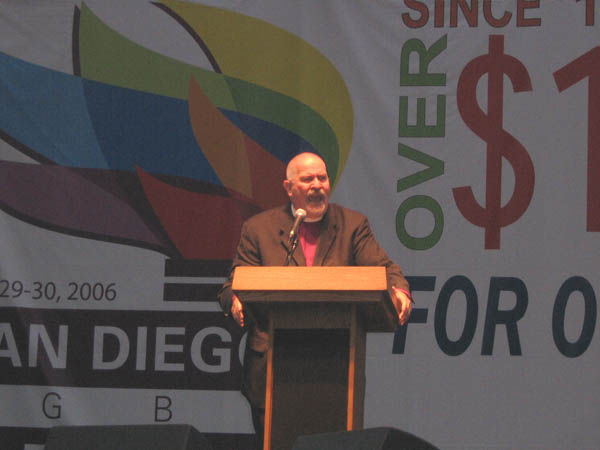
Under the slogan “Equality: No Turning Back,” San Diego’s 37th annual LGBT [Queer] Pride events kicked off with a sparsely attended “Spirit of Stonewall” rally on Friday night, July 28. Attendance at the much more popular parts of Pride weekend — the parade through Hillcrest on July 29 and the festival in the Marston Point area of Balboa Park off Sixth Avenue July 29 and 30 — was strong despite some concerns that the unseasonably overcast and humid weather might keep people away (it actually rained briefly the morning of the parade).
The Pride celebrations featured some political activism, mostly around the demand for marriage equality for same-sex couples, but it was also promoted as a major tourist attraction for San Diego, Mayor Jerry Sanders, who rode in the parade, told newscasters before the event that Pride brings in about $21 million to the city, much of it spent by Queer tourists attracted to San Diego for the event. The Friday night rally took place under a giant banner announcing that in the last 10 years Pride had raised an estimated $1 million for various Queer community organizations and causes.
The rally was hosted by Lesbian activist Laura Jean Willcock and opened with introductions of the Pride organization’s board chairs, Philip Princetta and Anne Hewett, Pride executive director Ron deHarte, board members, community notables and City Councilmembers Toni Atkins and Donna Frye. Atkins and Frye were there to present the annual proclamation from the City Council of “LGBT Pride weekend,” which hadn’t been forthcoming in 2005 even though Atkins had been the city’s interim mayor during the pride events.
The 2005 proclamation was withdrawn at the last minute following a controversy started by radical-Right activist James Hartline, a self-proclaimed “ex-Gay,” HIV-positive recovering crystal addict, who had looked up the names of all Pride’s 10,000 volunteers on a state database of registered sex offenders and found four people listed. Openly Lesbian San Diego County District Attorney Bonnie Dumanis refused to participate in the 2005 parade unless all the former sex offenders were removed from the volunteer rolls, and the Pride board decided to withdraw their application for a city proclamation.
This year, though Hartline and fellow radical-Right activists packed the final City Council meeting before the events and said that city sanction of LGBT Pride would encourage the spread of pornography, drug use and AIDS, the proclamation not only went through, it was passed unanimously. What’s more, the usual section to the side of the parade cordoned off for religious-Right protesters drew a far smaller crowd — less than 10 — than usual.
“We continue our fight for equality in the courts, legislatures and at the ballot box,” Atkins said at the rally. Citing the recent appointment of Traci Jarman to head the San Diego Fire Department, Atkins added, “Who would have thought that the city of San Diego would select a Lesbian as our new fire chief, and not only would her sexual orientation not be an issue in her selection, it was hardly mentioned except by our community.”
Atkins’ comments set the assimilationist tone for much of the rally, which featured four major speakers. First up was Rev. Troy Perry, who founded the Metropolitan Community Church (MCC) in Los Angeles in 1968 after being kicked out of the Baptist ministry for being Gay. Perry built up the MCC into an international federation of nondenominational Christian churches that became the largest Queer organization of any kind in history. Though he recently retired as pastor of the L.A. MCC, Perry showed off in his speech at the rally that his “preacher chops” are alive and well, delivering a sort of secular sermon in the familiar rising and falling cadences of Baptist preaching.
Rev. Perry recalled an attack on the MCC in Atlanta, in which there were three attempts to burn the church down. When he went to Atlanta to see what he could do to help, he found the Atlanta Journal-Constitution had editorialized on behalf of the MCC members’ right to worship as they chose. What’s more, when he went to the church, “there were 40 butch dykes from the Atlanta Lesbian Feminist Association, and they said, ‘We are here to make sure nothing happens to this church.’ Who would have thought that God would send his angels in the form of biker Lesbians?”
Another one of Rev. Perry’s anecdotes took his audience back to the early days of the AIDS epidemic, when the syndrome was still called GRID — Gay-Related Immune Deficiency — and he got his first phone call from a member of his congregation who had been diagnosed with it. In those days, he recalled, hospital staff members routinely put AIDS patients in isolation, left their food by the door of their rooms rather than entering with it, and dressed up in protective suits for fear of catching the syndrome casually.
When Rev. Perry first went to the hospital to see Dean, his sick parishoner, “he was isolated as if he’d been in a nuclear accident,” Perry recalled. They said I needed to wear a mask and hooded suit, and I said, ‘Dean doesn’t need to see me this way.’ I went in and hugged him for 15 minutes. He said he was going to die in six months and I told him, ‘Say with me: “You’re going to live with it, not die with it.”’ He told me he couldn’t get out of bed and the hospital refused to feed him. They left his food outside his door and wouldn’t bring it to him.”
Furious, Rev. Perry charged into the office of the hospital’s director and, waved in by a secretary who called him “Father Perry” — a mistake he didn’t bother to correct — “I told him, ‘I have a member of my church on the first floor and the staff won’t feed him. You don’t know much about publicity, but I’m telling you, I’m the one who can give it to you.’” According to Rev. Perry, from that time on the hospital’s attitude towards Dean turned 180°, to the point where when he was released he complained that the staff had been in his room with food trays so often — every two hours — he worried about getting fat. Dean lived four years after his initial hospitalization, and the last time he saw Rev. Perry he said, “You see, I lived with it. I didn’t die with it.”
Rev. Perry also told of his joy at the Queer community’s two big court victories in late 2003 — the U.S. Supreme Court ruling in Lawrence v. Texas declaring sodomy laws unconstitutional and the Massachusetts Supreme Court ruling ordering that state to marry same-sex couples on the same basis as opposite-sex ones — as well as the legal victory for marriage equality in Canada, in a case actually filed by a Canadian MCC. “I told everyone I was going to marry Philip” (his partner), Rev. Perry recalled — then said he’d suddenly realized that the one person he hadn’t mentioned it to was Philip himself. After a classic movie proposal with Rev. Perry literally on bended knees in front of Philip asking him to marry him, the couple went to Canada despite warnings from reporters that they still wouldn’t be legally married in the U.S. Rev. Perry’s response paraphrased the famous National Rifle Association slogan: “They will take this ring off my cold, dead hand.”
Lavender Lens publisher and Lesbian activist and historian Bixi B. Craig had the unenviable task of following Rev. Perry. Craig’s talk was a surprisingly scholarly account of the evolution of the Queer struggle for equality from the early post-Stonewall days of “Gay liberation” into what she called “a more moderate, strategically rational movement.” Parts of Craig’s talk acknowledged more radical tendencies in the current Queer movement — including younger Queers’ growing tendency to reject the idea that they are “just like everybody else” and refuse to define themselves with hard-and-fast sexual orientations or gender identities — but most of her themes described a community becoming more integrated into the social norms.
“Our movement continues into the future with a ripening mood of integration into the popular culture,” Craig said. “We have learned to understand that spirituality is an integral part of people’s lives and our opposition is not rooted in church. … Another thing we have learned is that capitalism is not a bad thing after all. It has given us spaces in which to thrive: our own bars, restaurants, hair stylists and other businesses — and it has opened certain spaces for Gay and Lesbian life.” Craig described the marriage equality issue as a battle over “property rights” and the rights of same-sex couples to “procreate and raise children with the same rights as others, including full rights to adopt and foster.”
Craig wrapped up her speech with a laundry list of assimilationist demands: “Let Gay and Bisexual men have the same right to donate blood as everyone else [homosexually active men were barred from blood donations in the early 1980’s because of AIDS concerns and the ban remains in place to this day]. Let our military men and women serve not only proudly but openly as to who they are. Let our youth be guided in houses of education and everywhere else. Give same-sex couples the same access to the legal system as everyone else, not only marriage but family court and sexual-harassment litigation. Give us security in retail establishments. … As activists, we work for full LGBT rights in society. The language has changed but the message has not. Either we are fully equal or we are not.”
The following speaker was Neil Giuliano, former mayor of Tempe, Arizona and current executive director of Gay and Lesbian Alliance Against Defamation (GLAAD), a nationwide organization which lobbies for positive depictions of Queers in the media. Giuliano said that he had come to a San Diego Pride event in 1996 and had been encouraged by the experience to come out as a Gay man. He joked that when he finally did so, early in his second term as Tempe mayor, the stories in the local papers began, “Ending years of speculation … ”.
“I really believe that the way the media portray our lives doesn’t make a bit of difference: it makes all the difference,” Giuliano said. “The visibility of our issues is greater than ever before. There is no turning back from the issues, and the way the media talk about those issues and frame those issues is very important. Public policy changes as public opinion changes. I share the frustration of activists that we haven’t won everything yet, but we have to balance the frustration with the strong successes we have had in just the last five years.”
Giuliano mentioned various issues GLAAD has been involved in, including the full-page “Marriage Matters” ads in the New York Times and other papers, which he said were actually started not by Queers but by straight allies, including the mayors of Salt Lake City and Boston. He also warned that, though polls show that young people are more sympathetic to Queer issues generally and marriage in particular than any older age group, we can’t take it for granted that they’ll stay that way.
“Our young people are being targeted by the fundamentalist religious Right,” Giuliano warned. “They’re going after them with targeted programs at high schools and colleges, and we’re creating a youth media program of our own aimed not only at LGBT but straight youth.” He also said that GLAAD is aiming another program at “people of faith and religion,” specifically at finding and highlighting the voices of “those who are in inclusive communities of faith.”
The final speaker was Juba Kalamka, African-American Gay activist and rapper with the Deep Dickollective, one of the leading groups in the so-called “homohop” movement of Queer and Queer-friendly rap. Alone of the speakers, Kalamka addressed the class issues of Queerdom as well as the racial ones, devoting most of his time to reading an intensely moving poem he wrote to the memory of Rocky Williams. Williams, a close friend and mentor of his in San Francisco, had headed the African Program of the STOP AIDS Project until his suicide July 24. According to Kalamka, Williams killed himself because he’d suffered financially, could no longer afford to pay San Francisco’s notoriously high rents, and had ended up homeless.
“This is the first time this has happened to someone who I was close to and who was as active as he was,” Kalamka explained. “I can’t leave without talking about him. Randy was not isolated in terms of lack of access to resources, but he was isolated in other ways. For me, it’s about remembering that because I don’t want to have to deal with that again.”

Israel’s Racism
by MARK GABRISH CONLAN
Copyright © 2006 by Mark Gabrish Conlan for Zenger’s Newsmagazine • All rights reserved
Once upon a time Jews were among the world’s principal victims of racism. For centuries the Jews of Europe were locked in ghettos, forbidden employment in most businesses or trades, and routinely murdered, and their property destroyed, in state-sanctioned pogroms. Vicious lies were spread about them to justify these policies, from the myth that Jews sought to have sex with non-Jews to spread STD’s to the infamous “blood libel” that Jewish rituals required the sacrifice of Christian babies. Eventually, in the 1940’s, a major world power, Germany, sought to exterminate all the Jews in the world — and, at least in Europe, they came all too close to succeeding.
But that, as the saying goes, is so-o-o-o-o 20th century. Today it is the Jews — at least the ones currently running the so-called “Jewish state” of Israel and their faithful supporters and apologists in the U.S. — who are perpetrating and facilitating these kinds of racist abuses against Israel’s Palestinian and Arab neighbors. It is Jews who are locking Arabs into virtual ghettos where they can’t sustain themselves economically, making them pass through humiliating checkpoints on a daily basis, revoking their right to work without notice, sometimes leaving their sick to die by barring ambulances from traveling to hospitals, and often — as now — physically attacking and killing them with rockets, bombs, tanks and bulldozers. They haven’t built killing centers to murder the Palestinians en masse — at least not yet — but the Jews who run Israel have done everything else to the Palestinians that the Nazis did to the Jews.
The turnabout from Jews as victims to Jews as perpetrators really began in 1895, when an international Jewish congress founded the Zionist movement to set up a Jewish-run state in historical Palestine. For 50 years, with a few exceptions (like the British government’s Balfour Declaration in 1917), the rest of the world treated Zionism as the madness it was, an arrogant attempt by one group of people to displace another group from a country the Jews hadn’t lived in for nearly 2,000 years. That changed with the end of World War II, when the victorious Allies — genuinely surprised by the scope and extent of the Holocaust and rightly feeling guilty at having done so little to stop it while it was in progress — were guilt-tripped into giving Zionist militias the “right” to conquer 78 percent of Palestine and use it to establish Israel. The formation of Israel was a perfect example of the proverbial second wrong that doesn’t make a right.
The Zionists took the land that is now Israel from its Palestinian and Arab occupants with the same no-holds-barred fury and viciousness their forebears had used in stealing the same piece of real estate from the Philistines and Canaanites 5,000 years earlier. They launched endless artillery attacks and acts of terrorism to drive the Palestinians from their homes and force them into exile, often into squalid “temporary” refugee camps where many of their descendants live to this day. Indeed, one of the leading Jewish terrorists of the late 1940’s, Menachem Begin, became prime minister of Israel 30 years later.
The 22 percent of historic Palestine that hadn’t been conquered by Jews in the late 1940’s fell to them in the Six-Day War of 1967. Israel took vast swaths of land from the Arab states it had defeated — Jordan, Syria and Egypt — and in the West Bank and Gaza (formerly parts of Jordan and Egypt, respectively), Israel launched an ambitious program of settlement-building that steadily continued under both “liberal” and “conservative” Israeli governments. Israel’s aim was the same as the Nazis’ had been: to create Lebensraum (“living space”) for the Jews to occupy permanently, driving out or exterminating the previous occupants — and, like the Nazis, the Jews justified these actions by making racist claims of superiority over the people they were displacing.
Yes, Israel later gave back some of the land they conquered in 1967 — but only when U.S. presidents like Jimmy Carter and Bill Clinton pressured them into it by reminding them that the U.S., which gives more foreign aid to Israel than any other country, essentially keeps Israel afloat economically. But until former Israeli prime minister Ariel Sharon announced his sham “withdrawal” from Gaza in 2005, they held on to all of Palestine and continued to move in Jewish settlers. The “withdrawal” from Gaza was part of Sharon’s plan to “solve” the Israeli-Palestinian crisis by annexing virtually all of the West Bank, leaving the Palestinians a non-viable rump “state” in Gaza and bits of the West Bank where few or no Jews had settled. The idea was to create a greater Israel that would still have a Jewish majority — and prevent the Palestinians from someday taking over Israel the way the Blacks took over South Africa: by demanding inclusion in the political process and voting themselves in and the Jews out.
The current crisis in Israel, Lebanon and Gaza can’t be understood except as part of Israel’s ongoing quest for domination of the entire region — and the racist prejudices that underlie it. It began in late June when a small band of terrorists affiliated with Hamas, the ruling political party in what there is of a Palestinian state, staged a minor cross-border raid into Israel, killed two soldiers and kidnapped a third. Israel’s response showed that, despite their pretense of having “withdrawn” from Gaza, they still considered themselves boss: they sent in troops, tanks and bombers, burned the headquarters of the Palestinian government and arrested its ministers.
While more rational people called Israel’s response wildly disproportionate, Israel’s apologists made clear their real racist agenda. In a column in the July 6 Los Angeles Times, Alan Kaufman said that Israel’s critics didn’t realize that, “in Israel, the loss by death or abduction of a single soldier is an utterly devastating national event.” Like New Republic publisher Martin Peretz, who had justified a previous Israeli atrocity by saying Israel needed to show the Arab world that “Jewish blood does not come cheap,” Kaufman’s statement revealed the racism at the root of Israel and the entire Zionist project. “Jewish blood,” “Jewish lives,” the justification of killing hundreds or even thousands of Palestinians or other Arabs over the death or abduction of one Jew: it’s a weirdly reversed version of the Nazis’ monstrous ideology in which the Jews have put themselves where Hitler put the so-called “Aryans” — on top as a “master race.”
As in Gaza, so in Lebanon: Israel’s attack on a country they supposedly “withdrew” from six years earlier was prompted by the kidnapping of two Jewish soldiers, and at press time had been so asymmetrical that Lebanon’s death toll was 234 — almost all of them civilians — while Israel had lost just 34 people, 19 of them active-duty servicemembers and therefore legitimate targets in Lebanon’s war of self-defense. While the U.S. media generally gave an account of these events heavily slanted in Israel’s favor (radical Israelis frequently say that their own country’s media are freer to criticize Israel’s policies than ours are), bits of the truth have leaked through — notably a CNN report that many Lebanese believe Israel’s attack on their country is the first step towards conquering it, driving out its Arab Muslim and Christian inhabitants and resettling it with Jews. What’s more, they think that once Israel conquers Lebanon they will turn north and do the same thing to Syria.
Far-fetched? Not when you realize Israel has done the exact same thing at least twice before, in 1948 and 1967. It’s become clear from Israel’s history and policies — pursued with equal fervor and determination under “liberal” Labor, “conservative” Likud and now “moderate” Kadima governments alike — that the United Nations General Assembly had it right in the 1970’s when it proclaimed that Zionism was racism. Israel’s apologists like to say that the reason the Middle East is still in crisis is because groups like Hamas and Hezbollah, and the states that sponsor them — Syria and Iran, respectively — have never reconciled themselves to Israel’s “right to exist.” Why should they? Every square inch of Israel was taken at gunpoint from its Palestinian and other Arab inhabitants — and as long as Israel continues to justify both its existence and its policies on the racist lies of Zionism, its neighbors will have every right in the world to fight to gain their land back.
by MARK GABRISH CONLAN
Copyright © 2006 by Mark Gabrish Conlan for Zenger’s Newsmagazine • All rights reserved
Once upon a time Jews were among the world’s principal victims of racism. For centuries the Jews of Europe were locked in ghettos, forbidden employment in most businesses or trades, and routinely murdered, and their property destroyed, in state-sanctioned pogroms. Vicious lies were spread about them to justify these policies, from the myth that Jews sought to have sex with non-Jews to spread STD’s to the infamous “blood libel” that Jewish rituals required the sacrifice of Christian babies. Eventually, in the 1940’s, a major world power, Germany, sought to exterminate all the Jews in the world — and, at least in Europe, they came all too close to succeeding.
But that, as the saying goes, is so-o-o-o-o 20th century. Today it is the Jews — at least the ones currently running the so-called “Jewish state” of Israel and their faithful supporters and apologists in the U.S. — who are perpetrating and facilitating these kinds of racist abuses against Israel’s Palestinian and Arab neighbors. It is Jews who are locking Arabs into virtual ghettos where they can’t sustain themselves economically, making them pass through humiliating checkpoints on a daily basis, revoking their right to work without notice, sometimes leaving their sick to die by barring ambulances from traveling to hospitals, and often — as now — physically attacking and killing them with rockets, bombs, tanks and bulldozers. They haven’t built killing centers to murder the Palestinians en masse — at least not yet — but the Jews who run Israel have done everything else to the Palestinians that the Nazis did to the Jews.
The turnabout from Jews as victims to Jews as perpetrators really began in 1895, when an international Jewish congress founded the Zionist movement to set up a Jewish-run state in historical Palestine. For 50 years, with a few exceptions (like the British government’s Balfour Declaration in 1917), the rest of the world treated Zionism as the madness it was, an arrogant attempt by one group of people to displace another group from a country the Jews hadn’t lived in for nearly 2,000 years. That changed with the end of World War II, when the victorious Allies — genuinely surprised by the scope and extent of the Holocaust and rightly feeling guilty at having done so little to stop it while it was in progress — were guilt-tripped into giving Zionist militias the “right” to conquer 78 percent of Palestine and use it to establish Israel. The formation of Israel was a perfect example of the proverbial second wrong that doesn’t make a right.
The Zionists took the land that is now Israel from its Palestinian and Arab occupants with the same no-holds-barred fury and viciousness their forebears had used in stealing the same piece of real estate from the Philistines and Canaanites 5,000 years earlier. They launched endless artillery attacks and acts of terrorism to drive the Palestinians from their homes and force them into exile, often into squalid “temporary” refugee camps where many of their descendants live to this day. Indeed, one of the leading Jewish terrorists of the late 1940’s, Menachem Begin, became prime minister of Israel 30 years later.
The 22 percent of historic Palestine that hadn’t been conquered by Jews in the late 1940’s fell to them in the Six-Day War of 1967. Israel took vast swaths of land from the Arab states it had defeated — Jordan, Syria and Egypt — and in the West Bank and Gaza (formerly parts of Jordan and Egypt, respectively), Israel launched an ambitious program of settlement-building that steadily continued under both “liberal” and “conservative” Israeli governments. Israel’s aim was the same as the Nazis’ had been: to create Lebensraum (“living space”) for the Jews to occupy permanently, driving out or exterminating the previous occupants — and, like the Nazis, the Jews justified these actions by making racist claims of superiority over the people they were displacing.
Yes, Israel later gave back some of the land they conquered in 1967 — but only when U.S. presidents like Jimmy Carter and Bill Clinton pressured them into it by reminding them that the U.S., which gives more foreign aid to Israel than any other country, essentially keeps Israel afloat economically. But until former Israeli prime minister Ariel Sharon announced his sham “withdrawal” from Gaza in 2005, they held on to all of Palestine and continued to move in Jewish settlers. The “withdrawal” from Gaza was part of Sharon’s plan to “solve” the Israeli-Palestinian crisis by annexing virtually all of the West Bank, leaving the Palestinians a non-viable rump “state” in Gaza and bits of the West Bank where few or no Jews had settled. The idea was to create a greater Israel that would still have a Jewish majority — and prevent the Palestinians from someday taking over Israel the way the Blacks took over South Africa: by demanding inclusion in the political process and voting themselves in and the Jews out.
The current crisis in Israel, Lebanon and Gaza can’t be understood except as part of Israel’s ongoing quest for domination of the entire region — and the racist prejudices that underlie it. It began in late June when a small band of terrorists affiliated with Hamas, the ruling political party in what there is of a Palestinian state, staged a minor cross-border raid into Israel, killed two soldiers and kidnapped a third. Israel’s response showed that, despite their pretense of having “withdrawn” from Gaza, they still considered themselves boss: they sent in troops, tanks and bombers, burned the headquarters of the Palestinian government and arrested its ministers.
While more rational people called Israel’s response wildly disproportionate, Israel’s apologists made clear their real racist agenda. In a column in the July 6 Los Angeles Times, Alan Kaufman said that Israel’s critics didn’t realize that, “in Israel, the loss by death or abduction of a single soldier is an utterly devastating national event.” Like New Republic publisher Martin Peretz, who had justified a previous Israeli atrocity by saying Israel needed to show the Arab world that “Jewish blood does not come cheap,” Kaufman’s statement revealed the racism at the root of Israel and the entire Zionist project. “Jewish blood,” “Jewish lives,” the justification of killing hundreds or even thousands of Palestinians or other Arabs over the death or abduction of one Jew: it’s a weirdly reversed version of the Nazis’ monstrous ideology in which the Jews have put themselves where Hitler put the so-called “Aryans” — on top as a “master race.”
As in Gaza, so in Lebanon: Israel’s attack on a country they supposedly “withdrew” from six years earlier was prompted by the kidnapping of two Jewish soldiers, and at press time had been so asymmetrical that Lebanon’s death toll was 234 — almost all of them civilians — while Israel had lost just 34 people, 19 of them active-duty servicemembers and therefore legitimate targets in Lebanon’s war of self-defense. While the U.S. media generally gave an account of these events heavily slanted in Israel’s favor (radical Israelis frequently say that their own country’s media are freer to criticize Israel’s policies than ours are), bits of the truth have leaked through — notably a CNN report that many Lebanese believe Israel’s attack on their country is the first step towards conquering it, driving out its Arab Muslim and Christian inhabitants and resettling it with Jews. What’s more, they think that once Israel conquers Lebanon they will turn north and do the same thing to Syria.
Far-fetched? Not when you realize Israel has done the exact same thing at least twice before, in 1948 and 1967. It’s become clear from Israel’s history and policies — pursued with equal fervor and determination under “liberal” Labor, “conservative” Likud and now “moderate” Kadima governments alike — that the United Nations General Assembly had it right in the 1970’s when it proclaimed that Zionism was racism. Israel’s apologists like to say that the reason the Middle East is still in crisis is because groups like Hamas and Hezbollah, and the states that sponsor them — Syria and Iran, respectively — have never reconciled themselves to Israel’s “right to exist.” Why should they? Every square inch of Israel was taken at gunpoint from its Palestinian and other Arab inhabitants — and as long as Israel continues to justify both its existence and its policies on the racist lies of Zionism, its neighbors will have every right in the world to fight to gain their land back.

World Mobilizes on Anniversary of Iran’s Execution of Gays
Small Crowd Turns Out for Anti-Iran Protest; Leftists Question Timing
by MARK GABRISH CONLAN
Copyright © 2006 by Mark Gabrish Conlan for Zenger’s Newsmagazine • All rights reserved
The turnout for San Diego’s event was small — only 10 people showed up for the protest vigil at Front and Broadway across the street from the U.S. Federal Building July 19 — but they were part of a worldwide movement that chose the first anniversary of the execution of Iranians Mahmoud Asgari and Ayaz Marhoni to mobilize against the anti-Queer laws and policies of Iran’s Islamist government. Carrying signs that included blow-ups of video frames showing Asgari and Marhoni, both 17, being hanged for having consensual sex with each other, the protesters mostly kept silent, waved their signs at passing cars and talked with journalists about why they were there.
Most of the protesters were not part of San Diego’s usual activist crowd, but ordinary citizens who’d seen and been shocked by the video of the executions of Asgari and Marhoni and remembered their initial reactions when the call for a worldwide mobilization came down a year later. A number of the participants carried placards criticizing the death penalty in general and its application to children and teenagers in particular, as well as signs calling on the government of Iran to repeal its laws that allow homosexuals to be punished by death.
The principal organizer was a young man named Michael Mussman who, asked why he had called the demonstration, said, “First of all, being a Gay man, I can sympathize with Mahmoud and Ayaz. But on a much deeper level, I feel that with everything going on in the world right now, it’s time for Gays and Lesbians to take a stand for each other around the world. It’s not just American issues, it’s not just issues here in California. There are actual human-rights issues involved with Gays and Lesbians everywhere, and especially in totalitarian nations like Iran. We who are so fortunate in the United States need to be doing more to support our brothers and sisters in those other countries.”
Surprisingly, the worldwide call for the July 19 mobilization aroused a good deal of controversy in the Left-wing press and on radical Queer e-mail lists. Opponents raised at least three major objections. First, a number of writers repeated claims made by the Iranian government after the original executions that Asgari and Marhoni were actually put to death for raping 13-year-old boys, not for having sex with each other. Second, they questioned whether Asgari and Marhoni should really be considered “Gay” in the Western sense when the Iranian cultural norms surrounding sexuality and its expression are different from the West’s.
Third, and most significantly, they questioned whether progressives should be mounting demonstrations against Iran right when the U.S. government is threatening a war on Iran, including the possibility of a nuclear attack, to force it not only to abandon any plans it might have to develop nuclear weapons but to give up its right under the Nuclear Non-Proliferation Treaty to manufacture nuclear fuel for civilian purposes. Though the official call to the action worldwide included a statement opposing foreign intervention in Iran — “regime change must come from within: by and for the Iranian people themselves,” it read — opponents like Leslie Feinberg, writing in the July 20 Workers’ World newspaper, claimed that many of the organizers supported a U.S. attack on Iraq and said that a U.S. invasion would be far worse for Iranian Queers than their current situation.
“Imperialist-instigated regime change, invasion or occupation of Iran would usher in neocolonialism — a form of enslavement that the 70-million strong Iranian population as a whole would certainly fight with the same tenacity as the people of Iraq and Afghanistan and Palestine,” Feinberg wrote. “The Pentagon is no vehicle for Gay liberation. The CIA is using anti-Gay and anti-Trans humiliation and rape — from Abu Ghraib to Guantánamo — as bedrock components of its science of torture.”
Barbara MacKenzie, medical marijuana activist and participant in many local demonstrations against the U.S. “war on terror,” joined the July 19 protest against Iran and bristled at the suggestion that the action would somehow encourage the U.S. to launch a war against Iran. “Standing up for human rights is not going to push us any further into a war with Iran,” she said. “If that excuse is used, then we should all just expose it as an excuse. I don’t think anyone is that stupid out here to really believe that George Bush would have a war over Gays’ rights. Over oil, yes.”
But one participant in the action, Iranian Kurdish émigré Dara Rizgari, said he supported a U.S. attack on Iran. Rizgari said he fled Iran 17 years ago — 10 years after the revolution that ousted the pro-U.S. Shah and installed the “Islamic republic” that has governed Iran since — because he and his friends “were being hunted. Many of my friends were cut up, hanged or shot.” Rizgari said he and his friends, who were teenagers at the time, were also afraid of being drafted to fight in the 1980-88 war between Iran and Iraq, and that he personally knew some Gay Iranians “but they never dared to say anything because they knew they would be killed.”
Rizgari said he hoped the demonstration would “make people aware that this [Iranian] government is a killer government,” and said that his family and most of his Iranian-American friends joined him in supporting a U.S. attack on Iran. “I hate war, but to be honest with you, we support that,” he said. Asked how he could back a U.S. invasion of Iran given the current situation in Iraq, Rizgari said that things had been worse for both Iraqis and Iranians when Saddam Hussein was still in power and the two countries were at war. “Saddam Hussein killed in his own hands more people every day than are killed there now,” Rizgari claimed.
Another participant, Mark Kenner, said he was inspired to join the action because he himself was Queer-bashed just a few days before the executions of Asgari and Marhoni in Iran in July 2005. “It happened in San Ysidro,” he recalled. “I was coming home in the early morning hours … [when] a young man attacked me all of a sudden. He punched me in the face [and] called me ‘fucking faggot.’” According to Kenner, he was able to restrain his attacker and call for a police officer — police routinely patrol the area near the U.S.-Mexico border — but “instead of arresting my attacker … they were very homophobic to me.” Kenner said the officer who came to the scene said that if Kenner persisted in pressing charges against the attacker, the officer would arrest him.
“I insisted that my attacker be arrested for what he did, for a hate crime, and they said, ‘If you insist, we have to arrest you, too.’ I said, ‘I’m the victim. Look at my shirt and my face. It’s full of blood.’ They arrested me, as I insisted he be arrested, and they treated me horrifically.”
Kenner said his experience encouraged him to participate in the demonstration against Iran because “it’s the same type of hatred. It’s the same type of bias. It is the same type of no existence of objectivity in a person when they look at a Gay or Lesbian. Because of either their upbringing or their personal choice of bias, or their religion, or their state law, they cannot choose objectively to do what is morally right, to not discriminate in any way against a person just because they are different.”
War Protester Carlos Arredondo Speaks in San Diego
Set Himself on Fire in Marine Van After Son Died in Iraq
by MARK GABRISH CONLAN
Copyright © 2006 by Mark Gabrish Conlan for Zenger’s Newsmagazine • All rights reserved
The over 2,500 U.S. servicemembers who have died so far in the Iraq war all had family members who mourned them, but few have been as traumatized by their grief — or have expressed it in such a physically and emotionally intense way — as Carlos Arredondo, who came to San Diego July 8 to share his story. The day Carlos learned of his son Alexander’s death, August 25, 2004, was also Carlos’s birthday, and when he saw the U.S. Marine van pull up in front of his home in the Boston suburb of Holyoke, Massachusetts, his first assumption was that Alexander had managed to get leave to come home briefly and join his dad for his birthday.
When he learned the truth — that Alexander had been killed in combat — Carlos freaked out. At first he got a hammer from his garage and tried to attack the van. Then he used his cell phone to call the recruiter who’d signed Alexander up, and the recruiter hung up on him twice. Then he took a can of gasoline and a torch from his garage and approached the Marine van, asking its occupants to leave. When they didn’t, Carlos broke into the van with a hammer, poured the gasoline all over its interior, and then used the torch to set it — and himself — on fire.
“He was burned over 26 percent of his body,” Carlos’s wife, Melida Arredondo, told the audience of over 100 at the Joyce Beers Community Center in Hillcrest June 8. “There was his face, neck, left arm, both hands and his feet. The first thing the doctors told me — they’re such optimists — was, ‘He’s never going to walk again.’” His doctors wanted to give him major skin grafts, but instead Carlos insisted on going to his son’s funeral even though he had to be carried to it on a stretcher. Carlos eventually recovered fully — though there are still burn scars on his body — and he and Melida credit the emotional impact of attending his son’s funeral, wake and mass with energizing him enough to heal spontaneously.
Today Carlos Arredondo is an anti-war activist with the Gold Star Families for Peace, an organization of opponents to the Iraq war who have lost family members to it headed by Cindy Sheehan, who made national headlines last year when she camped outside President Bush’s ranch in Crawford, Texas and demanded a direct explanation from Bush as to what was the “noble cause” for which her son Casey died. Carlos joined her at “Camp Casey” in Crawford last year and plans, if he can raise the money, to do so again this year.
Carlos Arredondo was born in Costa Rica in 1960. Two years later, his parents took him to an event that, despite his age, he remembered vividly: President Kennedy came to Costa Rica as part of his tour through Latin America to announce the Alliance for Progress. “Since that day,” Carlos said, “we have been very good in our appreciation for the American people, the way they have given us a hand, the way they have been there for us. We always look up to them, and there are still a lot of good American people. Just remember that, please.”
In 1979, Carlos decided to emigrate to the U.S. He was undocumented and the route here from Costa Rica would take him through Nicaragua in the middle of the revolution between the Sandinistas and the Somoza regime they were trying to replace, but he went anyway, crossing the border at Nogales, Arizona. Later he acquired legal residency by agreeing to testify against the coyotes — smugglers — who exploit undocumented immigrants. Melida, also a Latina but born in the U.S., is Carlos’s second wife — his first wife was the mother of Alexander and his brother Brian — and at the July 8 meeting she did much of the talking for the family because of her stronger command of English.
Once the initial wounds — physical and emotional — started to heal, Carlos Arredondo responded to his son’s death much the way local activist Fernando Suárez del Solár, North County resident and immigrant from Tijuana who lost his son in the early months of the war, did. Like Suárez, Carlos focused much of his attention on the slimy, deceitful practices used by military recruiters to ensnare young men — especially poor young men of color — into joining the service. Also like Suárez, Carlos formed a scholarship fund to raise money so people in his community will have an alternative to the military to finance their college education. (Suárez was at the meeting with the Arredondos but had to leave early due to illness.)
Carlos recalled all too well how he heard the news that Alexander had joined the Marines in the first place. “I went, ‘Oh, my God. Oh, no, Alex. Oh, no. Why did you do that?’ In 1980, when I came to America, I was in front of a TV and then suddenly they were showing this explosion in Beirut, and there were almost 270 Marines who got killed in a single bomb at the headquarters of the Marines in Beirut. I never forgot that. I never got over seeing all those Marines … and I didn’t want my son to get killed. I said, ‘Honest, I don’t want you to come home in a body bag.’ He said, ‘Dad, don’t worry. We’re not at war.’”
According to Carlos, Alex told him that the reason he’d joined the Marines was because he didn’t want his father to have to take out a second mortgage on his house to finance his college education. “The way they did this to him was by offering him a $10,000 bonus and a $50,000 scholarship,” Carlos recalled. “ My son was only 16, and they were already seducing him.”
Alex joined the Marines in 2001 and was still in basic training when the September 11 attacks occurred. According to Melida Arredondo, Alex wrote them from boot camp in 2002 and said, “‘Please send information about Iraq, Saudi Arabia, Iran, I know nothing about it, and they keep talking about it here at Parris Island.’ Keep in mind, this is August of 2002. No war has been declared, yet they’re talking about it at Parris Island.”
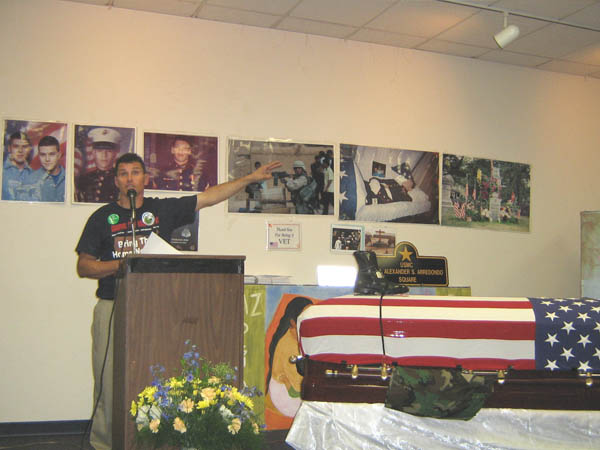
Carlos and Melida Arredondo spoke at the Joyce Beers Center against a backdrop of various photos and props with which they travel the country to build opposition to the war and awareness of its toll in human life. The main item is a full-size coffin with two boots mounted on top. There is also a set of blow-ups of photos from Alex’s life, ranging from childhood pictures of Alex with his brother Brian — who, much to Carlos’s horror, has also enlisted in the Marines — to a picture of Alex’s body in an open casket.
“I’m very lucky, in a way, that [my son] had an open casket,” Carlos explained. “This is a picture most other Gold Star Families members cannot have, because their sons and daughters died in explosions and a lot of these families cannot bear to see those pictures. But a lot of the families I’ve met before, when they see [Alex’s] picture, they pretty much take it personally. They’re seeing their sons’ and daughters’ faces, and they are very grateful for seeing that picture.”
Carlos’s personal priorities these days are to tour the country with his story and his display, get it seen by as many people as possible — including Marines at bases like Camp Pendleton — challenge the lies told by military recruiters and raise money for the scholarship fund. He’s also got another goal: to become a U.S. citizen. Paul Vauchelet, one of the organizers of the event at the Joyce Beers Center, asked people in attendance to write letters to Congress asking that they push for Carlos to be granted citizenship. He’s already got Massachusetts Senator Edward Kennedy on board, but he needs more support. Still, he’s grateful for the public reaction he’s received already — which he credits with keeping him from being prosecuted and imprisoned for burning the Marine van.
“I thought I would end up in one of those places for being an immigrant, for doing this to the government,” Carlos said.” Years ago they used to kill people for doing that, or put them in the war, or shoot them. I knew that. I saw a lot of movies, and I thought that was what would happen to me. I was worried that perhaps I was going to be in one of those foreign zoos, you know? But thank God, you know, what happened here is that a lot of the American people stood up for me, made a lot of phone calls, sent a lot of e-mails to the police station in Holyoke, to the politicos in Holyoke, and they didn’t allow this. And this didn’t happen because a lot of people stood up to help me. That’s why I’m free today, because a lot of people stood up.”

Nonviolent Peaceforce Representative Speaks in San Diego
Group Trains Peacemakers, Brings Locals Together to Solve Problems
by MARK GABRISH CONLAN
Copyright © 2006 by Mark Gabrish Conlan for Zenger’s Newsmagazine • All rights reserved
Linda Dunn is a short, quiet-seeming woman who’s old enough that when she spoke at the First Unitarian-Universalist Church in Hillcrest July 20 she introduced her husband Mike and said they’d been together 48 years. But, in addition to serving with the Quaker church in Riverside, where the Dunns live, she’s also on the cutting edge of a new approach to peacemaking. She’s part of an organization called Nonviolent Peaceforce [sic] whose goal is to train 500 paid, professional peacemakers for service throughout the world by 2008 — and last summer she and her daughter Diane went to Sri Lanka, Nonviolent Peaceforce’s first target country, to be a part of the effort.
Dunn led an elaborate presentation at the church that included a 12-minute video on the group, a PowerPoint slide show on its efforts in Sri Lanka and introductions to seven local activists involved with the Nonviolent Peaceforce chapter in San Diego. She described the mission of Nonviolent Peaceforce as to protect human rights, deter violence and, instead of taking the place of local individuals and organizations, to work with them and create space for them to do their jobs and stay alive.
Though Sri Lanka’s situation is virtually unknown in the U.S. — as are most of the world’s conflicts in which this country is not directly involved, Dunn rather glumly stated — it has one of the most intractable political situations in the world. The majority of Sri Lankans are Sinhalese Buddhists, but about 20 percent of the people are Tamils, most of them Hindus and many of whose families were brought to the island to work on tea plantations when the place was still called Ceylon and ruled by Britain. In addition, there’s a significant Muslim community and some Christians and believers in other religions.
Much of the conflict comes from the Liberation Tigers of Tamil Army, colloquially known as the “Tamil Tigers,” with a reputation for brutality and recruiting children at festivals. According to Dunn, the average age of a Tamil Tiger is 16 and many of them are 12 or even younger. The Sinhalese and Tamil languages are so different they’re even written with separate alphabets, Dunn explained — and many of the slides she showed featured signs written in three separate tongues, Sinhalese, Tamil and English, with three different alphabets.
Sri Lanka has had to deal with civil war for about 20 years — and as if that weren’t bad enough, the 2004 tsunami did enormous damage to the country and its infrastructure. While much of the reporting on the tsunami told a silver-lining story of Sinhalese and Tamils coming together to help treat the injured and clean up the damage, Dunn said that effect was short-lived and “there has been trouble since.”
According to the United Nations organization UNICEF, the Tamil Tigers recruited 700 children in 2003 alone. Dunn’s slide had the word “recruited” in quotes — which made it look that the children were actually being kidnapped — but Dunn added that this wasn’t entirely true. She said many of their parents shared the nationalistic goals of the Tigers and acknowledged that one of their responsibilities to the movement was to furnish one of their kids to join the Tamil armed forces. But whether the children are taken with the approval of their parents or not, Dunn stressed, it still destroys their lives.
“When children are taken from their families, they lose their hope, innocence and chance for life,” Dunn explained. “The women, if released, have a much harder time being re-integrated into society than the men. Sri Lankan women have very long hair, and the first thing that happens to them in the army is they cut their hair.” Therefore, she added, any short-haired woman in a Tamil community will become an outcast and be unable to marry or have any role in her village again.
Dunn’s team were suddenly confronted with this volatile issue when 26 children were recruited from the grounds of a Hindu temple during a religious festival in 2005.”The field team members actually did help get those 26 children returned and re-integrated into society,” Dunn said. “We were the only NGO [non-governmental organization] invited to the meeting because we were the only one without our own agenda. What they [local activists] do is at great personal risk in this culture of silence.”
Another example Dunn gave for how Nonviolent Peaceforce works took place in the largely Hindu town of Trincomolee. “The Sinhalese Auto Drivers’ Association put up a large statue of Buddha in the middle of the Hindu area,” she recalled. The resulting riots, with “a lot of grenades being thrown,” took at least one life and destroyed many homes. “Nonviolent Peaceforce teams were well known enough to patrol the streets at night and engage the appropriate authorities and community leaders,” Dunn recalled.
The solution was finally brokered by a Buddhist monk who agreed to come to Trincomolee and mediate — but who needed the protection of her group’s field team to make it through Tamil territory and get to the village in the first place. The monk turned out to be the biggest loser in the confrontation; when his superiors in the order found out he’d been involved in negotiations with Tamils, “he was demoted and assigned to a spot in the middle of nowhere, where we fear for his safety,” Dunn said.
Nonviolent Peaceforce was originally founded in 1999 by two veteran activists, Dick Hartsough and Mel Duncan. “I’ve known Dick for about 35 years,” Dunn said. “I remember him telling of how he first got involved in the civil rights movement as a white student in a primarily Black college. He was involved in a sit-in when the white resistance was growing in numbers and in viciousness. After a while, a few determined men came in to the diner where he was involved in the sit-in, and one man raised a knife behind him and said, ‘I’m going to kill you.’ Dick said, ‘Do what you must, but know that whatever you do, I will love you.’ The man’s hand began to shake, the knife began to shake, and it dropped to the floor.”
The group came about when Duncan and Hartsough, who’d independently thought of the idea for it, met at a conference of peace activists in the Hague. Duncan went from meeting to meeting at the conference and was unable to get anyone to give him a chance to speak and outline the concept. “His wife said, ‘Maybe you’re not meant to talk. Maybe you’re meant to listen,’” Dunn said. “Then he heard Dick speak and describe the same vision he had — and they’ve been working together ever since.”
One of the goals of Nonviolent Peaceforce is to make its teams “as geographically, ethnically and religiously diverse” as possible, Dunn explained. “It’s important for the people [in the host country] to see people of various races and religions living and working together.” Dunn said that of the 177 recruits worldwide since December 28, 2005, 45 have been women, 132 men, and most have come from Africa (70, including five Arabs), Europe (39) and Asia (33). Relatively few have come from North America, she explained, because “North American applicants often don’t have the language skills.”
According to Dunn, Nonviolent Peaceforce hopes to start operating in a second country by the end of this year. “Areas under consideration include Mindanao in the Philippines, northern Uganda and southern Sudan, and Colombia,” she said. “We’re working to recruit and train 150 people and have 500 people by the end of 2008. There are trainers being trained to work at four sites worldwide. One of our big problems is getting people visas since the U.S. doesn’t want to let some of our people in.” Dunn said that the cost of this program is $1.8 million per year — about what it costs to run the U.S. military for two minutes.
For more information on Nonviolent Peaceforce, or to make a donation, visit their Web site at http://www.nonviolentpeaceforce.org
Subscribe to:
Posts (Atom)