Why Vote, and Who For?
November 7 Election Endorsements
by MARK GABRISH CONLAN, Editor
Copyright © 2006 by Mark Gabrish Conlan for Zenger’s Newsmagazine • All rights reserved
Perhaps the first question to consider in this space just before an election is why bother to vote at all. Many people on the Left I respect are against voting on principle, and their objections have some merit. As the late political scientist Hans Morgenthau wrote in The New Republic in 1974, elections under capitalism will always avoid the real issues of power and wealth distribution in a country simply because “there are some issues on which the ruling class will not let itself be outvoted.” All too many citizens have reached the same conclusion, coming to the idea that since the electoral system can’t or won’t address the issues of importance to them — particularly access to decent employment and health care in an era in which the capitalist class worldwide is determined to end all this nonsense about liberal “reform” and reduce the world’s workers to subsistence and the poor to penury and desperate want — it’s not worth participating in.
But elections do matter. As the anti-war movement learned in early 2003 when it mobilized the largest numbers ever to participate in demonstrations over a single issue (the U.S. attack on Iraq) on a single day and the war happened anyway, street actions don’t succeed unless the politicians who actually make the decisions are receptive to the message of the street activists — or at least are scared that the passions of the street activists threaten their own continuation in office. If we decide not to vote as a matter of “principle,” we give up our one power actually to get back at the politicians who don’t do what we want them to do.
It’s true that in any class system politicians “govern” within a narrow band of alternatives dictated in advance by the ruling class, but even within that band there are real advantages to having one capitalist party in power rather than another. Neither the Republicans nor the Democrats are likely to address the underlying problems of capitalism in the U.S., but the Democrats are more likely to raise the minimum wage, appoint National Labor Relations Board members who will make it easier for unions to organize, expand access to health care, take global warming and other environmental problems seriously, protect the civil rights of people of color, women and Queers, get us out of Iraq and curb the foreign-policy adventurism and civil-liberties and due-process abuses of the Bush administration.
Not that they’re going to do that without prodding. If many direct-action activists make the mistake of assuming that because elections can’t address the real contradictions of capitalism they don’t matter at all, many electoral activists make the opposite mistake: the idea that merely electing candidates sympathetic to our issues is enough for reform. They’re wrong, and the generally disappointing record of Bill Clinton on progressive issues proves it. Even if the Democrats take control of both houses of Congress in 2006 and elect a President in 2008, that’s not going to solve all our problems. We’ll still need to be in the streets, pressing the Democrats as hard or harder than we have the Republicans, mobilizing support to get them to do the right thing and avoid being sucked into the go-along-to-get-along influences they’ll be under from major campaign donors and corporate interests to screw us over.
As a long-time Leftist, it’s been frustrating to me to see electoral and direct-action activists treat each other as enemies. The simple fact is that to get anywhere as a movement, we need to do both: we need to mobilize around elections in order to get the best people in office we can and we need to stay in the streets at all times to make sure the best people we can get in office actually do the right thing. So if your thing is marching in the streets, getting in people’s faces with chants and leaflets and generally raising a ruckus, do that; just don’t put down the people who’d rather precinct-walk and phone-bank for an electoral candidate or party. And if you’re more comfortable doing campaign work, go ahead; just don’t put down the street activists whose help you’re going to need to hold the people you’ve helped elect accountable.
So with that, here are the Zenger’s election endorsements for November 7, 2006:
Governor: PETER CAMEJO
U.S. Senate: TODD CHRETIEN
Let’s be real here. It’s a foregone conclusion that center-Right Democrat Dianne Feinstein is going to sail to re-election as California’s senior U.S. Senator — and, alas, it’s equally obvious that Arnold Schwarzenegger is going to win a full term as Governor by a double-digit margin. Indeed, after his hard-fought primary win against Steve Westly, Democratic gubernatorial nominee Phil Angelides’ campaign has melted down so thoroughly it’s reminded me of Mort Sahl’s joke about the “McGovern juggernaut” that came to the 1972 Democratic convention in Miami, won him the nomination — and then seemingly disappeared as McGovern lost to Richard Nixon in the most lopsided defeat of a major-party Presidential nominee to that time. (“Some of those people must still be down there!” Sahl said almost a year later.)
So if there’s ever a time and a place to cast a protest vote, these races are it. With nods to the San Diegans who are running for both offices — Janice Jordan for Governor as the Peace and Freedom nominee and Kent Mesplay, who lost the Green Party primary to Chretien but is running as a write-in on the theory that a southern Californian can mobilize more votes for the Greens in southern California than a northerner like Chretien — progressive voters should stick to the Green nominees in both races and send a message to center-Right Democrats and Republicans alike that we’re out here and we demand to be heard.
Lieutenant Governor: JOHN GARAMENDI
Secretary of State: DEBRA BOWEN
Attorney General: JERRY BROWN
Treasurer: BILL LOCKYER
Controller: JOHN CHIANG
Insurance Commissioner: CRUZ BUSTAMANTE
Though we’re endorsing Greens at the top of the statewide ticket, for the remaining state offices Zenger’s is recommending the Democratic Party slate. John Garamendi is a proven progressive with a strong pro-consumer record as insurance commissioner and also one of the most stalwart pro-environment stands of anyone in elective officer in California. Debra Bowen, unlike the Republican incumbent, has a properly skeptical attitude towards electronic voting machines and will be a champion of electoral integrity. Jerry Brown will be an aggressive attorney general who will see the job as more than just the state’s chief prosecutor. Though the other Democratic nominees for statewide office (aside from Lockyer, who’s been a good attorney general in an office from which he’s been forced out by term limits) don’t have records as distinguished as Garamendi’s, Bowen’s or Brown’s, and it’s unlikely that Bustamante will be as aggressive a regulator of insurance companies as Garamendi has been, they are still preferable to their Republican opposite numbers.
Congress and State Legislature: ANY DEMOCRAT
However blurry the differences between the Democrats and Republicans sometimes seem, they are real. It’s not so much that the Democrats are perfect (they’re not) as that the Republicans are far worse. The important thing in these races is to put the Democrats in the majority in Congress and keep them in control of the California legislature.
Superior Court Judge, Office 36: ROD SHELTON
Community College Board: MARIA SENOUR, RICK GROSCH, PETER ZSCHIESCHE
San Diego Unified School District Board: KATHERINE NAKAMURA, JOHN DeBECK
I think the framers of the U.S. Constitution got it right where judges are concerned: keep them off the ballot, appoint them for life (unless they screw up grossly, in which case they can be impeached) and thereby insulate them from political pressures and allow them to do their job: to enforce the law and protect the rights of minorities under the Constitution. Unfortunately, that’s not how most of the states do it. California actually has one of the stronger state constitutions when it comes to protecting judicial integrity, but local judges still have to run in competitive elections hamstrung by the clash between the necessity of campaigning and the canons of the legal profession, which severely restrict what they can and cannot tell voters about themselves.
Rod Shelton deserves our endorsement not only for his own qualities but because his opponent, Larry Kincaid, has tried to politicize the campaign in ways that themselves call his ability to serve impartially into question. Kincaid wrote letters to County Supervisors Ron Roberts, Pam Slater and Greg Cox saying they should support him because they and he are all Republicans and Shelton is a Democrat. Kincaid also falsely stated that he led in the primary election (he didn’t) and that Shelton was a “liberal Democrat” who belonged to the American Civil Liberties Union (he doesn’t).
We’re also endorsing all the incumbents in the San Diego Unified School District and Community College District races. The departure of the controversial Alan Bersin as San Diego Unified superintendent has eased the political conflicts that previously roiled the district. Some of the incumbents, like John DeBeck and Peter Zschiesche, are people we’ve long supported; others, like Katherine Nakamura, are people we’ve questioned in the past but they’re still better than their opponents this time.
STATE PROPOSITIONS
Proposition 1A (Transportation Funding): NO
Proposition 1B (Highway Bonds): NO
Proposition 1C (Affordable Housing Bonds): YES
Proposition 1D (School Facilities Bonds): NO
Proposition 1E (Disaster Preparedness/Flood Prevention Bonds): YES
Remember those old Star Trek episodes in which the Enterprise crew had to defeat a super-powerful computer and did so by throwing such illogical statements at it until it blew itself up out of sheer frustration and confusion? That’s what trying to come to a rational decision on this massive package of state borrowing proposed by Governor Schwarzenegger and signed onto by the Democratic state legislature is like. Aside from Proposition 1A — which puts new restrictions on the state’s ability to spend the tax on gasoline, and is yet another example of the dangerous ballot-box budgeting that has hamstrung state government generally — the bond measures 1B through 1E have two main problems.
First, because of the interest charges on government bonds over their long maturities (usually 30 years), paying for anything with a bond issue generally costs twice as much as it does to finance it on a pay-as-you-go basis. Second, in a practice Schwarzenegger pledged to stop in his initial campaign to replace Gray Davis in the 2003 recall and instead has pushed to the max, California is already massively in debt, doing the governmental equivalent of using one credit card to pay another as it borrows again and again just to keep the state government running. Schwarzenegger is running for re-election largely on the boast that he’s avoided a tax increase — but the longer the state goes without facing the fact that it can’t provide all the services its residents want on the taxes those residents have so far been willing to pay, the harsher and more severe the inevitable tax increase will be when it finally comes.
So we’re splitting the vote on the bond measures, endorsing 1C and 1E partly because they’re the most narrowly focused on specific state problems and partly because they’re the cheapest: face values of $2.85 billion for 1C and $4.09 billion for 1E compared to nearly $20 billion for 1B (virtually all of it for more freeways and streets; the pittances for public transportation were put in by demand from Democratic legislators) and $10.4 billion for 1D.
Proposition 83 (Restrictions on Sex Offenders): NO!
Proposition 84 (Water Bonds): YES
Proposition 85 (Abortion; Parental Notification): NO!
Proposition 86 (Tobacco Tax to Fund Health Care): YES
Proposition 87 (Tax on Oil Producers to Fund Alternative Energy): YES
Proposition 88 ($50/Parcel Property Tax to Fund Education): YES
Proposition 89 (Clean Elections; Publicly Financed Campaigns): YES!
Proposition 90 (“Regulatory Takings” Initiative): NO
Proposition 83 is a draconian and utterly unnecessary attempt to wreak vengeance on people already convicted of sex crimes who have completed their sentences. It adds further restrictions on where they can live — which, as some analysts have said, could actually make them more dangerous by driving them out of big cities and into rural areas where therapy and support services to keep them from re-offending don’t exist — and, worse, requires that every Californian ever convicted of a sex crime (including Gay and Lesbian people who pled guilty under California’s sodomy laws until they were repealed in 1975) wear a GPS tracker that will allow government to monitor their movements for the rest of their lives. Proposition 83 isn’t about punishing these people for the crimes they have committed; it’s about punishing people for crimes they may or may not commit in the future — which is utterly repugnant to any reasonable concept of justice. What’s more, implementing and monitoring all those GPS devices will cost nearly $1 billion -— money that can better be spent on police resources to catch, try and convict people who are actually committing crimes in the here and now.
Proposition 84 is a water-quality bond measure similar to 1C and 1E: a limited focus and a relatively small price tag ($5.4 billion face value).
Proposition 85 is one of those bad ideas that refuses to die — thanks largely to the cash resources of San Diego Reader publisher Jim Holman, the principal financial backer both of this and of the previous attempt to pass it, Proposition 73 on the November 2005 ballot. Though 85 eliminates the most obnoxious feature of 73 — its attempt to write a statement into the California constitution that life begins from the moment of conception, which would have automatically abolished legal abortion in California if the Supreme Court ever overturned Roe v. Wade — the rest of it is sufficiently identical that the points we made in our endorsement against 73 still go on 85:
“The problem with parental notification requirements is it’s precisely the parents who are most sexually conservative themselves, the ones likely to be judgmental and condemnatory towards sexually active children, who are most likely to raise their daughters (and sons) in a sexually naïve manner that will make them more likely, not less, either to contract or to cause an unwanted pregnancy. Parents sufficiently in touch with their own sexuality to accept their children’s inevitable maturation into sexual beings don’t need parental notification laws because their children almost certainly will have talked to them on their own. Indeed, sexually aware parents are less likely to have daughters who need abortions because either they’ve worked with their kids to counter the peer pressure on them to have sex or, if their children are going to have sex, they’ve educated and supplied them with birth control. … Under parental notification laws, teenagers will either resort to dangerous illegal abortions or ruin their lives bearing children who will be burdens on society. The one thing most of them won’t stop doing is having sex.”
Propositions 86 and 87 have become textbook examples of the kinds of campaigns giant corporations wage against initiatives which attempt to hold them to account for the damage their products cause society. The tobacco and oil companies have both hid behind nice-sounding organizational names — though if you wait to the ends of the TV ads where they legally have to announce who funded them you’ll hear familiar names like Philip Morris and Chevron — and they’ve tried to confuse the issues as much as possible, even (in the case of the opponents of 86) inventing a giant conspiracy on the part of hospital bureaucrats to fatten their own treasuries on the taxes paid by smokers. Nonsense: 86 and 87 are simple, reasonable measures that address major social problems and attempt to hold corporations accountable for the individual and social harm they cause. Vote for both and don’t fall for the corporate hype.
While we’re concerned about the regressivity of Proposition 88 — the fact that the additional property tax it charges to finance education is on a $50 per parcel basis rather than as a percentage of assessed valuation (though under California’s warped Proposition 13 definition of “assessed valuation” that would produce its own set of inequities) — for the most part this seems like a reasonable initiative and an better alternative than the massive borrowing for school construction and repair Proposition 1D would authorize.
Proposition 89 may be the most important initiative on the 2006 ballot in the long term. It would allow candidates for public office in California to opt for the so-called “clean money” system already in place in Maine and Arizona. This way, a candidate who either can’t or doesn’t want to fund his or her campaign with massive donations from wealthy individuals and (where it’s legal for them to contribute) corporations has an alternative: get enough people to sign a nominating petition and cough up a nominal sum (usually $5) to demonstrate public support, and then everything else they need to run a competitive campaign is paid for by the public — in 89’s case, specifically by the corporations that have been the main beneficiaries of California’s pay-to-play politics. An enthusiastic yes on this one …
… and a reluctant no on Proposition 90. This is one of 12 measures on various state ballots sponsored by New York real-estate developer Howard Rich and his organization, Americans for Limited Government. Its ostensible purpose is to rein in the vast and unjust expansion in the government’s power of eminent domain — their ability to force you to sell your property for a “public purpose” — allowed by the U.S. Supreme Court last year in the Kelo decision. Originally government could only take private property for genuine public purposes — to build a road, a school, a hospital, a park. Then big developers and politicians beholden to them invented “redevelopment,” a sort of law that said that as long as they could first declare that a particular community was “blighted,” government could take private property from one set of owners and give it to another to build bigger, splashier businesses and housing developments that would eliminate the “blight” (translation: drive out poor and working-class people and bring in middle-class and upper-class people) and increase the tax revenues generated by the property.
It got worse when creative legislators and developers invented “tax-increment financing,” which meant that once you seized people’s property and “redeveloped” it, the increase in property taxes generated by the new development didn’t go back into the community’s general fund. Instead it went into the coffers of the redevelopment agency, thus giving agencies like San Diego’s Centre City Development Corporation (CCDC) the incentive to look for other “blighted” areas of the city and “redevelop” those as well. Originally founded to rehabilitate the Gaslamp Quarter in 1975, CCDC has become a bloated monster sucking tax-increment revenues while the city starves and heads for bankruptcy. Kelo made the situation even worse by removing the requirement that redevelopers first had to certify an area as “blighted” before they could use the power of government to take it away from its owners.
So why is a New York real-estate developer financing a nationwide campaign supposedly aimed at reining in the excesses of real-estate developers? Because of what else he sneaked into Proposition 90 and its 11 clones in other states: a doctrine called “regulatory takings” that says that if government makes any decision at all that affects your ability to profit from land you own, they have to compensate you not only for the fair-market value of your land as it stands but also for any potential profits you might have been able to make if they hadn’t regulated. In practice, this would virtually destroy environmental regulation, zoning laws and all other brakes on the power of big businesses and wealthy individuals to do whatever they like no matter what the effect on the overall common good.
Veteran environmental activist Al Meyerhoff put it best when, in an anti-90 op-ed he wrote for the September 29 Los Angeles Times, he wrote, “There will be no open and honest debate on the two very different visions raised by Proposition 90. Under one vision, we are all in this together, agreeing to use, enjoy and preserve California’s magnificent natural resources as a public trust — a concept of the ‘commons’ grounded in Roman law. We enter into this social contract because, as President Kennedy once told us, ‘in the final analysis … we all inhabit this small planet. We all breathe the same air. We all cherish our children’s future. We all are mortal.’ Under the other vision, we are each in this alone, free to exploit resources for profit or personal use — or be paid by the California taxpayer not to do so.”
LOCAL PROPOSITIONS
Proposition A (Advisory Vote on Miramar Airport): NO
Proposition B (Voter Approval of City Pensions): YES
Proposition C (Privatization of City Services): NO
Proposition N (Community College Bonds): YES
Fifteen years ago, the last time San Diego voters had a chance to consider locating a new airport at Miramar, it would have been a good idea. The Navy was planning to close down its fabled “Top Gun” air station and the surrounding area was still relatively undeveloped. Today the Marines are firmly ensconced on the base, the build-out around Miramar has made it almost as dangerous an airport location as Lindbergh Field, UCSD students complain that they already have trouble hearing their teachers or doing their homework during Marine fly-bys and a civilian airport would be even worse, and Orange County had to abandon their own attempt to convert El Toro naval base into an airport because of all the toxic waste the military left behind. It doesn’t matter how this vote goes, anyway, because it’s only “advisory” and there’s no way Miramar is ever going to be a civilian airport because the military ain’t leavin’.
San Diego Mayor Jerry Sanders is pushing Propositions B and C as a package, as his proposed solution to the city’s pension crisis. Proposition B would require future increases in city workers’ pensions to be approved by the voters. In 1985, after the San Diego City Council had shown itself to be dangerously irresponsible in approving rampant development in the city’s future urbanizing area, we took that power away from them and gave it back to ourselves through the ballot box. It seems eminently reasonable to do the same now that the Council has shown equal irresponsibility in approving pensions the city can’t pay for.
Proposition C is another matter entirely, a siren’s song prepared for by decades of Right-wing propaganda extolling the supposedly miraculous “efficiency” of private companies as compared to the alleged slovenliness and uncoolness of public agencies. Proposition C would allow private contractors to bid on existing city services, replacing city agencies. It’s been tried in other cities and the results have been disastrous — most notoriously in Atlanta, which hired a private company to take over the city’s water system and then found the pipes dispensing a dirty brown fluid instead of the clear liquid Atlanta’s public water department had formerly provided.
Private companies who seek contracts under measures like Proposition C generally promise to deliver services at lower costs to city taxpayers. Since they also have to make a profit — their whole reason for existence — there are only two ways they can squeeze enough money out of the operation to charge the city less than it was paying its own people and still make money. One is to reduce the quality of the service; the other is to slash the pay of the workers.
Usually, when cities privatize services, most of the same people who worked for the city agency end up doing the same work for the private company — only they do it for dramatically lower wages, fewer (or no) benefits and no pensions. Indeed, Mayor Sanders’ advocacy of Proposition C suggests that this is his long-term solution to the city’s pension crisis: privatize everything, get rid of the pensions the city had promised its workers (promises that wouldn’t be binding on their new “private” employer) and thereby get out of the unfundable pension obligations while the workers are left either with inadequate 401(k) plans or no retirement benefits at all.
Finally, Proposition N is a local bond issue to build and rehabilitate community college facilities. It shares with the other bond issues we are endorsing a relatively low price tag and a narrow focus on genuine and immediate community needs.
Friday, October 27, 2006

Local Volunteer Speaks on Katrina Cleanup
Volunteers Came Through When Government Didn’t, Brown Says
by MARK GABRISH CONLAN
Copyright © 2006 by Mark Gabrish Conlan for Zenger’s Newsmagazine • All rights reserved
For Jim Brown, his two stints as a volunteer in the effort to clean up New Orleans and the Gulf Coast after Hurricane Katrina wound from Encinitas, where he lives, through Dallas and Crawford, Texas. Brown attended the 2005 Veterans for Peace (VFP) convention in Dallas and there met a woman the world would soon come to know: Cindy Sheehan. “She showed up and said, ‘I’m tired of talking, writing and sitting down,’” Brown recalled. “’I’m going to take that Bush guy face-to-face. I’m going to Crawford, Texas tomorrow. Is there anyone who wants to join me?’”
About 50 people from the VFP, including Brown, took her up on her suggestion. They joined about 50 other anti-war activists in Crawford — and were watched over by “200 policemen, Secret Service officers, and media,” Brown said. Told by the local police and sheriff’s deputies that they couldn’t be any closer to the Presidential compound than a ditch 200 feet away, Brown started asking the local authorities why not. “I asked, ‘Is that why you signed up to be a sheriff’s deputy, to ride heard on a bunch of old veterans in a ditch?’”
Sheehan’s installation on the outside of Bush’s ranch in Crawford, dubbed “Camp Casey” after her late son — whose death in combat in Iraq had been the impetus for Sheehan’s whole effort — grew until by the end of her two-month stay, “There was a huge amount of gear on three trucks, including wireless transmission for phones and computers, as well as a large supply of food, water and medical supplies,” Brown recalled. As Camp Casey wound down there was a major debate about what to do with all this stuff, almost all of which had been donated from across the country. At first the consensus was leaning towards sending it all to Washington, D.C., where Sheehan was planning to lead another camp-out action against the war. Then, at the end of August 2005, Hurricane Katrina struck New Orleans — and the plans quickly changed.
“A lot of people there lived in New Orleans or on the Gulf Coast,” Brown recalled. “They said, ‘Cindy, you go to D.C. We have to go to New Orleans.” Going there wasn’t easy — Highway 10, the main thoroughfare in and out, was blocked, and the Federal Emergency Management Agency (FEMA) had men with guns stationed on all the entrances to the city stating that no one would be allowed in or out. But the Veterans for Peace found a working entrance to the city — Pontchartrain Highway, ironically the circumference road around the lake whose flooding had created the waves that destroyed so much of New Orleans — and got past the FEMA guards because one of the VFP volunteers had a contractor’s license.
They showed up on the doorstep of Malik, an African-American activist and former Black Panther who headed up an organization called Common Ground. “We showed up on his doorstep with medical equipment, food and water,” Brown recalled. “It was all grass-roots organizations the first few days. The Red Cross and FEMA weren’t there.” Brown said that even the major TV networks were being kept outside the city for the first few days, but because they had all the high-tech communications equipment left over from Camp Casey, “We could get news out.” Filmmaker Michael Moore heard about the crisis and raised $1 million for the effort, and other donors started contributing as well.
Brown wasn’t part of the initial VFP crew of volunteers in New Orleans. He was sent for later, and for an interesting reason: he makes his living as a roofing contractor in Encinitas, and as part of his job he had taken a California-certified course on how to remove mold from a home. With many of the homes in New Orleans totally or partially flooded, so that even when the waters receded they were wet, mold was one of the biggest cleanup problems they faced — and one of the most serious health hazards. Among the things Brown had learned in that course was that about 10 percent of the population, mostly people with asthma and other respiratory conditions, get sick around mold — and 1 percent of the population gets so sick they fall over.
“VFP put the call out on the Internet, and thousands of people came forward and went to New Orleans to help,” Brown recalled. “They wondered who could tell them what to do, and one of them remembered hearing me speak in Crawford and remembered I was a mold guy. They paid my way down and I said, ‘I’m not going unless you show me everything.’” According to Brown, “In California your average mold-removal job has hundreds of mold spores in a house. Here you had hundreds of thousands, and occasionally even a million.”
Brown showed about an hour’s worth of slides from the times he spent in New Orleans — a stint in November 2005 and another in March 2006 — and much of his talk was about the wide gap between the enthusiasm of the volunteers and their lack of training and proper safety equipment. If you’re doing something as tricky and potentially hazardous as mold removal — not only to yourself but to everyone else around you — you’re supposed to be dressed in a full Haz-Mat suit and a respirator mask. Many of the volunteers — including Brown’s own son — didn’t realize the importance of proper protection and went to work in street clothes and either no protection at all or just a plain cotton mask, which doesn’t keep out bacteria or mold spores.
One family in particular, an African-American couple to whom Brown gave the pseudonym “Mr. and Mrs. J. J. Jones,” especially moved him. “This family’s house filled up with mold 10 feet high,” he recalled. “They had just paid off their mortgage and had a mortgage-burning party — and Katrina hit two days later and the insurance company did not pay them anything. If you didn’t have flood insurance, they didn’t pay you for the flood damage. If your roof came off, they wouldn’t fix it. If you think insurance will pay you off in a big disaster in southern California, you’ve got another think coming.”
Without any insurance money or other help, the Joneses determined to fix and clean their house themselves. “He didn’t have a pension or a savings account, just his home,” Brown recalled. “His wife said, ‘I’ve been to the hospital twice. It feels like there’s a hand in my chest,’ She’d had respiratory problems before and I couldn’t bear to see her suffer from the mold in the house.” Jones had tried to fix up the house as best he could and had had his wife stay in the cleanest room available in it — but she’d still got sicker and sicker, Brown explained.
Help finally arrived in the form of a FEMA trailer, Brown said. Mrs. Jones was able to move into one and live in a clean environment while her husband continued to work on their house and finally got it clean enough to live in. “I came back a few months later, the house was fully fixed up and she survived,” Brown said, “but she wouldn’t have if she’d had to continue staying in that house.” Brown said he expects many New Orleanians to have long-term health problems similar to those faced by the New York City cleanup crews sent into the World Trade Center site after 9/11, who also entered an environment full of toxins and weren’t given proper protective gear or even warned about the potential dangers.
Brown said that contrary to the popular belief elsewhere in the country, which was that the Black parts of New Orleans flooded while the white parts stayed dry, “Eighty percent of New Orleans was under water, and it wasn’t just the poor places. It was about half Black and half white. The difference was the whites had assets. They had money, they had other places to live, and they had cars. The only assets Black people had were the homes they owned, and 80 percent of them were renters and didn’t even have that. They have been parceled out all over America.”
Another common misconception about Katrina that Brown corrected was that it was not the Mississippi River that flooded New Orleans: it was Lake Pontchartrain, to the north of the city. “The Mississippi River levees did not break,” he said, “but New Orleans sits at the bottom of a natural bowl between Lake Pontchartrain to the north and the Mississippi to the south. When it starts to fill up, the city’s canals are supposed to drain the water and dump it out into the river. What happened was the surge of water from the lake knocked out the canals.”
Among Brown’s grimmer recollections were passing auto dealers and seeing rows and rows of new cars, “all dingy because they all flooded.” He said he saw that not only on his first trip in November but again in March. He also saw garbage dumps with rows and rows of refrigerators awaiting disposal. Residents who’d had refrigerators, washers and dryers in their homes were told to take them to dumps because the flooding had made them nonfunctional and impossible to repair — and when the refrigerators were trucked to the dump sites they still had food in them. Workers had to be warned not to open the refrigerator doors because if they did, they’d be assaulted by the putrid smells of all that rotting food.
Brown’s slide show contained images that ranged from an otherwise intact home that had had a tree fall through its roof — a common sight in post-Katrina New Orleans — to the side of rock legend “Fats” Domino’s house, on which a fan with a spray can had painted a premature obituary. Domino was airlifted out of the region and survived, though the flooding of his home destroyed his three grand pianos and all the music awards he’d won over the years. Indeed, even the destruction wrought by Katrina showed the importance of music to New Orleanian culture; Brown said you could hardly pass a house that had flooded without seeing ruined pianos, guitars, string basses and other instruments — which, as an amateur bassist himself, hit Brown particularly hard.
According to Brown, none of the government agencies — federal, state or local — were any help. Virtually all the early cleanup and aid work was done by volunteers, mostly sent by churches all over the country — though Brown himself worked with Common Ground, which he described as “more rough-and-tumble” than the church groups. “I spent a lot of time setting up tool libraries and getting people the proper masks,” he said. “We have been trying to embarrass the government. Fortunately, it’s starting to happen.” He mentioned that 10,000 FEMA trailers sat unused in a lot in Arkansas during the entire crisis (they’re now being sent to Indian reservations), and that the entire contract for the trailers was given to a former Harley-Davidson motorcycle dealer who charged the government a $10,000 markup per trailer for units that ordinarily sold for $15,000 to $25,000.
“Half of the workers in New Orleans who are being paid to rebuild are Latinos, and half of them are undocumented,” Brown said. “One-fourth of them are Black and one-fourth are white. Roofing contractors came down hoping for a lot of contracts and couldn’t get them because people down there are always holding out for a cheaper deal. There were people charging $2 per square foot just to put blue tarpaulins over a roof — and that’s the going rate for actually rebuilding a roof. They would haul out trash for $2 per cubic yard and FEMA was paying $25 per cubic yard.”
One reason it was costing so much was the so-called “tiered contract system,” which the U.S. is also using in Iraq. The federal government would contract with a large company like Halliburton and that company would hire a subcontractor, who would hire another subcontractor, and frequently three or four companies would take their cut of the government money before any of it filtered down to the people who were actually doing the work. “The government spent a lot of money but probably wasted half of it,” Brown said. “They said they wanted to put in $110 million, but they only put in one-tenth of that, and half of that was flood insurance they’d have had to pay anyway.”
Asked what the future of New Orleans is likely to be, Brown said, “I think the cleanup is going to be a slow project. It’ll take 10 years but it will happen because they need that town. It’s 20 percent of the U.S. oil and gas industry and 20 percent of American trade. But if Black people don’t move back soon, it won’t be an African-American city anymore. It’ll be what Mayor Ray Nagin called a ‘chocolate city,’ half Black and half White. I’d like to see a Civilian Conservation Corps organized not only to clean up New Orleans but to train an entire generation of Americans to build things and work with their hands. Also, all the National Guard troops from Mississippi and Alabama who are in Iraq would rather be back home than doing nothing in Iraq and watching their mommas go down the river.”
One thing about Katrina that gives Brown hope for the future is the extent to which Katrina mocked the pretensions of the Right that “big government” is a mid-20th century anachronism, the “private sector” is always more efficient and “the market” can take care of everything. He talked to the people who came down as volunteers from church groups and said that, contrary to what one might think — that the speed with which the churches acted compared to the slowness and inefficiency of the government’s response might reinforce their pastors’ Right-wing political messages about “faith-based institutions” being superior to government — the volunteers’ view of the figurative and literal rot brought on by Right-wing neglect was moving them politically to the Left. “I think we’re training a whole generation of progressives there,” Brown said.

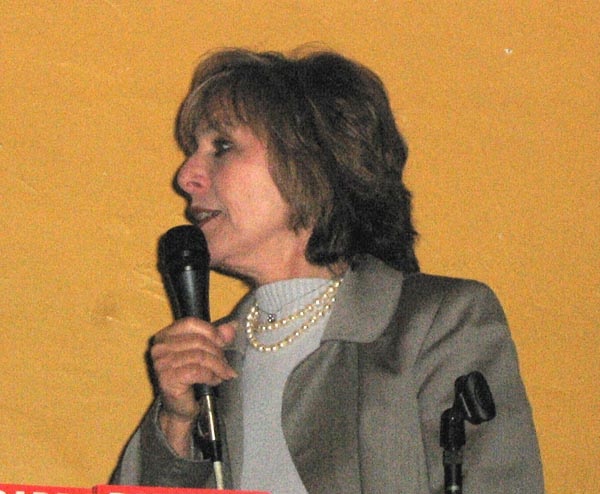
Senator Barbara Boxer Speaks at Claire de Lune
Promotes Book, Urges Votes for Democrats Nov. 7
by MARK GABRISH CONLAN
Copyright © 2006 by Mark Gabrish Conlan for Zenger’s Newsmagazine • All rights reserved
U.S. Senator Barbara Boxer (D-Calfornia) spoke at the Claire de Lune coffeehouse in North Park October 19, ostensibly to promote and sign copies of the newly released paperback edition of her 2005 novel A Time to Run. But most of the people who attended and asked her questions weren’t interested in Boxer the novelist; they wanted to hear her talk about the Bush administration, whether Democrats will regain a majority in either house of Congress in the November 7 election, and what they might do differently if they did.
A Time to Run wasn’t Boxer’s first book. Shortly after her election to the U.S. Senate in 1992 — after an unusual race in which California’s other Senate seat was also open and she and Dianne Feinstein, the Democratic nominee for the other seat, coordinated their campaigns and cross-endorsed each other, which their Republican opponents couldn’t do because they had dramatically different positions on abortion — she wrote a nonfiction book called Strangers in the Senate. The book was a response to the hype surrounding 1992 as “The Year of the Woman” in the U.S. Senate. “We tripled our number of women Senators — from two to six,” Boxer ruefully noted.
The cover of A Time to Run contains Boxer’s name in large type and below it, much smaller, the name of her collaborator, Mary-Rose Hayes. Often that’s a giveaway that the celebrity author contributed little more than her name and maybe a basic idea, and the collaborator did most of the actual writing. Not this time, Boxer insisted. She said she spent five years working on A Time to Run solo “and still didn’t get it right, so I asked my publisher for a collaborator.” After Hayes came on board, it still took two more years to finish the book to Boxer’s satisfaction before it was published. Boxer cited Richard North Patterson as a favorite writer of hers in the thriller genre and a role model for the style of A Time to Run.
The book follows three friends — two women, one man — who meet in college and follow different paths, politically and personally, as their lives separate and then reunite on a collision course. “I wanted to explore why people become conservative or liberal,” Boxer explained. She noted that conservative critics had complained that the liberal character is the most likable one in the book and that she triumphs in the end. “Even in fiction they don’t want us to win!” she said.
Boxer read a short passage from the book that takes place on August 8, 1974, the night Richard Nixon announced his resignation from the presidency rather than face near-certain impeachment and removal from office over his role in the Watergate cover-up. “I wanted to set the book during Watergate because it’s when I got into politics,” Boxer explained, “but if any time since has reminded me of Watergate, it’s now. We have a President who lied us into a war and refuses to reconsider his policy.”
The questions Boxer faced from the audience ranged from the war in Iraq and the Democrats’ chances in this year’s election to concerns about computer voting systems and the erosion of civil liberties and due-process rights under the Bush administration and a Republican-dominated Congress. On the war, Boxer said, “Our military in Iraq cannot win this situation. We know from Bush’s own intelligence agencies that our presence in Iraq is a recruiting tool for the jihadists. The American people see this isn’t working.”
Boxer said the best possible outcome for Iraq is a constitution that divides the country into three “semi-autonomous regions” — Shi’ite Arab, Sunni Arab and Sunni Kurd — comparable to U.S. states, with the regional governments responsible for maintaining order and revenue from “oil and other resources distributed by the federal government.” She cited Sandra Mackey’s book The Reckoning, a history of Iraq that notes that the country was first founded in 1920 by the British, who were anxious to install a cooperative government that would allow British companies to run Iraq’s oil industry, and to forestall any unified resistance “they put together all the regions that hated each other” and called that “Iraq.”
Asked why only she and one other senator, Tom Harkin, supported the effort of senator Russ Feingold to censure President Bush for wiretapping U.S. citizens without legally required court warrants, Boxer said, “I’ve got news for you. Democrats are not perfect, but we have awakened. If you listen to us today, you’ll see a very different group of people.” She talked about how, under Republican control, Congress has become so toothless that during her tenure as national security adviser in Bush’s first term, Condoleeza Rice appeared before the Senate Foreign Relations Committee exactly once to talk about the war in Iraq. Boxer recalled her confrontation with Rice, which made headlines nationwide: “I told her, ‘Your devotion to the President is overwhelming your commitment to truth.’ She said I was impugning her integrity. I wasn’t; I was just stating a demonstrable fact.”
When a long-term voter said that she was frightened at the extent of the loss of civil liberties and rights under the Bush administration, Boxer said, “You have every reason to be frightened, but you’re here, you’re with MoveOn.org and you’re fighting back. People who sleep through this election deserve what they get. Under this new military tribunal bill, people can be held forever, even if they’re American citizens. They’ll just say, ‘Our information is that you’re not.’” Boxer expressed confidence that, even though the bill states that the federal courts no longer have jurisdiction over anyone the President declares to be an “enemy combatant,” the courts will find that unconstitutional and “give this guy his comeuppance,” but she stressed the importance of electing Democratic majorities in the House and Senate as the only effective way to start putting the brakes on the Bush administration.
“You don’t know the half of Abu Ghraib,” Boxer said. “I went into a secret room to look at the pictures that haven’t been released to the public. I didn’t want to. It was like going on a treadmill test. After 10 minutes I was completely beside myself and I had to leave. What’s happening to my country, to my people, that they could do this? They lost their way because the people at the top — President Bush, defense secretary Rumsfeld, attorney general Gonzalez — said the Geneva Conventions were ‘old’ and ‘quaint,’ that it’s a war and we can do what we want.”
The question on electronic voting came from a woman who had talked to other members of the audience before Boxer arrived and said she’d been an activist on the issue for some time. Boxer said that in California, at least, a rule made by former secretary of state Kevin Shelley and continued by his successor, Bruce McPherson, provided “that anyone who wants a paper ballot can have one. I think that’s very important. Plus we can vote by absentee,” in which case you get a paper ballot automatically. Earlier, however, the woman had expressed concern that San Diego County’s registrar of voters wasn’t ordering enough paper ballots for voters who wanted that option, and said in some precincts voters who don’t apply for absentee ballots might show up at the polls and have either to wait hours for paper ballots to arrive or to take their chances with the touch-screens.
“I think we should do away with all this electronic voting,” Boxer said. “It doesn’t make your life any easier. I love high-tech, but in this case we can’t make it work any better.” She said that she, Hillary Clinton, John Kerry and Congressmember Stephanie Tubbs-Jones had written a bill demanding that all voting machines used in federal elections leave a so-called “paper trail” — a written record of a vote the voter can examine to make sure the machine registered his or her intentions properly, and which could also be used for recounts — but the Republicans currently in control of both houses of Congress “won’t even hold a hearing on it.”
An audience member who’d seen the film Iraq for Sale asked Boxer how she would deal with the corruption and collusion between government officials and private companies documented in the film. “Money in politics is horrible,” Boxer said. “Ever since I’ve been politically aware I’ve been for public financing. There is no question that the government is for sale.” She cited the Medicare prescription drug benefit, which in order to satisfy the large pharmaceutical companies was written to prevent Medicare from using its purchasing power to bargain with drug companies for lower prices. “I win because I’m not afraid to stand up to them,” Boxer said. “I blame the special interests, but I also blame the people for not waking up to what’s going on. It’s why we don’t have affordable health care. … Complaining about corruption is O.K., but you also have to support the candidates who stand up to the special interests.”
Again and again, Boxer stressed the necessity of electing Democratic majorities in Congress as the only way to slow down the Bush administration and its agenda. “I’m focused on one thing: November 7,” she said. “The only way to check the President is to have a Congress that won’t be compliant, won’t be servile, and will do its job. … This is our challenge to take our country back. Whatever we have to do, we will do. Don’t think about 2008. Don’t think about the future. Think about November 7.”
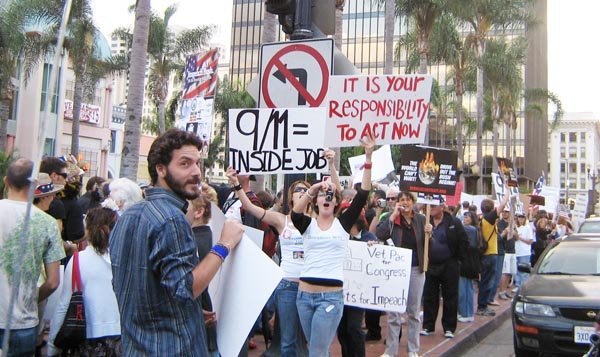
Over 500 Attend “World Can’t Wait” Anti-Bush Protest
Speakers, Organizers of Oct. 5 Event Divide over Electoral Politics
by MARK GABRISH CONLAN
Copyright © 2006 by Mark Gabrish Conlan for Zenger’s Newsmagazine • All rights reserved
Over 500 people attended San Diego’s “World Can’t Wait” protest at Horton Plaza October 5, part of an international call to “drive out the Bush regime” and end George W. Bush’s presidency before his term expires on January 20, 2009. But speakers at the afternoon rally that climaxed the event differed widely on whether the end of the Bush regime could best be hastened by voting for Democrats in this November’s election or some unspecified escalation of the protests that avoided engaging the election at all.
The disagreement was apparent as soon as the rally started, when the two people sharing MC duties came down on opposite sides of the electoral question. Though he acknowledged that there are uncertainties about whether election results really reflect the will of the people voting, especially now that so many elections are conducted by computer without a so-called “paper trail,” Matthew Cappadocía said that the solution was to mobilize so many anti-Bush voters that there would be no way pro-Bush forces could steal the election.
“We can’t have these elections constantly won by a margin that is so small you can’t really even measure it,” Cappadocía said. “We need a major movement of people to come out in an election where the end result is known, and if it doesn’t come out the way it’s supposed to, we must rise up! We must bring this injustice to a level of attention where the whole nation knows that we are counting the votes, we are looking at the votes, we’re looking at who’s counting the votes and what that end result is.”
Cappadocía’s co-MC, Aïda Reyes, immediately expressed a different point of view. “The ‘World Can’t Wait’ is not about the elections,” she said. “Both of the parties have screwed us all and are screwing the planet. Excuse me, that’s what I’m thinking. You probably think I’m too radical. … We cannot wait until 2008 for the elections, two more years, to have something done. There won’t be a world, guys.”
“World Can’t Wait” promoted a massive worldwide mobilization on October 5, issuing various statements and calls to action. “We come from different political viewpoints but we all agree: we must bring the Bush program to a HALT,” said one of the documents passed out at the rally and march. The leaflet called the demand for Bush’s mid-term removal from office “an audacious and historic venture born of urgent necessity,” but was vague on precisely how the organizers proposed to drive Bush from office early.
The call included seven accusations against “Your Government,” most of them common criticisms of the Bush regime’s practices and proposals. They included the “murderous and utterly illegitimate” war on Iraq, the use of torture against detainees, the act of detaining people at all “on the merest suspicion” without bringing them to justice, the influence of Christian Fundamentalists on the Bush administration that is “moving [the government] each day closer to a theocracy,” attacks on science “that doesn’t fit its religious, political and economic agenda,” worldwide attacks on women’s right to birth control and abortion, and the “culture of greed, bigotry, intolerance and ignorance” allegedly being fostered by the Bush administration.
“It’s time to feel powerful,” said Jeeni Criscenzo, peace activist and Democratic nominee against Republican incumbent Darrell Issa for a Congressional seat in North County. “It’s time to not stop. We have one chance for a revolution by election in 33 more days. Don’t let them tell you that your vote doesn’t count, because we can win by an overwhelming majority. All right: how do we get an overwhelming majority with what, what have we got here, less than 1,000 people? Every single one of you has to go out and knock on every neighbor’s door and call everybody, and argue with your relatives who think George W. Bush is wonderful. Get loud, get passionate, get strong! You have 33 days to do a peaceful revolution.”
“Thank you, Jeeni, so much, but you know what? They cheat!” Reyes said immediately after Criscenzo stopped speaking. “Look at the 2000 election. Four million of us more voted for Gore. They cheat. It went to the Supreme Court, Florida, whatever. Look what happened here in San Diego three times. They cheated. They took away Donna Frye from us and they put in Sanders, a Republican. O.K. O.K. with voting, but you know what? They don’t play fair. No matter how much we want to think they are respectful for our rights, they don’t give a f--- — I don’t like to say it in English — they don’t give a f--- for what we think. We don’t have the money. We’re not the corporations.”
USCD microbiology professor Milton H. Saier, Jr. gave a talk on the Bush regime’s war against science, criticizing it both for refusing to acknowledge genuine science like global warming and for putting bogus information on government Web sites, including allegations that abortion heightens a woman’s risk of breast cancer and statements that condoms are ineffective in reducing the risk of sexually transmitted diseases. The group then broke for a march through the Gaslamp District, where they were greeted with supportive honks from passing drivers — and accosted and heckled by people who had been drinking at sidewalk cafés.
Upon the group’s return to Horton Plaza, Planned Parenthood spokesperson Carolyn Desert urged people to vote against Proposition 85 on the November 7 ballot. Similar to a measure California voters defeated a year earlier, this would require that the parents of a girl under 18 seeking an abortion be notified in advance. This would be a bad idea, Desert explained, because “three out of five teens who become pregnant already tell their parents,” and the two-fifths who don’t “don’t for a good reason: they fear for their own safety. The bottom line is that, while parents wish to be involved in the health of their teens, you cannot make a law that mandates parent-child communication. Not all families are safe, and not all children can talk to their parents. In the real world, some teens live with real violence.”
After a brief appearance by a spokesperson for Amnesty International, the next speaker was local attorney Randall Hamud. He talked about his experiences representing accused terrorists and the abuses of the recently passed Military Commissions Act, which put Congress on record as supporting the contention of the Bush administration that it should have “carte blanche to declare anyone to be an ‘unlawful enemy combatant’ if he or she may ‘purposely or materially support terrorism or hostilities against the United States.” Pointing out the vagueness of that language, Hamud suggested that what the 500 attendees at World Can’t Wait were doing right then — “requesting the impeachment of a President” — might be defined as “hostility towards the United States” and be grounds for extensive detention without legal rights and ultimate trial before a military tribunal.
But, like Criscenzo, Hamud also closed his speech with an appeal for people to vote for Democratic candidates in the November 7 election, despite the fact that many Democrats — particularly U.S. Senate candidates in closely contested states — voted for the Military Commissions Act. “I don’t care if you disagree with [the Democrats] as far as their personal or political agenda is, we need to take one or both houses away from Bush,” Hamud said. “We need to seize back the government through the Congress. This Congress has been milquetoast. It’s deferred to him on everything. It’s created an autocratic presidency. We need to reverse it. We have one final chance to do that this November. I urge all of you: do not hesitate to be active in the Democratic party. Walk precincts, call voters, get out the Democratic vote, just as the Republicans are trying to do to continue the fascist practice of this regime.”
Once again, as she had done after every speaker who’d endorsed participating in the election and voting for Democrats, Reyes criticized Hamud as soon as he finished speaking. “Me personally, we have a saying in Spanish: ‘The Republicans hit you with a bare hand, and the Democrats just use a club,’” Reyes said. “That’s my thinking only. I’m probably too — I don’t know — too crazy. But, whatever you believe, I voted for Donna Frye three times, and look what happened. I don’t trust them.”

GERRY STUDDS:
First Openly Gay Congressmember Dies at 69
Interview by MARK GABRISH CONLAN
Copyright © 2006 by Mark Gabrish Conlan for Zenger’s Newsmagazine • All rights reserved
In one of those ironic coincidences that if a screenwriter tried to insert it into a film script, his or her producer would say, “Oh, come on, nobody in the audience is going to believe it,” former U.S. Congressmember Gerry (pronounced “Gary”) Studds (D-Massachusetts), who acknowledged his homosexuality after a House page he’d had sex with in 1973 “outed” him 10 years later, died at age 69 of a blood clot in his lung on October 14, right at the peak of the scandal surrounding former Congressmember Mark Foley (R-Florida), who resigned his seat after reports of his own sexual approaches to Congressional pages via e-mails and instant messages were published.
Not that Studds’ and Foley’s experiences were all that similar. Studds, as far as is known, had one consensual sexual affair with a 17-year-old page in 1973, shortly after he won his first Congressional election; Foley hit on multiple male pages with a compulsiveness recalling former Senator Robert Packwood’s (R-Oregon) approaches to women. Foley quit Congress as soon as the initial revelations came out; Studds stuck it out, accepted censure from his colleagues, kept his seat and won re-election in 1984 — thereby becoming the first House candidate to win even after he was known to be Gay. He remained in Congress until his retirement in 1997, and as a resident of the one U.S. state in which same-sex couples can marry he took advantage and wed his long-time partner, Dean Hara. Indeed, in a sign of how far we’ve come, the Associated Press obituary on Studds identified Hara as “his husband.”
I interviewed then-Congressmember Studds on September 19, 1986 when he came to San Diego to speak at the San Diego Democratic Club’s annual Freedom Banquet. In a pre-banquet reception he was asked about fellow Congressmember Robert Bauman (R-Maryland), who’d been “outed” cruising a Washington, D.C. restroom in the early 1980’s. Studds said he’d known Bauman for years because they both represented coastal districts and frequently worked together on fishing legislation important to both their constituencies -— but neither had had any idea that the other was Gay.
The initial version of this interview was published in the final issue of the San Diego Gayzette, a feisty Queer paper which came out from 1982 to 1986. Christine Kehoe, who later moved into politics herself as a San Diego City Councilmember, State Assemblymember and now State Senator, edited it for most of its final two years. The version below, however, is a new one, freshly edited from my original transcript.
Zenger’s: The obvious question I suppose everybody asks is that you came out rather accidentally, as a result of revelations in 1983. How did that affect your life, and do you think you ever would have come out openly without that happening?
Congressmember Gerry Studds: The second half I can address. Would I have done it if it had not been for that? I don’t know the answer to that question. I’d thought a great deal about it, but I kept coming up against an irony. That was, how does one call a press conference to make an announcement that will make headlines, inevitably, about a subject the principal point of which is its irrelevance? Then you’ll be making a statement about something which is fundamentally irrelevant; in fact, that would be the statement one was making. But, ironically, one would do it in the glare of publicity and headlines.
I could never figure out how that could be done. I think I had come to a point where I could have done it if I could have figured it out. Perhaps I would have. Certainly my own life had changed dramatically in the preceding five years or so, prior to 1983. Had that not been the case, I would not have survived — literally or figuratively — the events of that year.
Zenger’s: You told the Advocate that your life had been “wrapped up in self-pity and not functioning at all as a human being” before that. How precisely did being in the closet affect you, and did that change when you came out?
Studds: The before part of that question is a phenomenon that’s well known to virtually any Gay person, unless he or she is lucky enough to have grown up from a very early age in a totally open and accepting environment, which I think is very rarely the case. Perhaps someday it will be.
We’ve all been through that in one way or another over some period of time. Any Gay person who, having been through that and then, in his or her own way and in his or her own time, makes the statement, comes out, whatever the phrase may be, finds that whatever else it does, it transforms your life in virtually every respect. Every Gay person who’s been through that knows immediately what that means.
Zenger’s: How did it affect your relations with your colleagues in the House?
Studds: These relations are better, more cordial and stronger than they have ever bee, believe it or not. I’m not sure I fully understand, but I can certainly figure some of the reasons. I have to believe that I’m a good deal more pleasant to be around than I used to be — clearly, as you can see, hysterically funny. Any person who’s at east and comfortable with himself, and has a reasonable amount of self-respect, is infinitely more pleasant and agreeable to be around, and in turn elicits more respect from others. The transformation of himself is obvious, and to a certain extent contagious.
Zenger’s: As the only openly Gay Congressmember, do you consider that you have a special responsibility to come out on issues like Gay rights and AIDS, and do you think you’re taken more or less seriously on those issues because of your being openly Gay?
Studds: I don’t know if there’s a special responsibility. I’d like to think that the responsibility to speak on issues like that is inherently a human one, not a Gay one, and that one’s response would not vary according to one’s sexual preference. I myself spoke out on issues like that long before 1983, as did the members of Congress whom I respect most.
Whether or not other members look to me particularly on these issues, I don’t know. Clearly, those who are friends in a personal sense would do that, and clearly, when I speak on that, I speak with a certain authority, a certain presence. I suspect I’m listened to more so than I otherwise would have been, clearly. But I hope I’m listened to on questions of marine environment, where I also have a specialized knowledge. I listen to a farmer, who talks about things he knows about. I speak from a personal knowledge and concern, and people respond to that, I think.
Zenger’s: In recent months, we’ve seen a lot of reverses and some very successful attacks on the position of Gay people in society, things like the Supreme Court ruling in the Hardwick case [the 1986 decision which upheld state sodomy laws as constitutional, later reversed in 2003 in Lawrence v. Texas], the Justice Department opinion on the civil rights of AIDS patients, and the confirmation of Justice Rehnquist as Chief Justice. How have you dealt with these things personally, and what do you think you, in your political position, can do about them?
Studds: I think one can make the case, and I’ll say this again tonight, that this is either the best of times or the worst of times. It’s probably both. My own inclination is not to belabor the components of the argument that it’s the worst of times, several of which you just cited. It’s a very easy case to make. It’s particularly easy for a Gay person to make, because our lives have been replete with evidence of that unfairness and that injustice and that misery of it all. We’ve all been through that at one stage or another, and most Gay people probably still live lives that are not fully happy ones.
But I think things are changing for the better far more rapidly than I thought I’d ever see them change in my lifetime, , notwithstanding all the tragedies. You obviously could have added AIDS itself into that list of arguments that this is the worst of all possible worlds, but there are other things in life one can use to accentuate the affirmative and positive. Certainly my own experience tends to make the case, without for the moment suggesting that the horrors of the world, and particularly as they’re visited on Gay people in this, as in most cultures we know about, are not very real and painful.
But I think changes are coming. I think we see them, even in that horror of AIDS. I think we see the silver lining in that component of education which inevitably comes with that. Granting the unspeakable tragedy of AIDS, along with it comes a reference, worked through every day in the press, to the existence of a whole set of folks to whom there was no reference whatever in the press in the first 30 years of my life. We didn’t exist. I was over 30 years old before I met another Gay person, and I certainly didn’t read about them in the paper, or anywhere else.
I just think that the perception of society as a whole has changed. There is a large, significant Gay community. Its presence cannot be denied, and to the extent that increasing numbers of men and women who are part of it are free to proceed about their business openly, whatever it may be, these changes will accelerate.
Zenger’s: You got your political start as a young man working in Eugene McCarthy’s Presidential campaign in 1968, which was thought of as a kind of symbolic affirmation of what is thought of as the spirit of the 1960’s: the sense of idealism, the sense that anything is possible. We’re moving now in a much more conservative time, a much more materialistic time, which has been euphemistically referred to as a success-oriented period. How do you see the political universe as having changed, and how has that affected you personally?
Studds: I have to tell you that I shy away from generalizations like that. I also refuse to accept the label “conservative” for what’s going on in America today. If the people in Washington who are generally described as, and who ascribe to themselves, the label “conservative,” are conservative, then the English language has lost all meaning. Everyone knows it hasn’t been spoken for years in Washington, but that’s no reason for the rest of us to give up on it.
If Ronald Reagan and Ed Meese and Anne Burford and James Watt and that crew are conservatives, then I think there’s no point attempting to converse through that medium of the English language, because it means nothing. So I won’t let anyone, whether it’s in the context of a political debate at home or a forum in Washington or anywhere else get away with suggesting that that is anything that can be called “conservative.”
I think people have forgotten that he Reagan administration is far from the mainstream of his own political party, and his own political party is a minority in this country. So what we’re ruled by for the last six years is a minority within a minority, far from the broad bipartisan consensus of what government in this country is all about, developed over a great many decades.
No one took Ronald Reagan particularly seriously, at least in the rest of the world outside of California, until late 1979, or I guess maybe early 1980, when it became clear that he really was a serious candidate for the Republican nomination. I don’t think most of the country believed that. I don’t think most of the Republican Party believed that. He was a fringe, he speaks for a fringe within the Republican Party, which in turn is a minority within the nation. And those of us outside of California looked with some bemusement on the fact that a state as large as this could take him as seriously as it did.
We’ve learned our lesson the hard way, obviously, since then, but the fact remains, although he may have made some points about the gullibility of people from time to time, and he may have strained Abe Lincoln’s observation that you can’t fool all the people all the time, nonetheless the fact remains that he and h is folks are ideologues on one extreme of the American political spectrum, and the country will gradually return to some semblance of normalcy when he finally departs, hopefully without too much lasting damage either at home or abroad. Whatever he is, he’s not a conservative. I’m one of the few genuine conservatives left in Washington, as a matter of fact.
Zenger’s: If Ronald Reagan is a fringe ideologue in the American body politic, how come he won both his Presidential elections by such substantial majorities, and the second one by a 49-state landslide?
Studds: Yes, that’s an interesting question. You might ask an interesting corollary to that question, both of which would take a lot longer than you and I have to even begin to discuss, which is how come, in the last election for example, in 1984, notwithstanding all the difficulties I had in the year preceding that, Ronald Reagan carried my district in ’84, as he did in ’80, by the largest percentage in the state of Massachusetts, but the very same day that my district was voting by a substantial margin for Ronald Reagan, it voted by a slightly larger margin for me.
Now, you figure that out. Thousands and thousands of people in the same 30 seconds voted for me and for Ronald Reagan on the same ballot in the same moment. I don’t think you can explain or understand that by looking at the politics of Ronald Reagan or the politics of Gerry Studds. I think you have to look at the gut reaction of very complex human emotions, that package of complex emotions that comes through to a voter, and how it responds to the complexity of other human beings. It’s a very important question, and we’d better understand it at our peril, or we’ll find ourselves subjected to more of the kind of demagoguery that has characterized the Reagan administration.
Zenger’s: After the 1984 election, Congressmember George Brown, a veteran liberal Democrat from Orange County, had a similar electoral result to yours. Reagan carried his district by an overwhelming majority, but Brown also won by an overwhelming majority, and he said, “Well, the voters have made it very clear. They want Ronald Reagan to be President for four more years, and they want me in there to keep an eye on him.”
Studds: That’s part of it, but I think that’s only part of it. I didn’t want to suggest that either our plurality or his was that overwhelming in our district — he took 55 percent, we took 56 percent — but we got a few hundred more votes than he did, and that’s how I always love to respond. People say, “Well, how about the mandate?” I say, “Which one, his or mine?”
People are not ideological, for the most part. They don’t spend their lives that way, they don’t think that way, and they don’t vote that way, which is one of the things I find refreshing about America. Our tradition is a singularly nonideological one, which is another way in which Ronald Reagan stands outside of it.
(photos: Randy Rovang)
Cygnet’s Bug: Paranoia Loves Company
by MARK GABRISH CONLAN
Copyright © 2006 by Mark Gabrish Conlan for Zenger’s Newsmagazine • All rights reserved
Something moaned in the corner, I tried my best to sleep,
It was the bedbug’s mother praying, “Lord, give me some more to eat.”
— Bessie Smith, “Mean Old Bedbug Blues”
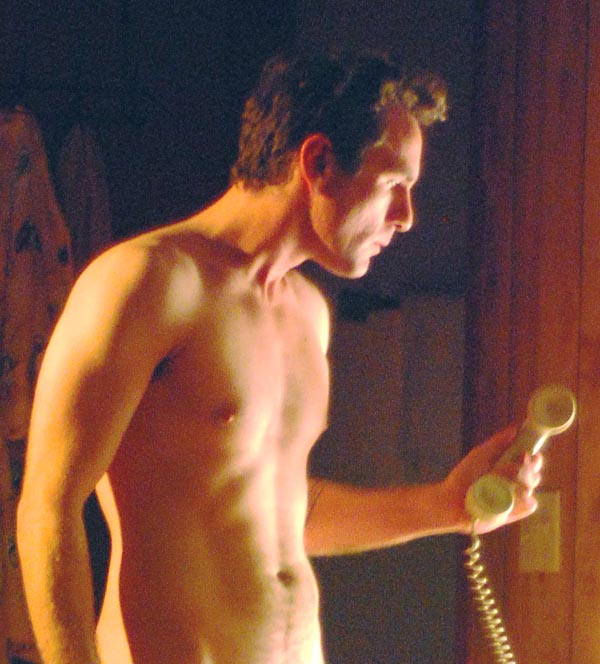
The Cygnet Theatre, an amazing company that’s probably less well known than it should be only because it’s stuck out on El Cajon Boulevard near Rolando, past San Diego State and almost in La Mesa, has really gone to the max hyping their latest production, the regional premiere of Tracy Letts’ (that’s a man, by the way) Bug. They’ve strewn postcards all over San Diego showing the play’s male star, John DeCarlo, naked, carrying a can of insecticide emblazoned with the play’s logo. They’ve taken out an ad in the PBS subscribers’ magazine, and no doubt other places as well, warning theatergoers to “brace yourself for the season’s wildest ride!” Cygnet’s artistic head, Sean Murray, has directed this production personally and calls the play “trashy, sassy and with a wicked sense of humor and danger.”
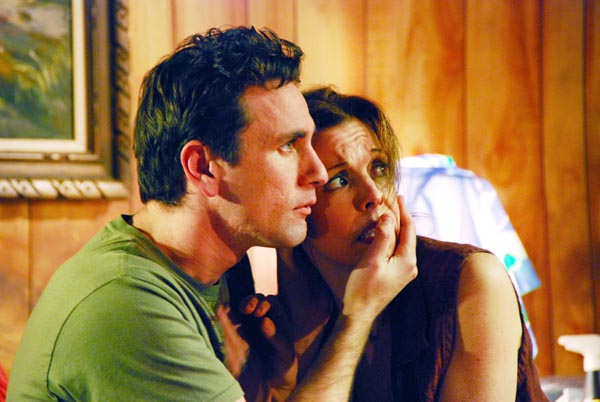
Bug is everything Cygnet’s ad campaign says it is, and more. Written by an actor/author whose best known previous play, Killer Joe, was set in a trailer park, Bug begins as a typical bit of lumpenproletariat fare centered around Agnes “Aggie” White (Robin Christ), a single woman who lives in a motel room in Oklahoma. Sean Murray, who in addition to directing the play also designed the set, has filled the playing space with boxes, crudely lettered with slogans to indicate whether they contain clothing or food, to hint that either she’s just moved into this space or is ready at a moment’s notice to move out. When the play opens, Aggie is getting a series of harassing phone calls and it soon develops that they’re from someone she knows and fears, her ex-con ex-husband Jerry Goss (Cygnet resident artist Manny Fernandes) who’s just been released from prison.
Aggie is a big-time abuser of alcohol and cocaine — she both snorts coke and smokes it in a rock pipe — and she has an unspecified job in a “honky-tonk” which makes us wonder how she can afford all the drugs. She also has a Black Lesbian friend, R.C. (Monique Gaffney), who despite her in-your-face abrasiveness eventually emerges as the voice of reason in this play. R.C. shows up at Aggie’s intending to take her to a party, but she has a quiet young man named Peter Evans (John DeCarlo) in tow and Aggie and Peter are so smitten with each other they abandon all other plans and decide to spend the night together. They don’t have sex the first night — Peter, a veteran of the first Gulf War and the son of an itinerant non-denominational minister who home-schooled him, is a bit on the twitchy side and is clearly carrying a pretty hefty load of psychological baggage that’s kept him from any sexual activity for years — but they do the night after that.
Their lovemaking — signaled by a discreet fade-to-black from lighting director Eric Lotze — comes to an abrupt end right after climax, when we hear Peter’s voice screaming, “Fuck! Fuck! Fuck! Fuck! Fuck!” Since that’s presumably what they’ve just been doing, we momentarily wonder what’s going on until Lotze turns the lights back up and we see Peter in the altogether, frantically searching for the insect that’s just bitten him. Through the rest of the first act he parades around naked, alternating protestations of love and discussions of entomology as he tries to figure out just what sort of bug is infesting Aggie’s room and what they ought to do about it. (The sight of the quite attractive DeCarlo parading around naked on stage through half of the first act — and yes, you do get to see dick — is reason enough for straight women and Gay men to see this play.)
Following an old and basic but still effective rule of play construction, Tracy Letts gives Peter a big speech at the end of act one that helps explain his character but also offers a new set of tantalizing possibilities to be explored after the intermission — during which Cygnet’s stagehands festoon the set with fly paper, fly traps, insecticides, roach motels and just about every other weapon humanity has created in its battle with the arthropods. When Aggie’s ex-husband Jerry, whom we’ve already met in the first act, appears in the second and sees the anti-insect war zone her room has become, he drawls, “Y’know, if I was a roach, I believe I’d take the hint.”
As the play moves toward its climax, Peter’s tales become more fantastic, a veritable conspiracy theory involving everybody from the U.S. military to the Bilderburg conferences. The appearance of Dr. Philip Sweet (Jim Chovick, a distinguished-looking older actor making his second appearance in a row as a scientist in a Cygnet production — previously he played atomic physicist Niels Bohr in Copenhagen), who depending on who you believe is either Peter’s VA psychiatrist or the mad scientist who implanted the bugs inside him in the first place (his knowledge of a dark secret from Aggie’s past certainly hints at the latter), precipitates the final catastrophe.
Bug isn’t exactly a joyous evening at the theatre, and you’d have to have a pretty kinky partner to use this as a “date play,” but it’s great fun in a twisted, sick sort of way. It’s also proof that you can create an edgy theatrical experience without sacrificing dramatic sense; Letts’ script is logical and impeccably constructed, but it packs a wallop nonetheless. After all, we’re living in a world in which newspaper headlines and TV news broadcasts all too often sound like the ravings of paranoiacs (most of whom actually don’t rave; like John DeCarlo in his performance in Bug, they say the most outrageous things in perfectly calm, matter-of-fact voices). Ron Suskind’s book on the “war on terror,” The One-Percent Doctrine, says that at least one “terror alert” that led the Department of Homeland Security to raise the threat level from yellow to orange came from a group of intelligence experts who were convinced that al-Qaeda was sending secret messages to operatives in the U.S. encoded in the “crawl” slogans on the bottom of the screen of al-Jazeera’s newscasts — which sounds like something Tracy Letts would make up and put into the mouth of one of his drug-soaked characters.
It’s an indication both of Letts’ skill as a playwright and the effectiveness of Cygnet’s production that even as Peter’s pronouncements get wilder and wilder we still can’t quite be sure he’s crazy. After all, if the U.S. government could release bacteria into the Detroit airport to see how fast they would spread, feed retarded kids radioactive cereal, march soldiers straight into ground zero right after a nuclear test and lie to them about the risks of radiation, and fund experiments in which gastrointestinal tubes were inserted into children to force-feed them anti-HIV medications in higher than adult doses …
Cygnet’s production of Bug is powerfully acted by a marvelous ensemble cast; the highest compliment that can be paid them is that while you’re watching the play you forget they are just acting. The physical elements of the production are also first-rate. Cygnet isn’t one of those independent theatres that puts actors on stage and then asks us just to believe that terrible things are happening to them; as their insectophobic delusions (if they are delusions) lead Peter and Aggie to wound and maim themselves ever more seriously throughout the second act, the makeup and stage-blood effects are utterly convincing. (Memo to Cygnet: please start crediting your makeup people in your programs. They deserve it.) There’s only one glitch in Murray’s direction and set design: both Peter and Jerry make their initial appearances by casually strolling on stage from the part of the set representing Aggie’s bathroom — and you get the impression this motel was so weirdly designed that each room has two entrances, one of which directly admits you to the bathroom.
If you want a play that reaches out and grabs you — one that shakes the core of your belief systems while still offering a plot that makes sense (at least within the rules of its own internal logic) and characters we genuinely grow to like and care about even as their behavior becomes more and more off-putting — Bug is it. Cygnet’s press kit indicates that veteran director William Friedkin (The Boys in the Band, The French Connection, The Exorcist, Cruising, To Live and Die in L.A.) has filmed Bug with Ashley Judd as Aggie and Michael Shannon, who created the role in the world premiere, as Peter, but this is one time you shouldn’t wait for the movie. See it now, live, in this excellent production that heightens the effect by having real people enact this story in the flesh and in real time.
Bug plays through Sunday, November 12 at Cygnet Theatre, 6663 El Cajon Boulevard, suite N. Performances are Thursday, Friday and Saturday at 8 p.m. and Sunday at 2 p.m. and 7 p.m. Tickets are $25 for Thursdays and Sunday evenings, $27 for Fridays and Sunday matinees, and $29 for Saturdays. Tickets can be purchased by phone at (619) 337-1525 x3 or online at www.cygnettheatre.com

Filmmakers Present Works at S.D. Public Library
Independent Movies Explore Historical, Contemporary Race Issues
by MARK GABRISH CONLAN
Copyright © 2006 by Mark Gabrish Conlan for Zenger’s Newsmagazine • All rights reserved
One of the best places to see movies in San Diego is the third-floor auditorium of the San Diego Public Library at 801 “E” Street downtown. In addition to a long-running series of films every Monday night at 6:30, mostly independent narrative films that got little or no theatrical distribution in the U.S., the library has been co-sponsoring a number of compelling documentaries and historical films made in association with the PBS network but not always shown by the local PBS affiliate. Often the films’ directors appear in person at these screenings and answer questions about their works.
On Wednesday, October 11 the library presented Recalling Orange County by filmmaker Myléne Moreno. The title was a pun since the film featured two “recalls” of Orange County: Moreno’s own recollections of her childhood there and how being the daughter of immigrants, a Mexican father and a French Canadian mother, affected her growing up in a county famous throughout the nation as a seat of white backlash; and the successful recall drive to remove immigrant-rights activist Nativo Lopez from the Santa Ana School District board in 2003.
Lopez lost his seat in a special election about a month before voters statewide tossed governor Gray Davis out of office and replaced him with Arnold Schwarzenegger. The main issue in the Lopez recall was his strong support of bilingual education as an option for Latino parents who wanted their children to keep the Spanish language as a tie to their home culture. A statewide initiative sponsored by North County Congressmember Darrell Issa had called for an end to bilingual education, but the initiative’s wording allowed parents the option to enroll their children in bilingual classes — and Lopez campaigned throughout the district to make sure Latino parents were aware they had this choice.
The recall campaign against Lopez was actually started by Latino mothers who opposed bilingual education and wanted their children taught only in English in hopes that would improve their chances for success as adults in an English-speaking country. But it was quickly joined by anti-immigrant and radical-Right activists, as well as affluent property owners anxious to keep a proposed new school out of their neighborhood. One recall leader profiled in the film was Tim Whitacre, a balding ex-Marine who toured the district in a converted military vehicle with a sound system blasting pro-recall messages. In the film, he tells Moreno that the question of who’s on the local school board is entirely academic to him, saying, “I wouldn’t let any of my own kids set foot in a public school” — he home-schools them — but that he’s participating in the recall campaign to help less affluent parents for whom private school and home-schooling are not options.
Complicating the recall campaign was an accusation from a state agency just before the election that Lopez’s social-service organization, Hermandad Nacional, had misallocated over $2 million in state funding aimed at reaching out to Latinos to encourage them to vote. Though the allegation was dropped four months after the election, it fatally damaged Lopez’s chances of remaining in office. “He lost in every district by a good percentage, at least 10 percent,” Moreno said. Even the primarily Latino parts of Santa Ana voted against him.
Moreno appeared after the showing of her hour-long film, made for Latino Public Television but not currently scheduled for broadcast on San Diego’s KPBS, and led a wide-ranging discussion about topics ranging from whether bilingual education is really effective to how future generations of Orange County Latinos will vote. Though her closing commentary in the film suggested that the children and grandchildren of modern-day immigrants will make Orange County more open to immigrants and Latino culture generally, Moreno acknowledged that the opposite might happen: that they might become more assimilated and therefore more conservative.
Indeed, she said, that’s already happened with the descendants of German and Austrian immigrants who came to Orange County in the late 19th and early 20th centuries. Moreno’s film shows the Austrian community’s cemetery, featuring many elaborate headstones with inscriptions in German. She said that it’s likely Latinos in Orange County will follow the usual pattern of assimilation: “the first generation speaks the native language, the second speaks both the native language and English, and the third speaks only English.”
Four days after the showing of Recalling Orange County, the library once again invited a filmmaker to introduce her work and lead a discussion about it. This time, the film was Mother of the River, a gemlike half-hour fiction film made in 1995 and released on public television a year later, which took a folk legend from Haiti and transplanted it to North Carolina in the 1850’s, just before the Civil War and the abolition of American slavery. The central characters were Dofimae (Adrienne Monique Coleman, now a regular on Dancing with the Stars), the 11-year-old daughter of a slave couple, and “Mother of the River” (Anita Maria Taylor), a quasi-mythical figure who helped runaway slaves.
The film’s director, Zeinabu irene Davis (her credit on the film spelled her middle name in all lower-case letters), spoke afterwards and acknowledged that the character of “Mother of the River” was based on Sister Nanny, a real-life slave activist in Jamaica who became a legendary figure after her death. Among the legends were that she wore a necklace made from dead slaveowners’ teeth and she could bounce cannonballs off her back and aim them back in the direction of the whites who’d fired them at her. She shot the film in black-and-white, partly because in 1995. before high-definition video, she was working with 16mm film and black-and-white was still cheaper than color, but also because black-and-white gave the film a “timeless” quality and helped her conceal any problems with the authenticity of the costumes. “The top of the dress might have been pink and the bottom green, but in black-and-white they looked the same,” Davis said.
Davis said she was inspired to make the film in 1995, when she was teaching a media literacy class to nine-year-olds in Evanston, Illinois, a suburb 20 miles north of Chicago. “We were looking at images of slavery from Alex Haley’s Queen, starring Halle Berry,” Davis recalled, “and this nine-year-old girl said, ‘I wish I could have lived in those times. The clothes were so glamorous then.’ I nearly lost it. The whole idea that Halle Berry was playing a slave just went over her head.”
Enlisting her husband, Marc Anton Chéry (who attended the library screening but sat in the back as inconspicuously as possible), as her screenwriter, Davis shot Mother of the River on location at an actual slave plantation in North Carolina. Though this gave her film an extraordinary level of authenticity — the slave cabins her characters lived in had been the actual residences of slaves in the time in which her story took place — it also put her through “a difficult emotional experience” that showed her the racial attitudes that had made slavery possible weren’t quite dead in the Old South.
The problem, Davis explained, was the plantation’s owner, a white man who utterly refused to take an African-American woman seriously as a filmmaker. In the negotiations for the use of the property, Davis said, “He dealt with my line producer, a white male; and my script supervisor, a white female. The man wouldn’t deal with me or talk to me. He acted as if my line producer was the director and my script supervisor was the star.”
Despite the tribulations of filming it, including raising the money (“there are loans that still have to be repaid,” Davis ruefully admitted), dealing with the white landlord and getting Coleman and the white girl who played the plantation owner’s daughter to look properly antagonistic on screen when “they were buddies in real life,” Davis was pleased with the reaction to her film. “I was very fortunate to get great feedback from the kids,” she said. “It won awards at children’s film festivals in Chicago and Boston, and I’m especially proud of those because the juries were children.” The film played on PBS from 1996 to 2000 and is still in distribution through a small company called Women Make Movies (http://www.wmm.com), which rents it mostly to schools.
Today Davis is a bit rueful about the experience of making Mother of the River, especially since she hasn’t had the chance to direct a narrative film since — even though she clearly has the talent to make a theatrical feature. “I’m still the only African-American woman director to make a film about slavery,” she said. “I wish that weren’t true, but it is. The reason is it’s not a topic that’s going to make a lot of money. Most films in the U.S. are driven by the profit motive. Public support for the arts has dwindled in this country in the last 10 years. This film cost $100,000, which is a lot of money for an individual but not for the film industry. There’s not a lot of money available in this country for films like this.”
Saturday, October 07, 2006
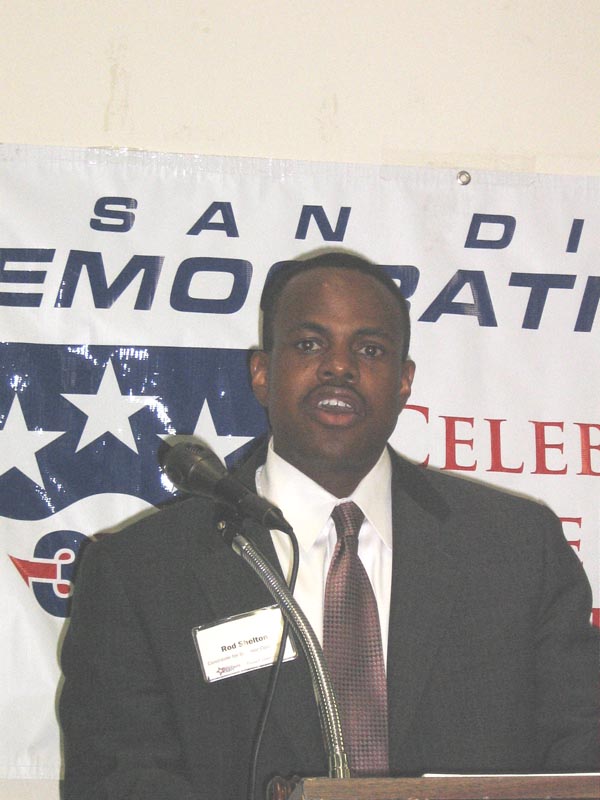
Queer Demos Endorse No on 83, Yes on 89
by MARK GABRISH CONLAN
Photos, top to bottom: Mike Aguirre, Ron Shelton, Maxx Stalheim
Copyright © 2006 by Mark Gabrish Conlan for Zenger’s Newsmagazine • All rights reserved
At its regular meeting September 28 — its last chance to make endorsements before the November 7 elections -— the predominantly Queer San Diego Democratic Club broke ranks with the state Democratic Party on two important propositions on the ballot. The club voted to oppose Proposition 83, which would increase sentences for child sexual abuse, require convicted sex offenders to wear GPS monitoring bracelets for the rest of their lives and prevent them from living within certain specified distances of schools, parks or anywhere children might congregate. The club also voted to support Proposition 89, a so-called “clean money” initiative that would provide public funding for grass-roots candidates to run for office, similar to systems that already exist in Maine and Arizona. The state party had supported Proposition 83 and remained neutral on 89.
While at least one club member strongly urged the club to endorse 83 — “This is the most disgusting crime there is, and we should stand on record against it” — opponents within the club pointed out that it would punish people not only for crimes they actually committed but for crimes they might commit in the future. They also pointed to the nearly $1 billion it would take to monitor all those GPS devices, according to the California attorney general’s analysis of what Proposition 83 would do, and said this would take away resources police departments need to fight real, here-and-now crime. One club member who works with victims of child sex abuse and domestic violence pointed out that, despite the stereotype of pedophiles lurking near children waiting to pick one off for abuse, 90 percent of adults who sexually abuse children are family members, friends or otherwise known to their victims in advance. She also said that measures like 83 make child sex abuse a criminal-justice problem, when it should be regarded as a mental illness and treated accordingly.
The club supported public financing of elections despite complaints from some members, including former club president Craig Roberts, that the financing would come exclusively from a new tax on corporations. “Why are corporations the only ones being asked to pay for this?” Roberts said. Members in support of Proposition 89 noted that in the states where similar laws are in effect now it had opened the political process to grass-roots candidates without either personal fortunes or rich campaign contributors, and had enabled Democrat Janet Napolitano to become governor of Arizona even though she could not have afforded to run a competitive race using private money. The club endorsed 89 by a vote of 18 to one, with two members abstaining.
The meeting also featured extensive debate on Propositions 1A through 1E, the multi-billion dollar bond package for infrastructure improvements worked out by Republican governor Arnold Schwarzenegger with the Democratic majority in the state legislature. Proposition 1A isn’t actually a bond measure, but a proposal to restrict the state from spending gasoline taxes on anything but transportation-related programs. Of the other measures, 1B would provide $19 billion in bonds for freeways, roads, bridges and some money for public transit (the latter put in at the insistence of Democrats in the legislature — Schwarzenegger and the Republican legislators had wanted to restrict the funding to freeways and roads alone); 1C would provide $2.85 billion for affordable housing; 1D would provide $10.4 million to build and refurbish schools and colleges; and 1E would provide $4.09 billion to strengthen levees on the Sacramento river and for flood-control projects in general.
Part of the debate on the bond measures centered around the fact that it costs twice as much money to build something with borrowed bond money as it would cost if you could finance it on a pay-as-you-go basis. Club members also expressed concern over the amount of money the state has borrowed over the past four years to pay current operating expenses, and the whopping debt this generation of California lawmakers is already bequeathing to the future even if this year’s infrastructure bonds lose. One member said that as long as the state discriminates against Queer couples by not allowing them to marry, Queer voters should not grant the state any additional borrowing authority but should instead ask, “What’s in it for us?” Nonetheless, despite the misgivings, the club eventually voted to endorse four of the five measures in the bond package and take no position on 1B,the transportation bonds. The state Democratic Party had endorsed them all.
On other state measures, the club voted to support Proposition 86, which would increase the taxes on tobacco to fund emergency-room services and other health-related programs, and to oppose two other propositions: 88, which would tax every California property owner $50 per parcel to increase state funding for education; and 90, which would impose new restrictions on the state’s right to take property by eminent domain. While a number of club members were sympathetic to the ostensible purpose of 90, which is to protect the rights of individual property owners from the effects of the U.S. Supreme Court’s Kelo decision — which essentially allows state and local governments to take people’s property if a developer wants to build a business on the site that will generate more tax revenue — they pointed to what several members called the “Trojan horse” character of the measure.
One of 12 initiatives on various state ballots financed by New York developer Howard Rich and his organization, Americans for Limited Government, Proposition 90 would write the doctrine of “regulatory takings” into California law. “Regulatory takings” means that the government would have to compensate private property owners not only for actually seizing their land to use for a public purpose — like building a road, park, school or hospital — but for the loss of potential profits from any government regulation of their property, including environmental protection, zoning laws or health and safety regulations. Former County Supervisor candidate Richard Barrera said passage of Proposition 90 would effectively abolish the California Environmental Quality Act (CEQA), which for nearly 30 years has required developers to file environmental impact reports before they can build projects — and allowed government either to block a project or to demand so-called “mitigation” of any adverse environmental effects before the developer can build. The club’s vote against Proposition 90 was 20 to three, with one abstention; the vote against 88 was 14 to nine.
The club opposed three measures on the local ballot in San Diego but supported a local $870 million bond measure to build and refurbish buildings on community college campuses. The measures the club opposed were Proposition A, a nonbinding vote directing the city to work towards building a new civilian airport at Miramar; and the two initiatives San Diego mayor Jerry Sanders is pushing as his solution to the city’s pension crisis. One, Proposition B, would require voter approval of any further increase in city workers’ pension benefits; the other, Proposition C, would allow the city to outsource work to private companies — which opponents fear would not only gut workers’ pensions but lower their wages as well.
The lengthy debate on the propositions tended to overshadow the club’s featured speaker, San Diego city attorney Mike Aguirre. Taking pride in the Wall Street Journal editorial page’s denunciation of him as a “liberal Democrat,” Aguirre staunchly defended his record in court, where he has filed several cases attempting to have some of the city’s increases in workers’ pensions declared illegal on the ground that the city had no money to pay them. He said the reason the local media in general and the San Diego Union-Tribune in particular had portrayed his efforts as unsuccessful was because “the Union-Tribune is run by politicians, supported mainly by the car industry, and read mostly for the sports pages.”
Contrary to the impression given by the Union-Tribune — and by other media who take their cues from it — that Aguirre is getting his clock cleaned in court on the pension litigation, Aguirre said, “We have been successful in court. Even the Kroll report [the audit by a New York bond firm for which the city paid $20 million to be let back into the municipal bond market] agreed the benefits were illegal. The U.S. Securities and Exchange Commission [SEC] is making findings supportive of what I have found. The only office in the city that has come up with a plan to get our financial house in order has been the city attorney’s office, a year and a half ago. Why do we need to do this? We have disintegrating wastewater treatment, a water system without proper capacity for cleansing, storm drains overflowing in Chollas Park, no secondary sewage treatment for wastewater, and our roads and streets are getting worse every day.”
The club also heard from two candidates for office, Mark Hanson — who’s running for State Senate against Dennis Hollingsworth in a heavily Republican district — and Maxx Stalheim, openly Gay candidate for City Council in Imperial Beach. The club endorsed both candidates and also heard from Ron Shelton, whom the club had already endorsed for Superior Court judge against a Republican who had written letters to county supervisors Pam Slater, Ron Roberts and Greg Cox — all Republicans — denouncing them for endorsing Shelton and calling Shelton a “liberal Democrat” and a member of the American Civil Liberties Union and La Raza. He explained that he belongs to neither of those groups, though he is a member of La Raza Lawyers’ Association.
Subscribe to:
Posts (Atom)