Tuesday, August 29, 2006


“Creating Chaos” Teach-In Explores Middle East Issues

Speakers Call on U.S. Peace Movement to Endorse Armed Resistance

by MARK GABRISH CONLAN

Copyright © 2006 by Mark Gabrish Conlan for Zenger’s Newsmagazine • All rights reserved

Three powerful Arab-American speakers assembled at the Polish-American Association building in Golden Hill August 25 to give a different view of the current crisis in Lebanon and the overall status of the Middle East from the one usually heard in the mainstream media. But the presentations of Elias Rashmawi, national coordinator of the National Council of Arab-Americans; Grossmont College professor Basheer Idoui and local attorney Nadia Keilani, presented by the Middle East Cultural and Information Center (MECIC) under the title “Creating Chaos: Civil War 101: The U.S. Agenda in the Middle East,” traced the history back to 19th century colonizers from the major European powers and called on American peace activists to support armed resistance movements like Hezbollah and Hamas.

Idoui, the first speaker, called Israel’s recent attacks on Lebanon “the total destruction of an entire country through destroying its infrastructure and massacring its civilian population, of which Qana was just one example. At least 1,400 Lebanese have been killed, one-third to one-half of them children; 500,000 people displaced from their homes and Lebanon bombed back to the state it was in 15 years ago. It will take an estimated $15 billion to rebuild.” Idoui said Israel’s attack on Lebanon was “nothing new,” noting that in 1982 “there was also a systematic destruction of Lebanon [by Israel] in which 8,000 people were killed, Beirut was bombed and under siege for 89 days, and ultimately Palestinian refugees were massacred at Sabra and Shatila.” Those massacres — he didn’t need to remind an already informed audience — were personally ordered by Ariel Sharon, former prime minister of Israel, founder of the ruling Kadima party and mentor to the current prime minister, Ehud Olmert, who ordered the attacks this year.

According to Idoui, Israel’s repeated attacks on Lebanon “reveal the true nature” of the Jewish state. He said the attack on Arabs in general began in the late 1940’s,when Israel was founded by Jewish militias who systematically uprooted thousands of Palestinian Arabs from their land and, in some cases, wiped entire villages off the map. Many of these people and their descendants “are still refugees,” Idoui added, still living in the squalid “temporary” refugee camps in Lebanon, Syria and Jordan to which they fled in the first place. Idoui called Israel’s policy towards Palestinians “ethnic cleansing” and added, “It’s still happening in Gaza and the West Bank. It’s the continuation of the process started in 1948.”

Idoui also argued that the United States’ role in all of this is basically as Israel’s enablers, and that U.S. Secretary of State Condoleeza Rice’s talk about the current crisis being “the birth pangs of a new Middle East” is actually part of a long-standing policy by the U.S. and Israel to keep Israel’s Arab neighbors divided and weak. He said that in 1982 the Javits Center worked out a long-term plan for Israel’s security that included “promoting all the tribal divisions” within Lebanon, Syria and Jordan to make sure none of them became strong enough to threaten Israel. “You unleash different forces within the state,” he explained, “one group against another, like in Iraq between Kurds and Arabs, Sunnis and Shi’ites. You create ‘constructive chaos,’ as they call it, by promoting bloody civil wars.”

Keilani, Iraqi-born, focused most of her presentation on postwar Iraq and argued that the chaos in the country today is the direct result of a deliberate U.S. policy. ”I don’t believe the chaos in Iraq today is the result of ‘unintended consequences’ of Bush’s policy,” she said. “I don’t believe it was a ‘mistake’ to destroy every single aspect of Iraq’s society and infrastructure.”

According to Keilani, Iraq today is a nation in virtually complete chaos, comparable to Afghanistan under the Taliban. “Armed militias control the streets,” she said. “The educated middle class has mostly left. There has been a deliberate attempt to target the intellectuals both inside and outside Iraq. Eighty percent of Iraq’s institutions of higher education have been looted or burned to the ground. Iraqis are fleeing to Syria and Jordan. There are no servies. Less than half of all Iraqis have clean water and only eight percent have sewage services. The electrical grid in Iraq under Saddam Hussein was functional and advanced for the Middle East; three and a half years after the U.S. took them over, they still only get electricity 1 1/2 hours a day.”

Since clean water no longer is available through Iraq’s taps, and the virtual lack of electricity makes it impossible to refrigerate food, Keilani explained, Iraqis have to leave their homes every day to buy food, water and ice. This, she said, makes them vulnerable to militia attacks. ”Militias stop buses and make people show their new government-issued ID’s,” Keilani said — and, since the ID’s give the people’s religious and ethnic affiliations, this makes them fair game: a Sunni militia will simply kill everybody on the bus whose card says “Shi’a,” and vice versa.

Among the elements involved in what she described as a deliberate attempt to plunge Iraqi society into chaos and keep it there, Keilani cited the decision by U.S. military forces not to put guards on Iraq’s armories after the occupation — with the result that 250,000 tons of ammunition went missing, much of it, she suspects, now being used to fire on U.S. troops and make improvised explosive devices (IED’s). She also criticized the U.S. for not securing any of Iraq’s government ministries except the oil ministry, for allowing the looting of the Baghdad museum and its irreplaceable collection of antiquities from the founding of civilization in what is now Iraq, and for dissolving the army and police force and putting a blanket ban on members of Saddam Hussein’s Ba’ath Party from holding office or government jobs in the “new Iraq.” She said that as a schoolgirl in Iraq she recalled Ba’ath Party recruiters coming to her classroom to sign up children — and that in Saddam Hussein’s Iraq you couldn’t get a government job without being a party member.

The insurgency, Keilani said, came from these decisions, which created a population of tens of thousands of young men, thrown out of government, the military or the police, with ready access to arms and a major grudge against the occupiers. The U.S.’s solution, she said, was to foment sectarian violence and turn the resistance into a civil war. Among the ways they did this was to set up the Iraqi Governing Council, the advisory group to America’s direct rulers in Iraq in the early days of the occupation, and allocate the 25 seats proportionately on the basis of religion and ethnicity: 13 Shi’ites, five Sunni Arabs, five Kurds, one Maronite Christian and one Turkoman. “These moves were the beginning of the end of Iraqi national unity,” Keilani explained.

Asked just what the U.S. gained from plunging Iraq into chaos and civil war, Keilani said, “At first the insurgency was directed at the U.S. military. Then there were bombings at Sunni or Shi’a mosques, which I don’t think came from any indigenous movement. It divided an otherwise cohesive movement and got these powers to fight each other instead of the U.S. Also, chaos in Baghdad does not influence the oil industry. The U.S. can still pump out oil without metering it, essentially stealing it from the Iraqi people.”

Keilani drew back from an accusation that the U.S. itself bombed both Sunni and Shi’ite mosques to start an Iraqi civil war, but Idoui said the sectarian violence “was in part begun by Ahmad Chalabi and his group, which was supposed to play up the ethnic divisions and play the role of the Northern Alliance in Afghanistan. The people who came in with the U.S. tanks formed death squads, and there seems to have been an attempt to start sectarian violence by bombing Shi’a monuments.” (Chalabi, an Iraqi Shi’ite who fled the country when the British-installed king was overthrown in 1958 and never returned until after the U.S. seized Baghdad, was defense secretary Donald Rumsfeld’s choice for a ruler for postwar Iraq. He was reportedly responsible for much of the prewar intelligence alleging — falsely — that Saddam Hussein’s regime had weapons of mass destruction, and was later revealed to have been on the payroll of Iran’s secret service.)

Rashmawi, who had been scheduled to begin the meeting but who went on last because his flight was delayed, gave two strongly worded speeches, one in the middle and one at the end, saying the current crisis in the Middle East could only be understood in a geopolitical context. He said that because of its strategic location between Africa and Asia, energy resources, control of the waterways by which oil is shipped to the world and available labor pool, “you cannot be a unipolar power and dominate the world without having clear domination of the Middle East.”

According to Rashmawi, the U.S. currently dominates the Middle East through various mechanisms, including direct colonization (as currently in Iraq), indirect colonization, military regimes and so-called “proxy states.” Among America’s proxy states he listed not only the obvious one, Israel, but also Saudi Arabia and Egypt: Saudi Arabia because it sells oil to the U.S. and its allies at cheap prices in return for U.S. military assistance, and Egypt because it serves as a dumping ground for refugees created by U.S. policies elsewhere. He attributed Israel’s recent attack on Lebanon in part due to the failure of the so-called “Cedar Revolution,” by which Syria was forced out of Lebanon, to create a Lebanese government that would be a viable proxy for the U.S.

“The heart of the liberation movement today is in Egypt, Iraq and Syria,” Rashmawi said. “South Lebanon is a recent failure of the proxy-state policy. They tried to uproot and destroy a homegrown Lebanese resistance movement [Hezbollah] twice, once in 2002 and once in 2006, and now they’re trying to clean up the process by containing their failure. … When you see 3,000 to 5,000 folks able to stand up to the Israeli army and reverse it, two dynamics develop. The first is intensification by the colonists. The second is intensification by the resistance.

Rashmawi said the resistance movement in the Middle East is just a part of a broader anticolonial movement that began after World War II and swept through Africa and Central and South America. He cited Frantz Fanon’s 1961 book The Wretched of the Earth as a source for his analysis of anticolonialism as a worldwide movement that is still going on — and he said that the peace movements in the U.S. and other Western countries need to fish or cut bait: either embrace the anticolonial struggle fully, including support for armed resistance against the colonial power, or remain what he called a “boutique movement” interested more in marketing political merchandise and building influence within mainstream political organizations like the U.S. Democratic party than in supporting fundamental change in the world.

According to Rashmawi, American peace groups take people on tours to areas of struggle, “and you pay $3,000, $4,000 and come back to the U.S. with slides of a tearing mother and a baby just about to die. You know how much I hate that? If it was a photo under the context of liberation, I’d say that child is paying a price that no one should have to pay. But when it’s shown in the context of pity, I hate that. What about a broken flower, a cactus in a broken village, people with rifles working for their own movement? This movement is decontextualized.”

Rashmawi recalled some of his experiences as a part of the A.N.S.W.E.R. (Act Now to Stop War and End Racism) coalition and their attempts to co-sponsor peace events with the liberal United for Peace and Justice (UPJ) coalition until UPJ permanently broke off relations with A.N.S.W.E.R. in 2004. He said that he would be told by UPJ organizers that there were “too many Arabs” or “too many scarved women” in the front lines of joint marches, and that he would have to send the Arabs and Palestinians to the rear of the march so that military veterans or some other group UPJ was trying to promote would be in front. Most importantly, Rashmawi said, A.N.S.W.E.R. insisted that the issue of freedom for Palestine and ending the Israeli occupation be “front and center” in all the demonstrations — while UPJ refused to make ending the occupation of Palestine a demand in its actions at all. According to Rashmawi, the current U.S. peace movement is “married to the Democratic Party” — and thereby cut off from the worldwide anticolonial struggle that alone can bring peace to the Middle East and justice to the world.

Queer Demos Make Busby for Congress a Priority Campaign

by MARK GABRISH CONLAN

Copyright © 2006 by Mark Gabrish Conlan for Zenger’s Newsmagazine • All rights reserved

“You still love me! Thank you!” said an exuberant Francine Busby, Democratic candidate against Republican incumbent Brian Bilbray in the 50th Congressional district, to the predominantly Queer San Diego Democratic Club August 24. Despite her disappointing loss to Bilbray in the June 6 runoff to replace Randy “Duke” Cunningham — who was driven from the seat when he pleaded guilty to accepting millions of dollars’ worth of gifts from lobbyists in the biggest corruption scandal involving a single Congressmember in U.S. history — Busby is the Democratic nominee against Bilbray in the regular election November 7. “I have a lot of work to do, and I’m still fighting,” she said.

“This country is no better now than it was in April [when Busby led the field in the first round of the special election but failed to win a majority],” Busby told the club. “It’s no safer than it was in June. The polls are saying that the rest of the country is waking up to the fact that Iraq has nothing to do with terrorism and debt is just as bad when it’s Republican as when it’s Democratic. People are waking up.”

And, Busby added, she’s confident that enlightenment is coming even to voters in as heavily Republican an area as the 50th district. “The fact that 45 percent of the people voted for me is proof of how anxious they are to get rid of [Bilbray],” she said. “Ninety percent of the Republicans didn’t vote and 45 percent voted for someone other than Bilbray. Businesspeople are not that happy with him because his only two issues are the Mt. Soledad cross and illegal immigration. Businesspeople are against illegal immigration but they also want a guest worker program,” which Bilbray opposes.

According to Busby, the combination of voter dissatisfaction with Bilbray and the makings of an overall “Democratic year” makes her race winnable despite her defeat in their initial matchup in June. She cited a nationwide map of Congressional districts published by the New York Times which changed her district “ from solid ruby-red to pink” — indicating it was still “leaning” Republican but was winnable by a Democrat. She’s also hoping for a fair chance to present her views without the nasty campaigns both the Republican and Democratic Congressional campaign committees ran last time.

Busby’s impassioned speech won her what she most wanted from the club: status as a “priority race” in November, as she had had in June. A priority race for the San Diego Democratic Club is one for which they make a special effort to raise money, volunteers and publicity. Prior to the August 24 meeting the club had designated two campaigns as priorities: Phil Angelides’ race against Arnold Schwarzenegger for governor and openly Gay Chula Vista mayor Steve Padilla’s re-election bid. On August 24, they added Busby’s race and also no on Proposition 85, the latest attempt to weaken California’s pro-choice abortion laws by requiring minors to notify their parents if they intend to have an abortion.

Though she really didn’t need to — the club had already endorsed against 85 and prioritized it before she spoke — Caroline Desert of San Diego Planned Parenthood laid out the case against the measure. “Proposition 85 is unrealistic, unnecessary and dangerous,” Desert explained. “Three out of five teenage girls already talk to their parents about their abortion decision, and the others don’t because they fear for their safety or being kicked out of their homes.” She called Proposition 85 “part of a larger strategy to chip away at choice,” and added, “We cannot mandate parent-child communication.”

Desert acknowledged that the drafters of 85 had eliminated the worst feature of the previous parental notification initiative, Proposition 73 — defeated in the statewide special election in November 2005 — that would have written into the California constitution a definition of life as beginning at conception, which could have been read as automatically banning abortion in the state if Roe v. Wade is overturned. But she described the differences between 73 and 85 as “just superficial and mostly minor changes in language.”

In addition to Busby, the club also heard from various Democratic candidates for office, including one of the most controversial: Maxine Sherard, an African-American woman and retired professor who won the nomination against two-term Republican Shirley Horton in the 78th Assembly District. Sherard’s appearance was a fence-mending expedition aimed at reassuring the membership that she “will have an open-door policy” as an Assemblymember and has a Transgender person on her staff.

But the club received her coolly, partly because of a leaflet placed on people’s seats before they came in. It was a reproduction of an ad Sherard’s campaign placed in the February 2004 Philippine Village Voice during a previous campaign for the seat. The ad, which was in Tagalog — though whoever reproduced it provided an English translation — showed two other candidates with their families, said they supported “women marrying women and men marrying men,” and added that “according to Dr. Maxine Sherard this should not be allowed. Why? Because the Filipino culture and Catholic Religion says marriage is sacred. Marriage should be defined as between a man and a woman. This is what God told us through Adam and Eve: ‘Go and multiply.’”

The club also heard from Alejandra Sotero Solis, candidate for mayor of National City and a former staff member for Assemblymembers Lori Saldaña and Judy Chiu; and Patty Chavez, candidate for Chula Vista City Council. “I started out like the rest of you, fighting graffiti, traffic and crime,” she said. “I started the Adopt-a-Park program, and as a City Councilmember I have continued to roll up my sleeves and get things done.” The club agreed to endorse Chavez after the unsuccessful primary candidate the club had supported before, Pat Moriarty, announced that she’s not only endorsing Chavez in the general election but is working on her campaign team.

The only potential glitch for Chavez came over an answer she gave on the club’s issues questionnaire that she was “undecided” on whether or not the state should require married women seeking abortions to notify their husbands. Asked why she had given this answer, Chavez said, “I took it back to my marriage. I have three children, and as soon as I got pregnant it was about our marriage.” After a follow-up question, though, she conceded that as a matter of public policy “we shouldn’t be regulating anything” on this issue.

In addition to endorsing no on Proposition 85, the club also endorsed yes votes on two other statewide ballot measures: Proposition 84, a bond measure to invest in water quality and safety projects; and Proposition 87, a tax on petroleum products to find alternative energy. The club put off discussion of many of the most controversial measures on the ballot — including Propositions 1A through 1E, Governor Schwarzenegger’s infrastructure bonds; Proposition 83, a toughening of California’s already strict reporting and residency requirements for convicted sex offenders; Proposition 86, a tax on cigarettes to fund hospitals and emergency medical services; Proposition 89, a so-called “clean money option” for publicly funding political campaigns similar to laws already in place in Arizona and Maine; and Proposition 90, an attempt to restrict state and local governments’ right to take private property via eminent domain.

Cygnet’s Wonderful, Wonderful Copenhagen

by MARK GABRISH CONLAN

Copyright © 2006 by Mark Gabrish Conlan for Zenger’s Newsmagazine • All rights reserved

On Sunday, September 25, 1941, Werner Heisenberg, the most prestigious and internationally regarded physicist left in Nazi Germany and the head of the Nazis’ atomic weapons program, traveled to Copenhagen in Nazi-occupied Denmark, ostensibly to lecture at a Nazi-dominated scientific institute in the city but actually to visit his old friend, colleague and mentor, Niels Bohr. Heisenberg stayed in Copenhagen one week and saw Bohr on at least three occasions, but on one of those meetings their conversation was so explosive that Bohr returned home angry and told his wife Margarethe that he never wanted to see Heisenberg again. Exactly what went on between them during that week is a secret both men took to their graves — though Heisenberg and Bohr each offered contradictory accounts of it in interviews, statements and letters after the war — but it was from this raw material that British playwright Michael Frayn fashioned his 1998 play Copenhagen, playing through September 24 at the Cygnet Theatre, 6663 El Cajon Boulevard.

Frayn’s script doesn’t offer his own re-creation of what happened that fateful evening in Copenhagen on which Bohr and Heisenberg went for a walk as bosom buddies and came back furious with each other. Instead it plays fast and loose with the time frame and even shows Bohr and Heisenberg continuing on with their arguments after both men and Bohr’s wife —a third on-stage character and frequently the voice of reason between them even though all she knows about science is what she’s picked up from the manuscripts she’s typed for her husband — are all dead. (It’s hard to believe that if there is an afterlife and Bohr and Heisenberg made it there, they wouldn’t spend at least part of their time trying to reason out the physics of their current state of existence and reconcile those with the discoveries they made in this world.)

What results is a marvelous, if rather talky, play about the obvious dilemma facing both the proudly nationalistic German Heisenberg and the half-Jewish Dane Bohr: how to reconcile one’s calling as a scientist with one’s duty as a human being, and whether scientists ought to be held morally accountable for the consequences of their discoveries and hold back from certain lines of research that might have destructive consequences. It’s also about more than that: it’s about the thickets of contradictions Heisenberg, whose greatest contribution to science was the discovery of the so-called “uncertainty principle” at the heart of quantum physics, created in his public statements about his wartime role, and the irony that a man famous for explaining the universe as based on “uncertainty” would leave behind so many uncertainties about himself. And it’s a script that questions the common notion that scientists do their best work in close collaboration, or at least communication, with each other; in one of Frayn’s quirkiest and most moving moments, both Heisenberg and Bohr admit that their greatest insights came to them while they were totally alone in isolated environments that gave them a chance to think without distractions.

Even before Frayn wrote his play, the Copenhagen meeting(s) between Heisenberg and Bohr had taken on an almost mythical significance in the history of World War II and the role atomic weapons played in it. In the late 1930’s, Albert Einstein and Leo Szilard, both pacifists, Jews, and refugees from Nazi Germany, put aside their anti-war convictions and lobbied President Franklin Roosevelt to start a nuclear weapons program for fear that the Nazis were also working on such research — and if the Germans got the bomb before we did, given Hitler’s known record of brutality, he would use it to destroy whole cities, or even nations, and establish the “Thousand-Year Reich” of which he boasted. Ironically, Hitler’s bomb program was hobbled from the get-go by his racism; before Hitler took power Germany had been the world’s leader in theoretical physics — but most of those physicists were Jews and, smart enough to see the handwriting on the wall, left as soon as they could. Eventually most of the German physics community relocated to the U.S. and worked on the Manhattan Project, which gave the U.S. the world’s first nuclear weapon — and Bohr joined them as soon as he got out of Denmark in 1943, first to neutral Sweden and ultimately to the U.S.

Frayn takes all these facts and uses them to construct a somber, compelling meditation on the responsibilities of scientists, especially but not only in wartime. His play examines one of the great unanswered questions about Heisenberg — did he fail to build a bomb because he deliberately sabotaged the German nuclear program out of horror at what the Nazis would do with it, or did he simply get the science wrong and decide a bomb was impractical? It also questions whether Heisenberg, who confined his actual work to building an experimental nuclear reactor for energy and medical uses — though one which could also have made plutonium, which could have been used in a nuclear weapon instead of enriched uranium (and was in the bomb the U.S. dropped on Hiroshima) — was really morally superior to Bohr, who did work on a weapons program that manufactured atomic bombs that were used to destroy two cities. The currency of these issues was hammered home when on August 26, the day Cygnet’s production of Copenhagen opened, the Associated Press announced that, dodging international attempts to stop them from enriching uranium, Iran was going to build a heavy-water reactor that would allow them to use ordinary, unenriched uranium to generate power — and to create plutonium to fuel a nuclear weapon. This is the same kind of reactor Heisenberg was designing for the Nazis.

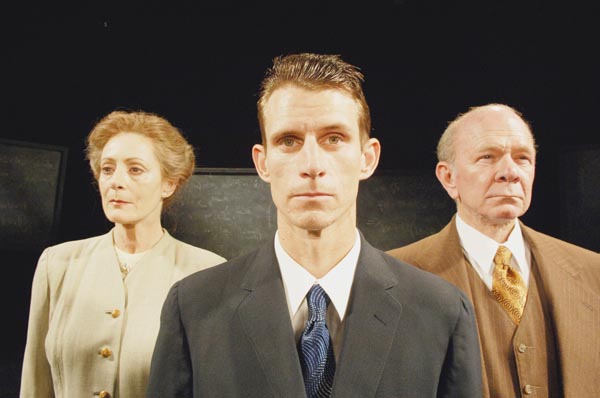
Cygnet Theatre gives Copenhagen a first-rate production. Jim Chovick stands out as Bohr; his age and overall appearance perfectly suit him to play an eminence grise but he’s also spry enough to catch the nervous, fidgety energy of a character who seems unable to sit still for more than a few seconds at a time. Rosina Reynolds as Margarethe turns out to be as good an actress as she is a director; superbly aged by Cygnet’s (uncredited) makeup artist, she’s not only effective as the materfamilias who holds her rambunctious, hot-tempered husband in place — in Frayn’s script Heisenberg calls their family an atom, with her as the stable nucleus and him as the randomly mobile electron — she also does a good job as the representative of all us non-scientists in the audience trying to make sense of what her husband and his equally abstruse friend are saying. Cygnet regular Joshua Everett Johnson is too young-looking for Heisenberg — one wouldn’t believe that this man turned 40 just three months after the Copenhagen meeting, and it seems odd that the makeup people who so effectively aged Reynolds didn’t give him a similar treatment — but otherwise his performance is great, ably portraying both Heisenberg’s misgivings and his rationalizations.

Director George Yé, faced with an unusually long (the first act is 80 minutes, the second an hour) script that’s basically three people talking in a room, solves the obvious problem of avoiding boredom by keeping the actors, Chovick especially, in almost constant motion and having them spit out Frayn’s dialogue so fast they have to lose themselves in their characters merely to keep up the pace. Yé also did his own sound design, which effectively mixes in music at the start and finish of each act — though the opening sound effect of Nazi forces marching through the streets of Copenhagen should have been “panned” across the theatre instead of remaining in one place aurally. The set by Sean Murray, Cygnet’s artistic director, is simple: just three chairs and a black backdrop in front of which are hung blackboards with mathematical equations — and lighting designer Eric Lotze creates a powerful effect towards the end when he uses the center blackboard as a screen on which to project the so-called “diffusion equation” which proved an atom bomb would work.

Copenhagen is a powerful drama that plays to the strengths of the Cygnet Theatre: incisive direction, strong character portrayals, excellent physical production. It’s not exactly a good-time piece, but it has its moments of humor. On opening night, when Bohr announced early on that he’d co-written a paper that conclusively proved it would not be possible to build an atomic bomb, the audience laughed at how wrong he turned out to be — but also with the mixed feeling of how much better off the world would have been if he’d been right.

Copenhagen plays through Sunday, September 24 at the Cygnet Theatre, 6663 El Cajon Boulevard, Suite N. Performances are at 8 p.m. Thursdays, Fridays and Saturdays, 2 and 7 p.m. Sundays. The Sunday, September 10, 2 p.m. show will feature a post-show discussion led by Herbert York, American nuclear physicist who worked on the Manhattan Project. Tickets are $25 Thursday and Sunday evenings, $27 Friday evening and Sunday matinee, $29 Saturday, and can be purchased by calling (619) 337-1525 x3 or online at www.cygnettheatre.com

Middle East Peace Demo Draws 400

Speakers Bash Israel, Praise Hezbollah Resistance

by MARK GABRISH CONLAN

Copyright © 2006 by Mark Gabrish Conlan for Zenger’s Newsmagazine • All rights reserved

A surprisingly high turnout of 400 people came out on warm Saturday, August 12 to Balboa Park to stage an action protesting Israel’s attack on southern Lebanon and continued occupation of historic Palestine. The crowd was evenly distributed between Arab and Muslim Americans, many of them in traditional Islamic clothing and carrying Lebanese, Palestinian and Iraqi flags, and mostly white peace activists. The event began with a gathering and a few speeches via a bullhorn at the fountain at the Park Boulevard side of the park, then included a march across the park to Sixth and Laurel, where a longer rally took place at the end.

Many participants in the march themselves seemed surprised at the size of the crowd. One local journalist covering the event said he’d got e-mails from four different Muslim organizations in San Diego. “I didn’t know there were that many!” he said. But at least one local peace activist said she was concerned about the foreign flags being carried by many participants and the Muslim garb some of them were wearing. She explained that the protests to protect the rights of undocumented immigrants only began attracting popular support once the participants began carrying U.S. flags and dressing like ordinary U.S. residents.

While the official theme of the march was peace and a call for Israel to withdraw from Lebanon, some of the participants took it farther. During part of the march, its leaders started chants actively supporting the Hamas and Hezbollah movements and the resistance to the U.S. occupation in Iraq. Later, when rally MC Carl Muhammad — not an Arab or Middle Easterner but an African-American activist with the San Diego branch of the International Action Center (IAC) — mentioned that some of the 10 counter-demonstrators on Laurel had carried signs reading, “Go get ’em, Israel!,” one member of the crowd responded by yelling out, “Go get ’em, Hezbollah!”

Like the participants, the speakers were more or less evenly divided between mostly white peace activists and Arab and Muslim Americans. The event was opened by a speaker identified only as Walid, who said, “Your presence here today as people of conscience is crucial to oppose the atrocities being committed by Israelis on Palestinians and Lebanese. One thousand Lebanese have been killed [in the current war] and hundreds of thousands have been made homeless. Lebanon has been bombed into smithereens. The Israelis deliberately attacked civilians in convoys, massacred women and children, and killed farm workers.”

Walid also noted the situation in Gaza, the Palestinian territory Israel supposedly “withdrew” from last year, which they invaded before they attacked Lebanon and under the same pretext: to “rescue” an Israeli soldier taken prisoner by resistance forces. “In Gaza, the daily shellings continue and more than 160 women and children have been killed in the last month alone,” he said. “This is the epitome of injustice, all paid for by our tax dollars in violation of our laws. We need to send a powerful message to our government that human life is not cheap, all life is sacred and we need to stop funding the war machine.”

Though the rally took place one day after the United Nations announced an agreement for a cease-fire in Lebanon, participants clearly regarded this resolution as a sham. Rebecca Anshell of the International Socialist Organization (ISO) explained that “the so-called ‘cease-fire’ calls for Hezbollah to disarm and allows Israel to ‘defend itself,’ which means they can continue too destroy Lebanon and kill Lebanese.” She didn’t need to explain to her audience that Israel and its apologists had justified all their recent actions in Lebanon and Gaza by calling them “self-defense.”

Noting that the Bush administration has openly taken Israel’s side in the current conflict, Anshell added that secretary of state “Condoleeza Rice calls this ‘the birth pangs of a new Middle East.’ This is a really forthright statement of the goal of the war on terror: to create new market structures in the Middle East to decide who gets oil and keep China or India from becoming a superpower. Israel has been the U.S.’s agent and is doing its dirty work. … It is our job as activists to explain the way the occupations in Afghanistan, Iraq, Palestine and Lebanon are part of a broader strategy. We have to take action against the whole agenda and unite people in the U.S. against this racist war.”

A number of speakers made the connection between Zionism and racism, but fewer more strongly than Jewish poet Steve Kowit. He was called to read his poem Intifada, which he’d also read at the Hiroshima Day peace demonstration at the Embarcadero six days before. But as he introduced the poem — which compares Israel’s oppression of the Palestinians to that suffered by the Jews throughout Europe and most of the world for the previous 1,600 years — he cited a book called Apartheid Israel by Uri Davis and said Israel has been the world’s most racist country since the apartheid system in South Africa was abolished.

“Ninety-three percent of Israel is reserved by law for the exclusive use of the Jewish people,” Kowit said. “If that isn’t the very definition of racism and apartheid, there is no such thing as racism. Israel stole the Palestinian homeland in 1947, 1948 and 1967, and now they talk about giving back a tiny bit of it and calling it the ‘Palestinian state.’ … The laws [in Israel] are designed to allow Jews to control the whole country and keep everyone else from being able to make a living.”

Zahid Mamouni of Al-Awda San Diego, the local branch of an international movement to demand that Palestinians be allowed to return to their former homelands inside Israel — a call fiercely resisted by virtually all Israeli politicians because it would mean the end of Israel’s Jewish majority — pointed out the disproportionality between the alleged provocations for Israel’s invasions of Lebanon and Gaza and Israel’s actual actions. “There was one prisoner of war in Gaza, and as a consequence 135 Palestinians are dead, 245 are injured and most Gaza residents are deprived of electricity, water and medical supplies,” he said. “In Lebanon, [there were] two Zionist POW’s, more than 1,000 Lebanese killed, 3,500 injured and hundreds of thousands displaced.” He called on members of the crowd to contribute to emergency relief funds being set up by Al-Awda to help people who’ve lost their homes due to the attacks.

“We need to liberate America from this fascist President and his group,” said Sheikh Sharib Wafiq. “Bush says the resisters in Palestine, Lebanon and Iraq are terrorists. But if someone invades our land, we will fight. Our duty is to resist. It’s very important to support our brothers in Iraq, in Lebanon, in Palestine. This is our duty. It’s very important for us as Americans to raise our voices. I hope San Diegans will stand with us. I hope we will have thousands at our next demonstration. It’s very important to vote against the criminals. God loves peace, and there is no peach without justice. And there is no justice without an end to the occupation of Palestine, Lebanon and Iraq, and without giving all the people their freedom. We pray for peace because we like peace and justice. May God support all the people under occupation, the people in Palestine, Lebanon, Iraq and our people here in America to liberate themselves from the lies of the mass media.”

100 Attend Annual Hiroshima Day March and Vigil

Speaker Accuses U.S. of Deliberately Depopulating Earth

by MARK GABRISH CONLAN

Copyright © 2006 by Mark Gabrish Conlan for Zenger’s Newsmagazine • All rights reserved

Before a crowd of 100 people outside the U.S.S. Midway museum on the Embarcadero downtown, Berkeley-based anti-nuclear scientist and activist Leuren Moret accused the U.S. government and the “vested interests” who control it of deliberately using nuclear weapons, including depleted uranium, to cut the world’s total population in half. Moret, an environmental commissioner in the Berkeley city government, president of Scientists for Indigenous People and host of a public-access cable TV show on nuclear issues, said the U.S. government “wants to eliminate two to three billion people” and cited a 30-year-old document as her source.

“This is not a conspiracy theory; this is U.S. national policy,” Moret said. “It’s called Global 2000 and it was written by Henry Kissinger, General Alexander Haig and [former Democratic senator and vice-presidential candidate] Ed Muskie for President Carter. We are in Global 2000 now, and I am convinced that the amount of carpet bombing and grid bombing that started under Clinton in the 1990’s is what Global 2000 is, because certainly the health statistics I have from India, Japan, Britain and the United States support that.”

Moret said that only a deliberate policy of extermination could possibly explain the U.S. military’s insistence on using so-called “depleted uranium” — ammunition made from leftover “spent fuel” from nuclear power plants — in all its wars at least since the first Gulf War against Iraq in 1991. “You and me and our children, and our future children, are living in the Auschwitz radioactive poison gas chamber today,” she said. “The whole global atmosphere is polluted now, and the half-life of depleted uranium is 4 1/2 billion years.”

According to Moret, the increased amount of radioactivity in the atmosphere is both a short-term and long-term health hazard, increasing not only the incidence of diseases long associated with radioactive exposure, like cancer, but other health hazards most people don’t think of as having a nuclear risk factor. “One radioactive atom is 10 to 100 million times more toxic to developing organisms than the most harmful chemicals, such as thalidomide,” she said. “Most of atmospheric testing pollution is actually depleted uranium, and it damages the pancreas and the ability of insulin to get into the cells and perform its proper function. So now you know … that our global diabetes epidemic is due to depleted uranium.”

Moret cited a new documentary film detailing what she called “the history of treason that our government has committed against our own soldiers,” including the atomic tests of the 1950’s in which army companies were marched through ground zero right after the bombs went off, the MK Ultra mind-control experiments, Agent Orange in Viet Nam, the anthrax vaccines largely believed to be the cause of “Gulf War syndrome” and Western sales of biological weapons and their precursors to Saddam Hussein’s regime in Iraq. “The bunkers [where these were stored] were blown up [in the 2003 attack] so that the public would not know that the ammunition and illegal biological weapons and other weapons were stamped, ‘Made in Russia,’ ‘Made in Germany,’ ‘Made in Jordan,’ ‘Made in Britain,’ ‘Made in the U.S.A.’,” Moret said. According to Moret, the U.S. government’s motive for all this is “GOD” — “God, Oil and Drugs.”

San Diego Mesa College political science professor George Callas, who’s involved with an organization called Campaign Against Sanctions and Military Intervention in Iran (CASMII), followed Moret with a discussion that touched briefly on the U.S. program for regime change throughout the Middle East. “History clearly shows that, since prior to 9/11 and as far back as early 1991, this administration has been planning for invading both Iraq and Iran,” Callas said. But most of his presentation focused on the determination of the Bush administration to loosen the controls on U.S. use of nuclear weapons to allow field commanders, with presidential approval, to launch nuclear attacks on states that don’t have nuclear weapons themselves.

“Since Bush first came into office, he has aggressively sought to create and promote the use of U.S. nuclear weapons of mass destruction against non-nuclear states,” Callas explained. “According to reports in the San José Mercury-News of March 15, 200 and Agence France Presse of February 2, 2005, Bush’s first-strike nuclear policy was originally traced to vice-president Dick Cheney and defense secretary Donald Rumsfeld. They initiated the 2001 Nuclear Posture Review, which states that the U.S. military, including nuclear forces, will now be used to dissuade adversaries from undertaking military programs or operations that could threaten U.S. interests or those of its allies and friends during conventional war.”

Callas quoted a Bush administration nuclear security official as having told the Senate Armed Services Committee in 2004 that Bush’s strategy “represents a radical departure from the past and the most fundamental rethinking of the roles and purposes of nuclear weapons in almost a quarter-century. Instead of treating nuclear weapons in isolation, it considered them an integrated component of American military power.” According to Callas, this policy will not only make the U.S. a nuclear aggressor for the first time since 1945, it will sabotage the Nuclear Non-Proliferation Treaty, encourage states and terrorist organizations that don’t now have nuclear weapons to get them, and create the threat that “any regional conflict could explode into an all-out nuclear war.”

Jewish poet Steve Kowit commented on Israel’s invasion of Lebanon — “the latest episode in Homo satanicus’s destruction of the planet,” he called it — and read a poem called Intifada, which paralleled Israel’s occupation and treatment of the Palestinians to the 1,600 years of oppression against the Jews, mostly by Christian Europeans. Kowit stressed that, despite the mainstream media’s portrayal of an Israeli population solidly behind prime minister Ehud Olmert’s military policy, “there are peace demonstrations, anti-invasion demonstrations, going on almost every day in Israel by extraordinarily courageous peace groups there: Rabbis for Human Rights, the Israeli Committee Against House Demolitions, Ta’iush, Gush shalom, Bat Shalom and Women in Black, which is now international but began as an Israeli peace group.”

Following Kowit’s moving reading, Gary Stewart of the San Diego Coalition for Peace and Justice came up and promoted the Declaration of Peace campaign, aimed at pressuring Congress to set a deadline for the withdrawal of U.S. troops from Iraq. “It demands that Congress adopt and activate a plan to get us out of Iraq and to commit to bringing the troops home by March 19 of next year, return the oil to the Iraqi people, close all the military bases [the U.S. is building in Iraq, and] have a peace divident that addresses the vital social needs of this country, and no preventive war in Iraq or anywhere else.” The Declaration of Peace group has set a deadline of September 21, 2006 for Congress to act; it it doesn’t, the group states on its Web site (www.declarationofpeace.org), “Declaration signers across the U.S. will engage in nonviolent action in Washington, D.C. and in communities throughout the nation.”

The rally outside the U.S.S. Midway also featured Sara Haldeman-Starr, pastor of the First Church of the Brethren where the San Diego Coalition for Peace and Justice meets, and folksinger Michael Officer, who sang three songs without explicit political content. Following the speechmaking, attendees walked on the traditional silent vigil down the Embarcadero and back to the Midway site.

Wednesday, August 02, 2006

REBECCA CULSHAW, Ph.D.:

Math Professor Explains Why HIV/AIDS Model Doesn’t Add Up

interview by MARK GABRISH CONLAN

Originally published in Zenger's Newsmagazine, July 2006

Copyright © 2006 by Mark Gabrish Conlan for Zenger's Newsmagazine

In 1997, Rebecca Culshaw was a graduate student in mathematics with an interest in pursuing “mathematical biology,” the application of mathematical models to biological problems. Her thesis advisor steered her to HIV research because it was a hot field, and Culshaw won both her Master’s degree and her Ph.D. with modeling work aimed at predicting the rate at which HIV would replicate in the human body. But by the time she received her Ph.D. in 2002, she no longer believed in her own work because she no longer accepted the central premise that HIV or any other single virus could cause AIDS.

Today Dr. Culshaw is a math professor at the University of Texas’s Tyler campus, and her apostasy on the HIV/AIDS question has pushed her out of the mathematical biology field and towards more theoretical branches of mathematical modeling. Early this year she published two articles on the Libertarian Web site www.lewrockwell.com, one called “Why I Quit HIV” — discussing how she encountered the alternative scientific perspective that AIDS is a long-term toxic condition rather than an infectious disease — and a follow-up called “Why I Quit HIV: The Aftermath,” detailing the responses she got to her first piece. While some of them bore the nastiness and personal attacks frequently leveled by defenders of the HIV/AIDS model against its critics, many were surprisingly supportive, including one from a social worker who works with “HIV-positive” women prisoners and told Culshaw “they always seemed more scared than sick.”

Zenger’s: Why don’t you start by telling me a little of your background, and what field of science you’re involved in, and how you got interested in it.

Rebecca V. Culshaw, Ph.D.: I’m actually a mathematician, and specifically a mathematical biologist. When I got to university I actually wanted to do medical research, but I gradually got less interested in that and I started taking more math classes. I got a math degree, and then when I finished my math degree I went to do a Master’s. I had to do a thesis, and I discovered that there are people that were doing mathematical models of infectious diseases. I thought this would be a perfect thing for me. I discovered that I could make and analyze models of infectious diseases, and the really big field at the time was HIV modeling. I’d been interested in this anyway because I thought it was an interesting disease, and I wanted to learn more.

So I started working on immunological models, not to analyze data or do epidemiology, but to use differential equations to analyze the evolution of a disease and its interaction within a single person’s body. This was a really big field at the time, and I started working on that in 1997. I wrote a thesis and we got a paper out of it. I wasn’t sure if I wanted to go on, so I took two years off and I worked as an actuary for a while. I was over in England for a while, working in a pub and that kind of stuff. After I worked with the insurance company, I decided that I wanted to go back and do more research. So I started in a Ph.D. program in the beginning of 1999.

I knew I wanted to do mathematical biology, but I wasn’t really sure that I wanted to work on HIV anymore. I wasn’t convinced that was where I wanted to go, but my advisor convinced me that I’d already started on this, and so I might as well continue. I started looking at some models of the interaction of HIV with the immune system and the natural immune response. At the time, the big thing was natural killer cells and their role in disease progression. I also started looking at treatment models. For my doctoral work, I started looking at using a different branch of mathematics, called control theory, to investigate what would happen if we tried to implement different kinds of treatments.

The hope with these models is they’ll help to streamline the process of designing clinical trials, for example, by showing what kinds of effects various treatments would have on the different surrogate markers. Instead of just picking things randomly, the idea is to establish some theoretical basis for saying this is more likely to work, so this is what we’re going to use. I finished my Ph.D. in 2002.

Zenger’s: When did you start having doubts about the HIV/AIDS model, and why?

Culshaw: That’s sort of a complicated question, because when I think about it objectively, I’d been having doubts about it for a lot longer than I have saidthe two papers that I wrote. Early on, during the AIDS era, I remember, even as a teenager, thinking that there was a big rush to judgment; people saying basically, “HIV equals AIDS.” I remember when Magic Johnson came out and said he was HIV-positive and all these people were saying, “Oh, Magic Johnson has AIDS.” I remember thinking, “This is ridiculous. He doesn’t have AIDS. He’s perfectly healthy. He’s HIV-positive. This is not the same thing.”

At the time, I didn’t think there was any doubt that this was the causative agent, but I remember thinking there’s something wrong here when people are saying that two different things are the same thing. I remember when I was working on my Masters’ thesis, and I’d been reading a lot of the biological papers for background, some things just weren’t adding up. I was thinking, at the time, that science was not perfect, we don’t understand everything yet, and I really bought into this whole “mysterious virus” thing.

I was on my way to a conference to present a talk, and for some reason I had picked up Spin magazine. I never read that magazine, so it was weird that I had picked it up, but there was an article by David Rasnick called “Blinded by Science.” This was the first time I’d seen that anybody ever had any doubts about HIV, and that actually scientists were having doubts about this. I thought, “Wow, this really makes sense. I had no idea there were doubts. This is really interesting.”

Then I kind of forgot about it for a while, because I had left academia, and it just wasn’t really at the forefront of my mind. When I went back to do my Ph.D., I still had some lingering doubts, like I — at the time I was still kind of in the co-factor camp. I thought, “Well, there are just too many things that don’t add up. There must be some sort of co-factors involved here.” But it would be interesting to work on mathematical models, and maybe understand more how that might work. So that was where I was with that for a long time. To be honest, after I finished my Ph.D. I felt, “I’m going to work on something else now,” and I sort of stopped thinking about it for a while. It’s only been in the last couple of years that my doubts were just really solidified from reading more of the information, basically.

Zenger’s: What were the factors that actually decided you that what we have been told about AIDS cannot be true and that HIV cannot be the cause of it, certainly not the way the mainstream says it is?

Culshaw: There were a lot of different deciding factors, to be honest with you. It was more an accumulation of information, some of it scientific but some of it political and sociological. I’ll start with the scientific evidence first. When I read some of Peter Duesberg’s stuff, I had never known what the difference was, really, between a virus and a retrovirus. I didn’t realize, for example, that our cells can produce retroviruses but they can’t produce real viruses — well, not “real viruses,” I don’t mean.

Zenger’s: Meaning the difference between an endogenous and an exogenous virus.

Culshaw: Yes, thank you. Good. So I read his 1989 Proceedings paper, “Correlation but Not Causation,” and also the paper about “Retroviruses as Carcinogens and Pathogens,” and thought, “This man obviously understands how retroviruses work, and if he’s going to say that there’s just no way they can kill cells the way people are saying that they’re going to. I have to take that seriously.”

Also, it seemed like the scientists were always changing their minds about things. This is something I experienced very directly, as somebody that was doing research in the field. It takes a long time to write a math paper. Not to mean any disrespect to biologists, but if you’re a biologist you can run your experiments, you can get some results, and even if it doesn’t do what you think it’s going to do, you can usually publish it pretty quickly. But if you’re a mathematician, if you propose some sort of theory or something and you can’t prove it, then you have nothing.

As a consequence, it will usually take several years from the start of a paper to getting it finished, refereed and back, and actually published. It will be up to three to four years at times. It happened to me on more than one occasion that I would cite some sort of reference on the dynamics of T-cell killing, for example, and as I worked the authors of the references I was citing kept changing their minds. That was a red flag that kind of came up for me, was why do they keep changing their minds? Do they not know how the T-cells are dying?

The reviewers would come back and they’d say, “Oh, this reference, it’s three years old, it’s out of date.” This would happen more and more, and I would think, “How can they just keep changing their minds?” Obviously, there’s something wrong here. This is not an accumulating body of secure knowledge that they’re building on. It’s more like they’re knocking the whole thing down a few years and just starting over with something else, all the while maintaining that this virus is at the center of it all. That just didn’t add up to me. So I guess, scientifically, those were the main things.

And also, the fact that there never was any agreed-upon mechanism of how the T-cells actually died. I thought that was suspicious. I thought, “How can they possibly spend this many billions of dollars and still not know how this virus works? It’s ridiculous. If we’ve got great brains working it out and they cannot figure out this problem, this virus cannot be that mysterious.”

I became more aware of what was happening within the scientific community to people who would question the hypothesis. Obviously, Peter Duesberg is the biggest example of somebody whose career has just been ruined by just the fact that he expresses doubts. I get very suspicious whenever I see this sort of massive consensus and belief. To me, it doesn’t guarantee that the people are wrong on their consensus is over, but it’s certainly a big red flag that there’s something. Why are they protesting so much? I thought that was a little strange. So I guess those are the main things that made me doubt.

Zenger’s: You said there were not only scientific reasons but also what you called political and sociological reasons.

Culshaw: O.K., so I’m not sure how to put this so that it really makes sense, but I read a lot of John Lauritsen’s work, and a lot of the things that he said made sense to me, about AIDS is really used as a social weapon. I don’t think that the government came up with this in order to try to oppress certain groups of people in society, at least not consciously, but it seems like there’s so much blame being thrown around. It’s disguised as political correctness and compassion and everything like that. There is a large proportion of society that is very bigoted, I think. I see it a lot of the time, especially living in East Texas, and people who are very uncomfortable with people who live lifestyles that are different from their own. Somewhere around the 1970’s and 1980’s it became much less popular — I hate this term, but I’m going to use it — to Gay-bash.

Then it seemed all of a sudden like AIDS sprung up. Boom! Then people could just say, “Oh, no, we’re not actually being homophobic at all, or racist, or whatever” — because there’s a very big racist component to AIDS as well. “We’re being compassionate. We really care.” To me it just stinks. I don’t understand how some of these government researchers can say that they’re being so “compassionate” when they have all of these programs in place to take away the civil liberties of anybody who’s just diagnosed HIV-positive. I mean, that’s just completely outrageous to me. Also, I think the religious Right just jumped on it. A lot of people were talking about “God’s wrath” at the time, and I think that a lot of people still think that way on some level, but it’s so internalized that they don’t even know it.

Zenger’s: I’ve raised the question, as a Gay man, of why does my community believe in HIV so totally and come down so hard on other Gays who dissent. It wasn’t just the predictable enemies of the Gay community who adopted that, it was Gays themselves who initially just leaped on to the HIV model as saying, “Oh, no. It’s not us. We’re not to blame. It’s not our lifestyle. It’s a virus.”

Culshaw: But, ironically, the whole virus thing has been turned around and now is used to place blame on people anyways. If somebody becomes HIV-positive, there’s this kind of blame that says, “You were irresponsible. You did things that you shouldn’t have done. You were bad, you were promiscuous, you did drugs,” or whatever it is. Even though it’s supposed to be this virus that doesn’t discriminate, people still use it to discriminate.

And everything is just moralizing. The line is, “If you don’t use a condom you’re an idiot.” basically. The amount of moralizing that goes on about this disease —from every aspect of it, from prevention campaigns to if you dare express a doubt that there’s a virus causing it — is crazy. I mean, there’s no rational discussion happening here, as far as I can see.

The average person on the street has a very distorted idea of what AIDS is, or what HIV is, or how effectively it’s spread. People just don’t know. And even if the HIV model of AIDS turned out to be correct, there’s still all sorts of misinformation. Most people think, for example, that “viral load” is actually measuring viruses. Nobody in the medical community is ever going to say that that’s not what they’re doing.

Zenger’s: Something you said earlier, it reminded me of a comment [pioneering New York AIDS physician and researcher] Joseph Sonnabend made when I interviewed him. He said it’s perfectly possible that HIV does cause AIDS, but that it causes it in the normal way viruses cause disease, which is that most people exposed to the virus don’t get an active infection; most people who get an active infection don’t get sick; and most people who get sick don’t die. Yet, as you pointed out, one of the basic principles of the HIV/AIDS model is that everyone who comes in contact with HIV will develop an active infection, will get AIDS and will die.

Culshaw: That leads into another thing that really bothers me about about the way the orthodoxy approaches this whole thing, and this would be a problem even if HIV is a real virus and even if it causes AIDS. There’s just no hope. They like to give lip service to the idea that they have these great new drugs and you can live a normal life for a long time,” blah blah blah, but the whole thing is marketed as this campaign of doom.

To me, that’s criminal. It’s just a horrible thing to do. I was reading something on some orthodox Web site — and they were discussing these “Four Stages of Disease.” I think there were four; I can’t remember exactly. They were based on T-cell counts. Stage IV was, I think, with less than 200 T-cells, and the Web site said something like, “Well, once you’re in Stage IV, you can never go back into any of the other stages even if your T-cells increase.” I thought that was ridiculous.

They’ve written it into the definition that you can’t recover, even if you do. People are just given absolutely no hope. There’s no other disease I can think of for which people are given no hope. Even the most horrible types of cancer, there’s an optimistic hope offered to patients that “cancer can be beaten.” There’s this sign in one of the parks around the town where I live, this big “cancer bell,” and it says, “Hope rings eternal. Cancer can be beaten.” I thought, “Well, nobody would ever say that about AIDS.”

I know other people have said this before, but it’s like a death cult. You can’t ever hope to get better. You cannot ever hope to recover, and if you get infected by this thing that might be a virus, then you can never clear it. This idea may have worked to some extent in modifying people’s behavior a little bit in the early days, but ultimately it’s a self-fulfilling prophecy, because if you think that you’re doomed, you’re very likely going to get sick, even if there’s nothing wrong in your body at all.

Zenger’s: Was there anything specifically relating to your area of scientific expertise that you could cite as a reason to question the HIV/AIDS model?

Culshaw: It wasn’t so much what I did find as what I didn’t find. Everybody that would create a model would make all these assumptions. They would assume that HIV was killing T-cells in this way, and that it was happening at all these different rates, and they’d have all these parameter estimates. You’d look at one paper and it’d have these parameter estimates, like this is the rate of T-cell clearance in the body, and they wouldn’t agree necessarily from paper to paper. Sometimes I actually came across some models where they just made up some parameters. They didn’t actually get these parameters from anything, you know, any real-life people or anything. They just made them up in order to make their model work. That was suspicious in and of itself.

As mathematicians, we’re trained to be very, very skeptical of our own theories. If you come up with some model or some idea that works for basically everything you’ve observed, you state it as a conjecture and then you try to prove it. But you never, ever, ever say, “Well, I’ve seen all these examples, and it works for all these examples, therefore it must be true.” You can’t do that. You would never finish your course, let alone get anything published.

Another thing is that if you have a theory, and you come across one counter-example that flies in the face of that theory, then you have to throw it out. You cannot use it again. It seemed to me, like with the HIV theory, not only were they using a bunch of examples but they were throwing away every counter-example that they found. I understand that medicine and biology are not as rigorous as mathematics, and there might be a little bit more room to move when it comes to proving things, but it seemed that they came up with this theory, and when it didn’t fit the observations, it wasn’t the theory that’s wrong, it was the observations. That’s counter-natural. That’s not the way science should work.

Zenger’s: Just one final question: what are you doing professionally right now?

Culshaw: I’m working on theoretical mathematics. As I mentioned before, I was using optimal control theory to work on these treatment models, and so I’m working on some more theoretical problems on control theory. I’ve distanced myself, at this point, from mathematical biology because, even though I haven’t had a whole lot of response from the mathematical biology community, I have the sense that referees in that field would not be terribly friendly to me. So I’m going to stay away from that field for a little while and concentrate on the theoretical aspects of mathematics.

Web references for the articles referred to above:

By Rebecca Culshaw:
“Why I Quit HIV”: http://www.lewrockwell.com/orig7/culshaw1.html
“Why I Quit HIV: The Aftermath”: http://www.lewrockwell.com/orig7/culshaw2.html

By AIDS dissidents:
Peter Duesberg: “Retroviruses as Carcinogens and Pathogens: Expectations and Reality” (1987): http://www.virusmyth.net/aids/data/pdcancer.htm
Peter Duesberg: “HIV and AIDS: Correlation but Not Causation” (1989): http://www.virusmyth.net/aids/data/pdpnas89.htm
Peter Duesberg and David Rasnick: “The AIDS Dilemma: Drug Diseases Blamed on a Passenger Virus” (1999): http://www.virusmyth.net/aids/data/pddrdilemma.htm
David Rasnick: “Blinded by Science” (1997): http://www.virusmyth.net/aids/data/drblinded.htm

Sunday, July 30, 2006


“Spirit of Stonewall” Rally Kicks Off Queer Pride

Event Followed by Parade, Two-Day Festival

By MARK GABRISH CONLAN

Copyright © 2006 by Mark Gabrish Conlan for Zenger’s Newsmagazine • All rights reserved

Under the slogan “Equality: No Turning Back,” San Diego’s 37th annual LGBT [Queer] Pride events kicked off with a sparsely attended “Spirit of Stonewall” rally on Friday night, July 28. Attendance at the much more popular parts of Pride weekend — the parade through Hillcrest on July 29 and the festival in the Marston Point area of Balboa Park off Sixth Avenue July 29 and 30 — was strong despite some concerns that the unseasonably overcast and humid weather might keep people away (it actually rained briefly the morning of the parade).

The Pride celebrations featured some political activism, mostly around the demand for marriage equality for same-sex couples, but it was also promoted as a major tourist attraction for San Diego, Mayor Jerry Sanders, who rode in the parade, told newscasters before the event that Pride brings in about $21 million to the city, much of it spent by Queer tourists attracted to San Diego for the event. The Friday night rally took place under a giant banner announcing that in the last 10 years Pride had raised an estimated $1 million for various Queer community organizations and causes.

The rally was hosted by Lesbian activist Laura Jean Willcock and opened with introductions of the Pride organization’s board chairs, Philip Princetta and Anne Hewett, Pride executive director Ron deHarte, board members, community notables and City Councilmembers Toni Atkins and Donna Frye. Atkins and Frye were there to present the annual proclamation from the City Council of “LGBT Pride weekend,” which hadn’t been forthcoming in 2005 even though Atkins had been the city’s interim mayor during the pride events.

The 2005 proclamation was withdrawn at the last minute following a controversy started by radical-Right activist James Hartline, a self-proclaimed “ex-Gay,” HIV-positive recovering crystal addict, who had looked up the names of all Pride’s 10,000 volunteers on a state database of registered sex offenders and found four people listed. Openly Lesbian San Diego County District Attorney Bonnie Dumanis refused to participate in the 2005 parade unless all the former sex offenders were removed from the volunteer rolls, and the Pride board decided to withdraw their application for a city proclamation.

This year, though Hartline and fellow radical-Right activists packed the final City Council meeting before the events and said that city sanction of LGBT Pride would encourage the spread of pornography, drug use and AIDS, the proclamation not only went through, it was passed unanimously. What’s more, the usual section to the side of the parade cordoned off for religious-Right protesters drew a far smaller crowd — less than 10 — than usual.

“We continue our fight for equality in the courts, legislatures and at the ballot box,” Atkins said at the rally. Citing the recent appointment of Traci Jarman to head the San Diego Fire Department, Atkins added, “Who would have thought that the city of San Diego would select a Lesbian as our new fire chief, and not only would her sexual orientation not be an issue in her selection, it was hardly mentioned except by our community.”

Atkins’ comments set the assimilationist tone for much of the rally, which featured four major speakers. First up was Rev. Troy Perry, who founded the Metropolitan Community Church (MCC) in Los Angeles in 1968 after being kicked out of the Baptist ministry for being Gay. Perry built up the MCC into an international federation of nondenominational Christian churches that became the largest Queer organization of any kind in history. Though he recently retired as pastor of the L.A. MCC, Perry showed off in his speech at the rally that his “preacher chops” are alive and well, delivering a sort of secular sermon in the familiar rising and falling cadences of Baptist preaching.

Rev. Perry recalled an attack on the MCC in Atlanta, in which there were three attempts to burn the church down. When he went to Atlanta to see what he could do to help, he found the Atlanta Journal-Constitution had editorialized on behalf of the MCC members’ right to worship as they chose. What’s more, when he went to the church, “there were 40 butch dykes from the Atlanta Lesbian Feminist Association, and they said, ‘We are here to make sure nothing happens to this church.’ Who would have thought that God would send his angels in the form of biker Lesbians?”

Another one of Rev. Perry’s anecdotes took his audience back to the early days of the AIDS epidemic, when the syndrome was still called GRID — Gay-Related Immune Deficiency — and he got his first phone call from a member of his congregation who had been diagnosed with it. In those days, he recalled, hospital staff members routinely put AIDS patients in isolation, left their food by the door of their rooms rather than entering with it, and dressed up in protective suits for fear of catching the syndrome casually.

When Rev. Perry first went to the hospital to see Dean, his sick parishoner, “he was isolated as if he’d been in a nuclear accident,” Perry recalled. They said I needed to wear a mask and hooded suit, and I said, ‘Dean doesn’t need to see me this way.’ I went in and hugged him for 15 minutes. He said he was going to die in six months and I told him, ‘Say with me: “You’re going to live with it, not die with it.”’ He told me he couldn’t get out of bed and the hospital refused to feed him. They left his food outside his door and wouldn’t bring it to him.”

Furious, Rev. Perry charged into the office of the hospital’s director and, waved in by a secretary who called him “Father Perry” — a mistake he didn’t bother to correct — “I told him, ‘I have a member of my church on the first floor and the staff won’t feed him. You don’t know much about publicity, but I’m telling you, I’m the one who can give it to you.’” According to Rev. Perry, from that time on the hospital’s attitude towards Dean turned 180°, to the point where when he was released he complained that the staff had been in his room with food trays so often — every two hours — he worried about getting fat. Dean lived four years after his initial hospitalization, and the last time he saw Rev. Perry he said, “You see, I lived with it. I didn’t die with it.”

Rev. Perry also told of his joy at the Queer community’s two big court victories in late 2003 — the U.S. Supreme Court ruling in Lawrence v. Texas declaring sodomy laws unconstitutional and the Massachusetts Supreme Court ruling ordering that state to marry same-sex couples on the same basis as opposite-sex ones — as well as the legal victory for marriage equality in Canada, in a case actually filed by a Canadian MCC. “I told everyone I was going to marry Philip” (his partner), Rev. Perry recalled — then said he’d suddenly realized that the one person he hadn’t mentioned it to was Philip himself. After a classic movie proposal with Rev. Perry literally on bended knees in front of Philip asking him to marry him, the couple went to Canada despite warnings from reporters that they still wouldn’t be legally married in the U.S. Rev. Perry’s response paraphrased the famous National Rifle Association slogan: “They will take this ring off my cold, dead hand.”

Lavender Lens publisher and Lesbian activist and historian Bixi B. Craig had the unenviable task of following Rev. Perry. Craig’s talk was a surprisingly scholarly account of the evolution of the Queer struggle for equality from the early post-Stonewall days of “Gay liberation” into what she called “a more moderate, strategically rational movement.” Parts of Craig’s talk acknowledged more radical tendencies in the current Queer movement — including younger Queers’ growing tendency to reject the idea that they are “just like everybody else” and refuse to define themselves with hard-and-fast sexual orientations or gender identities — but most of her themes described a community becoming more integrated into the social norms.

“Our movement continues into the future with a ripening mood of integration into the popular culture,” Craig said. “We have learned to understand that spirituality is an integral part of people’s lives and our opposition is not rooted in church. … Another thing we have learned is that capitalism is not a bad thing after all. It has given us spaces in which to thrive: our own bars, restaurants, hair stylists and other businesses — and it has opened certain spaces for Gay and Lesbian life.” Craig described the marriage equality issue as a battle over “property rights” and the rights of same-sex couples to “procreate and raise children with the same rights as others, including full rights to adopt and foster.”

Craig wrapped up her speech with a laundry list of assimilationist demands: “Let Gay and Bisexual men have the same right to donate blood as everyone else [homosexually active men were barred from blood donations in the early 1980’s because of AIDS concerns and the ban remains in place to this day]. Let our military men and women serve not only proudly but openly as to who they are. Let our youth be guided in houses of education and everywhere else. Give same-sex couples the same access to the legal system as everyone else, not only marriage but family court and sexual-harassment litigation. Give us security in retail establishments. … As activists, we work for full LGBT rights in society. The language has changed but the message has not. Either we are fully equal or we are not.”

The following speaker was Neil Giuliano, former mayor of Tempe, Arizona and current executive director of Gay and Lesbian Alliance Against Defamation (GLAAD), a nationwide organization which lobbies for positive depictions of Queers in the media. Giuliano said that he had come to a San Diego Pride event in 1996 and had been encouraged by the experience to come out as a Gay man. He joked that when he finally did so, early in his second term as Tempe mayor, the stories in the local papers began, “Ending years of speculation … ”.

“I really believe that the way the media portray our lives doesn’t make a bit of difference: it makes all the difference,” Giuliano said. “The visibility of our issues is greater than ever before. There is no turning back from the issues, and the way the media talk about those issues and frame those issues is very important. Public policy changes as public opinion changes. I share the frustration of activists that we haven’t won everything yet, but we have to balance the frustration with the strong successes we have had in just the last five years.”

Giuliano mentioned various issues GLAAD has been involved in, including the full-page “Marriage Matters” ads in the New York Times and other papers, which he said were actually started not by Queers but by straight allies, including the mayors of Salt Lake City and Boston. He also warned that, though polls show that young people are more sympathetic to Queer issues generally and marriage in particular than any older age group, we can’t take it for granted that they’ll stay that way.

“Our young people are being targeted by the fundamentalist religious Right,” Giuliano warned. “They’re going after them with targeted programs at high schools and colleges, and we’re creating a youth media program of our own aimed not only at LGBT but straight youth.” He also said that GLAAD is aiming another program at “people of faith and religion,” specifically at finding and highlighting the voices of “those who are in inclusive communities of faith.”

The final speaker was Juba Kalamka, African-American Gay activist and rapper with the Deep Dickollective, one of the leading groups in the so-called “homohop” movement of Queer and Queer-friendly rap. Alone of the speakers, Kalamka addressed the class issues of Queerdom as well as the racial ones, devoting most of his time to reading an intensely moving poem he wrote to the memory of Rocky Williams. Williams, a close friend and mentor of his in San Francisco, had headed the African Program of the STOP AIDS Project until his suicide July 24. According to Kalamka, Williams killed himself because he’d suffered financially, could no longer afford to pay San Francisco’s notoriously high rents, and had ended up homeless.

“This is the first time this has happened to someone who I was close to and who was as active as he was,” Kalamka explained. “I can’t leave without talking about him. Randy was not isolated in terms of lack of access to resources, but he was isolated in other ways. For me, it’s about remembering that because I don’t want to have to deal with that again.”
Israel’s Racism

by MARK GABRISH CONLAN

Copyright © 2006 by Mark Gabrish Conlan for Zenger’s Newsmagazine • All rights reserved

Once upon a time Jews were among the world’s principal victims of racism. For centuries the Jews of Europe were locked in ghettos, forbidden employment in most businesses or trades, and routinely murdered, and their property destroyed, in state-sanctioned pogroms. Vicious lies were spread about them to justify these policies, from the myth that Jews sought to have sex with non-Jews to spread STD’s to the infamous “blood libel” that Jewish rituals required the sacrifice of Christian babies. Eventually, in the 1940’s, a major world power, Germany, sought to exterminate all the Jews in the world — and, at least in Europe, they came all too close to succeeding.

But that, as the saying goes, is so-o-o-o-o 20th century. Today it is the Jews — at least the ones currently running the so-called “Jewish state” of Israel and their faithful supporters and apologists in the U.S. — who are perpetrating and facilitating these kinds of racist abuses against Israel’s Palestinian and Arab neighbors. It is Jews who are locking Arabs into virtual ghettos where they can’t sustain themselves economically, making them pass through humiliating checkpoints on a daily basis, revoking their right to work without notice, sometimes leaving their sick to die by barring ambulances from traveling to hospitals, and often — as now — physically attacking and killing them with rockets, bombs, tanks and bulldozers. They haven’t built killing centers to murder the Palestinians en masse — at least not yet — but the Jews who run Israel have done everything else to the Palestinians that the Nazis did to the Jews.

The turnabout from Jews as victims to Jews as perpetrators really began in 1895, when an international Jewish congress founded the Zionist movement to set up a Jewish-run state in historical Palestine. For 50 years, with a few exceptions (like the British government’s Balfour Declaration in 1917), the rest of the world treated Zionism as the madness it was, an arrogant attempt by one group of people to displace another group from a country the Jews hadn’t lived in for nearly 2,000 years. That changed with the end of World War II, when the victorious Allies — genuinely surprised by the scope and extent of the Holocaust and rightly feeling guilty at having done so little to stop it while it was in progress — were guilt-tripped into giving Zionist militias the “right” to conquer 78 percent of Palestine and use it to establish Israel. The formation of Israel was a perfect example of the proverbial second wrong that doesn’t make a right.

The Zionists took the land that is now Israel from its Palestinian and Arab occupants with the same no-holds-barred fury and viciousness their forebears had used in stealing the same piece of real estate from the Philistines and Canaanites 5,000 years earlier. They launched endless artillery attacks and acts of terrorism to drive the Palestinians from their homes and force them into exile, often into squalid “temporary” refugee camps where many of their descendants live to this day. Indeed, one of the leading Jewish terrorists of the late 1940’s, Menachem Begin, became prime minister of Israel 30 years later.

The 22 percent of historic Palestine that hadn’t been conquered by Jews in the late 1940’s fell to them in the Six-Day War of 1967. Israel took vast swaths of land from the Arab states it had defeated — Jordan, Syria and Egypt — and in the West Bank and Gaza (formerly parts of Jordan and Egypt, respectively), Israel launched an ambitious program of settlement-building that steadily continued under both “liberal” and “conservative” Israeli governments. Israel’s aim was the same as the Nazis’ had been: to create Lebensraum (“living space”) for the Jews to occupy permanently, driving out or exterminating the previous occupants — and, like the Nazis, the Jews justified these actions by making racist claims of superiority over the people they were displacing.

Yes, Israel later gave back some of the land they conquered in 1967 — but only when U.S. presidents like Jimmy Carter and Bill Clinton pressured them into it by reminding them that the U.S., which gives more foreign aid to Israel than any other country, essentially keeps Israel afloat economically. But until former Israeli prime minister Ariel Sharon announced his sham “withdrawal” from Gaza in 2005, they held on to all of Palestine and continued to move in Jewish settlers. The “withdrawal” from Gaza was part of Sharon’s plan to “solve” the Israeli-Palestinian crisis by annexing virtually all of the West Bank, leaving the Palestinians a non-viable rump “state” in Gaza and bits of the West Bank where few or no Jews had settled. The idea was to create a greater Israel that would still have a Jewish majority — and prevent the Palestinians from someday taking over Israel the way the Blacks took over South Africa: by demanding inclusion in the political process and voting themselves in and the Jews out.

The current crisis in Israel, Lebanon and Gaza can’t be understood except as part of Israel’s ongoing quest for domination of the entire region — and the racist prejudices that underlie it. It began in late June when a small band of terrorists affiliated with Hamas, the ruling political party in what there is of a Palestinian state, staged a minor cross-border raid into Israel, killed two soldiers and kidnapped a third. Israel’s response showed that, despite their pretense of having “withdrawn” from Gaza, they still considered themselves boss: they sent in troops, tanks and bombers, burned the headquarters of the Palestinian government and arrested its ministers.

While more rational people called Israel’s response wildly disproportionate, Israel’s apologists made clear their real racist agenda. In a column in the July 6 Los Angeles Times, Alan Kaufman said that Israel’s critics didn’t realize that, “in Israel, the loss by death or abduction of a single soldier is an utterly devastating national event.” Like New Republic publisher Martin Peretz, who had justified a previous Israeli atrocity by saying Israel needed to show the Arab world that “Jewish blood does not come cheap,” Kaufman’s statement revealed the racism at the root of Israel and the entire Zionist project. “Jewish blood,” “Jewish lives,” the justification of killing hundreds or even thousands of Palestinians or other Arabs over the death or abduction of one Jew: it’s a weirdly reversed version of the Nazis’ monstrous ideology in which the Jews have put themselves where Hitler put the so-called “Aryans” — on top as a “master race.”

As in Gaza, so in Lebanon: Israel’s attack on a country they supposedly “withdrew” from six years earlier was prompted by the kidnapping of two Jewish soldiers, and at press time had been so asymmetrical that Lebanon’s death toll was 234 — almost all of them civilians — while Israel had lost just 34 people, 19 of them active-duty servicemembers and therefore legitimate targets in Lebanon’s war of self-defense. While the U.S. media generally gave an account of these events heavily slanted in Israel’s favor (radical Israelis frequently say that their own country’s media are freer to criticize Israel’s policies than ours are), bits of the truth have leaked through — notably a CNN report that many Lebanese believe Israel’s attack on their country is the first step towards conquering it, driving out its Arab Muslim and Christian inhabitants and resettling it with Jews. What’s more, they think that once Israel conquers Lebanon they will turn north and do the same thing to Syria.

Far-fetched? Not when you realize Israel has done the exact same thing at least twice before, in 1948 and 1967. It’s become clear from Israel’s history and policies — pursued with equal fervor and determination under “liberal” Labor, “conservative” Likud and now “moderate” Kadima governments alike — that the United Nations General Assembly had it right in the 1970’s when it proclaimed that Zionism was racism. Israel’s apologists like to say that the reason the Middle East is still in crisis is because groups like Hamas and Hezbollah, and the states that sponsor them — Syria and Iran, respectively — have never reconciled themselves to Israel’s “right to exist.” Why should they? Every square inch of Israel was taken at gunpoint from its Palestinian and other Arab inhabitants — and as long as Israel continues to justify both its existence and its policies on the racist lies of Zionism, its neighbors will have every right in the world to fight to gain their land back.
This summary is not available. Please click here to view the post.