Sunday, July 30, 2006

World Mobilizes on Anniversary of Iran’s Execution of Gays
Small Crowd Turns Out for Anti-Iran Protest; Leftists Question Timing
by MARK GABRISH CONLAN
Copyright © 2006 by Mark Gabrish Conlan for Zenger’s Newsmagazine • All rights reserved
The turnout for San Diego’s event was small — only 10 people showed up for the protest vigil at Front and Broadway across the street from the U.S. Federal Building July 19 — but they were part of a worldwide movement that chose the first anniversary of the execution of Iranians Mahmoud Asgari and Ayaz Marhoni to mobilize against the anti-Queer laws and policies of Iran’s Islamist government. Carrying signs that included blow-ups of video frames showing Asgari and Marhoni, both 17, being hanged for having consensual sex with each other, the protesters mostly kept silent, waved their signs at passing cars and talked with journalists about why they were there.
Most of the protesters were not part of San Diego’s usual activist crowd, but ordinary citizens who’d seen and been shocked by the video of the executions of Asgari and Marhoni and remembered their initial reactions when the call for a worldwide mobilization came down a year later. A number of the participants carried placards criticizing the death penalty in general and its application to children and teenagers in particular, as well as signs calling on the government of Iran to repeal its laws that allow homosexuals to be punished by death.
The principal organizer was a young man named Michael Mussman who, asked why he had called the demonstration, said, “First of all, being a Gay man, I can sympathize with Mahmoud and Ayaz. But on a much deeper level, I feel that with everything going on in the world right now, it’s time for Gays and Lesbians to take a stand for each other around the world. It’s not just American issues, it’s not just issues here in California. There are actual human-rights issues involved with Gays and Lesbians everywhere, and especially in totalitarian nations like Iran. We who are so fortunate in the United States need to be doing more to support our brothers and sisters in those other countries.”
Surprisingly, the worldwide call for the July 19 mobilization aroused a good deal of controversy in the Left-wing press and on radical Queer e-mail lists. Opponents raised at least three major objections. First, a number of writers repeated claims made by the Iranian government after the original executions that Asgari and Marhoni were actually put to death for raping 13-year-old boys, not for having sex with each other. Second, they questioned whether Asgari and Marhoni should really be considered “Gay” in the Western sense when the Iranian cultural norms surrounding sexuality and its expression are different from the West’s.
Third, and most significantly, they questioned whether progressives should be mounting demonstrations against Iran right when the U.S. government is threatening a war on Iran, including the possibility of a nuclear attack, to force it not only to abandon any plans it might have to develop nuclear weapons but to give up its right under the Nuclear Non-Proliferation Treaty to manufacture nuclear fuel for civilian purposes. Though the official call to the action worldwide included a statement opposing foreign intervention in Iran — “regime change must come from within: by and for the Iranian people themselves,” it read — opponents like Leslie Feinberg, writing in the July 20 Workers’ World newspaper, claimed that many of the organizers supported a U.S. attack on Iraq and said that a U.S. invasion would be far worse for Iranian Queers than their current situation.
“Imperialist-instigated regime change, invasion or occupation of Iran would usher in neocolonialism — a form of enslavement that the 70-million strong Iranian population as a whole would certainly fight with the same tenacity as the people of Iraq and Afghanistan and Palestine,” Feinberg wrote. “The Pentagon is no vehicle for Gay liberation. The CIA is using anti-Gay and anti-Trans humiliation and rape — from Abu Ghraib to Guantánamo — as bedrock components of its science of torture.”
Barbara MacKenzie, medical marijuana activist and participant in many local demonstrations against the U.S. “war on terror,” joined the July 19 protest against Iran and bristled at the suggestion that the action would somehow encourage the U.S. to launch a war against Iran. “Standing up for human rights is not going to push us any further into a war with Iran,” she said. “If that excuse is used, then we should all just expose it as an excuse. I don’t think anyone is that stupid out here to really believe that George Bush would have a war over Gays’ rights. Over oil, yes.”
But one participant in the action, Iranian Kurdish émigré Dara Rizgari, said he supported a U.S. attack on Iran. Rizgari said he fled Iran 17 years ago — 10 years after the revolution that ousted the pro-U.S. Shah and installed the “Islamic republic” that has governed Iran since — because he and his friends “were being hunted. Many of my friends were cut up, hanged or shot.” Rizgari said he and his friends, who were teenagers at the time, were also afraid of being drafted to fight in the 1980-88 war between Iran and Iraq, and that he personally knew some Gay Iranians “but they never dared to say anything because they knew they would be killed.”
Rizgari said he hoped the demonstration would “make people aware that this [Iranian] government is a killer government,” and said that his family and most of his Iranian-American friends joined him in supporting a U.S. attack on Iran. “I hate war, but to be honest with you, we support that,” he said. Asked how he could back a U.S. invasion of Iran given the current situation in Iraq, Rizgari said that things had been worse for both Iraqis and Iranians when Saddam Hussein was still in power and the two countries were at war. “Saddam Hussein killed in his own hands more people every day than are killed there now,” Rizgari claimed.
Another participant, Mark Kenner, said he was inspired to join the action because he himself was Queer-bashed just a few days before the executions of Asgari and Marhoni in Iran in July 2005. “It happened in San Ysidro,” he recalled. “I was coming home in the early morning hours … [when] a young man attacked me all of a sudden. He punched me in the face [and] called me ‘fucking faggot.’” According to Kenner, he was able to restrain his attacker and call for a police officer — police routinely patrol the area near the U.S.-Mexico border — but “instead of arresting my attacker … they were very homophobic to me.” Kenner said the officer who came to the scene said that if Kenner persisted in pressing charges against the attacker, the officer would arrest him.
“I insisted that my attacker be arrested for what he did, for a hate crime, and they said, ‘If you insist, we have to arrest you, too.’ I said, ‘I’m the victim. Look at my shirt and my face. It’s full of blood.’ They arrested me, as I insisted he be arrested, and they treated me horrifically.”
Kenner said his experience encouraged him to participate in the demonstration against Iran because “it’s the same type of hatred. It’s the same type of bias. It is the same type of no existence of objectivity in a person when they look at a Gay or Lesbian. Because of either their upbringing or their personal choice of bias, or their religion, or their state law, they cannot choose objectively to do what is morally right, to not discriminate in any way against a person just because they are different.”

War Protester Carlos Arredondo Speaks in San Diego
Set Himself on Fire in Marine Van After Son Died in Iraq
by MARK GABRISH CONLAN
Copyright © 2006 by Mark Gabrish Conlan for Zenger’s Newsmagazine • All rights reserved
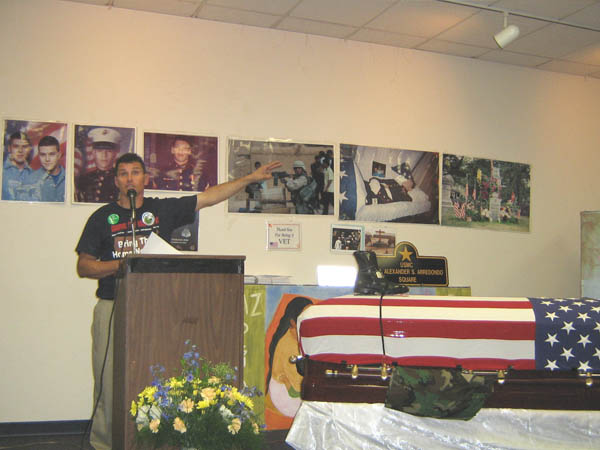
The over 2,500 U.S. servicemembers who have died so far in the Iraq war all had family members who mourned them, but few have been as traumatized by their grief — or have expressed it in such a physically and emotionally intense way — as Carlos Arredondo, who came to San Diego July 8 to share his story. The day Carlos learned of his son Alexander’s death, August 25, 2004, was also Carlos’s birthday, and when he saw the U.S. Marine van pull up in front of his home in the Boston suburb of Holyoke, Massachusetts, his first assumption was that Alexander had managed to get leave to come home briefly and join his dad for his birthday.
When he learned the truth — that Alexander had been killed in combat — Carlos freaked out. At first he got a hammer from his garage and tried to attack the van. Then he used his cell phone to call the recruiter who’d signed Alexander up, and the recruiter hung up on him twice. Then he took a can of gasoline and a torch from his garage and approached the Marine van, asking its occupants to leave. When they didn’t, Carlos broke into the van with a hammer, poured the gasoline all over its interior, and then used the torch to set it — and himself — on fire.
“He was burned over 26 percent of his body,” Carlos’s wife, Melida Arredondo, told the audience of over 100 at the Joyce Beers Community Center in Hillcrest June 8. “There was his face, neck, left arm, both hands and his feet. The first thing the doctors told me — they’re such optimists — was, ‘He’s never going to walk again.’” His doctors wanted to give him major skin grafts, but instead Carlos insisted on going to his son’s funeral even though he had to be carried to it on a stretcher. Carlos eventually recovered fully — though there are still burn scars on his body — and he and Melida credit the emotional impact of attending his son’s funeral, wake and mass with energizing him enough to heal spontaneously.
Today Carlos Arredondo is an anti-war activist with the Gold Star Families for Peace, an organization of opponents to the Iraq war who have lost family members to it headed by Cindy Sheehan, who made national headlines last year when she camped outside President Bush’s ranch in Crawford, Texas and demanded a direct explanation from Bush as to what was the “noble cause” for which her son Casey died. Carlos joined her at “Camp Casey” in Crawford last year and plans, if he can raise the money, to do so again this year.
Carlos Arredondo was born in Costa Rica in 1960. Two years later, his parents took him to an event that, despite his age, he remembered vividly: President Kennedy came to Costa Rica as part of his tour through Latin America to announce the Alliance for Progress. “Since that day,” Carlos said, “we have been very good in our appreciation for the American people, the way they have given us a hand, the way they have been there for us. We always look up to them, and there are still a lot of good American people. Just remember that, please.”
In 1979, Carlos decided to emigrate to the U.S. He was undocumented and the route here from Costa Rica would take him through Nicaragua in the middle of the revolution between the Sandinistas and the Somoza regime they were trying to replace, but he went anyway, crossing the border at Nogales, Arizona. Later he acquired legal residency by agreeing to testify against the coyotes — smugglers — who exploit undocumented immigrants. Melida, also a Latina but born in the U.S., is Carlos’s second wife — his first wife was the mother of Alexander and his brother Brian — and at the July 8 meeting she did much of the talking for the family because of her stronger command of English.
Once the initial wounds — physical and emotional — started to heal, Carlos Arredondo responded to his son’s death much the way local activist Fernando Suárez del Solár, North County resident and immigrant from Tijuana who lost his son in the early months of the war, did. Like Suárez, Carlos focused much of his attention on the slimy, deceitful practices used by military recruiters to ensnare young men — especially poor young men of color — into joining the service. Also like Suárez, Carlos formed a scholarship fund to raise money so people in his community will have an alternative to the military to finance their college education. (Suárez was at the meeting with the Arredondos but had to leave early due to illness.)
Carlos recalled all too well how he heard the news that Alexander had joined the Marines in the first place. “I went, ‘Oh, my God. Oh, no, Alex. Oh, no. Why did you do that?’ In 1980, when I came to America, I was in front of a TV and then suddenly they were showing this explosion in Beirut, and there were almost 270 Marines who got killed in a single bomb at the headquarters of the Marines in Beirut. I never forgot that. I never got over seeing all those Marines … and I didn’t want my son to get killed. I said, ‘Honest, I don’t want you to come home in a body bag.’ He said, ‘Dad, don’t worry. We’re not at war.’”
According to Carlos, Alex told him that the reason he’d joined the Marines was because he didn’t want his father to have to take out a second mortgage on his house to finance his college education. “The way they did this to him was by offering him a $10,000 bonus and a $50,000 scholarship,” Carlos recalled. “ My son was only 16, and they were already seducing him.”
Alex joined the Marines in 2001 and was still in basic training when the September 11 attacks occurred. According to Melida Arredondo, Alex wrote them from boot camp in 2002 and said, “‘Please send information about Iraq, Saudi Arabia, Iran, I know nothing about it, and they keep talking about it here at Parris Island.’ Keep in mind, this is August of 2002. No war has been declared, yet they’re talking about it at Parris Island.”
Carlos and Melida Arredondo spoke at the Joyce Beers Center against a backdrop of various photos and props with which they travel the country to build opposition to the war and awareness of its toll in human life. The main item is a full-size coffin with two boots mounted on top. There is also a set of blow-ups of photos from Alex’s life, ranging from childhood pictures of Alex with his brother Brian — who, much to Carlos’s horror, has also enlisted in the Marines — to a picture of Alex’s body in an open casket.
“I’m very lucky, in a way, that [my son] had an open casket,” Carlos explained. “This is a picture most other Gold Star Families members cannot have, because their sons and daughters died in explosions and a lot of these families cannot bear to see those pictures. But a lot of the families I’ve met before, when they see [Alex’s] picture, they pretty much take it personally. They’re seeing their sons’ and daughters’ faces, and they are very grateful for seeing that picture.”
Carlos’s personal priorities these days are to tour the country with his story and his display, get it seen by as many people as possible — including Marines at bases like Camp Pendleton — challenge the lies told by military recruiters and raise money for the scholarship fund. He’s also got another goal: to become a U.S. citizen. Paul Vauchelet, one of the organizers of the event at the Joyce Beers Center, asked people in attendance to write letters to Congress asking that they push for Carlos to be granted citizenship. He’s already got Massachusetts Senator Edward Kennedy on board, but he needs more support. Still, he’s grateful for the public reaction he’s received already — which he credits with keeping him from being prosecuted and imprisoned for burning the Marine van.
“I thought I would end up in one of those places for being an immigrant, for doing this to the government,” Carlos said.” Years ago they used to kill people for doing that, or put them in the war, or shoot them. I knew that. I saw a lot of movies, and I thought that was what would happen to me. I was worried that perhaps I was going to be in one of those foreign zoos, you know? But thank God, you know, what happened here is that a lot of the American people stood up for me, made a lot of phone calls, sent a lot of e-mails to the police station in Holyoke, to the politicos in Holyoke, and they didn’t allow this. And this didn’t happen because a lot of people stood up to help me. That’s why I’m free today, because a lot of people stood up.”

Nonviolent Peaceforce Representative Speaks in San Diego
Group Trains Peacemakers, Brings Locals Together to Solve Problems
by MARK GABRISH CONLAN
Copyright © 2006 by Mark Gabrish Conlan for Zenger’s Newsmagazine • All rights reserved
Linda Dunn is a short, quiet-seeming woman who’s old enough that when she spoke at the First Unitarian-Universalist Church in Hillcrest July 20 she introduced her husband Mike and said they’d been together 48 years. But, in addition to serving with the Quaker church in Riverside, where the Dunns live, she’s also on the cutting edge of a new approach to peacemaking. She’s part of an organization called Nonviolent Peaceforce [sic] whose goal is to train 500 paid, professional peacemakers for service throughout the world by 2008 — and last summer she and her daughter Diane went to Sri Lanka, Nonviolent Peaceforce’s first target country, to be a part of the effort.
Dunn led an elaborate presentation at the church that included a 12-minute video on the group, a PowerPoint slide show on its efforts in Sri Lanka and introductions to seven local activists involved with the Nonviolent Peaceforce chapter in San Diego. She described the mission of Nonviolent Peaceforce as to protect human rights, deter violence and, instead of taking the place of local individuals and organizations, to work with them and create space for them to do their jobs and stay alive.
Though Sri Lanka’s situation is virtually unknown in the U.S. — as are most of the world’s conflicts in which this country is not directly involved, Dunn rather glumly stated — it has one of the most intractable political situations in the world. The majority of Sri Lankans are Sinhalese Buddhists, but about 20 percent of the people are Tamils, most of them Hindus and many of whose families were brought to the island to work on tea plantations when the place was still called Ceylon and ruled by Britain. In addition, there’s a significant Muslim community and some Christians and believers in other religions.
Much of the conflict comes from the Liberation Tigers of Tamil Army, colloquially known as the “Tamil Tigers,” with a reputation for brutality and recruiting children at festivals. According to Dunn, the average age of a Tamil Tiger is 16 and many of them are 12 or even younger. The Sinhalese and Tamil languages are so different they’re even written with separate alphabets, Dunn explained — and many of the slides she showed featured signs written in three separate tongues, Sinhalese, Tamil and English, with three different alphabets.
Sri Lanka has had to deal with civil war for about 20 years — and as if that weren’t bad enough, the 2004 tsunami did enormous damage to the country and its infrastructure. While much of the reporting on the tsunami told a silver-lining story of Sinhalese and Tamils coming together to help treat the injured and clean up the damage, Dunn said that effect was short-lived and “there has been trouble since.”
According to the United Nations organization UNICEF, the Tamil Tigers recruited 700 children in 2003 alone. Dunn’s slide had the word “recruited” in quotes — which made it look that the children were actually being kidnapped — but Dunn added that this wasn’t entirely true. She said many of their parents shared the nationalistic goals of the Tigers and acknowledged that one of their responsibilities to the movement was to furnish one of their kids to join the Tamil armed forces. But whether the children are taken with the approval of their parents or not, Dunn stressed, it still destroys their lives.
“When children are taken from their families, they lose their hope, innocence and chance for life,” Dunn explained. “The women, if released, have a much harder time being re-integrated into society than the men. Sri Lankan women have very long hair, and the first thing that happens to them in the army is they cut their hair.” Therefore, she added, any short-haired woman in a Tamil community will become an outcast and be unable to marry or have any role in her village again.
Dunn’s team were suddenly confronted with this volatile issue when 26 children were recruited from the grounds of a Hindu temple during a religious festival in 2005.”The field team members actually did help get those 26 children returned and re-integrated into society,” Dunn said. “We were the only NGO [non-governmental organization] invited to the meeting because we were the only one without our own agenda. What they [local activists] do is at great personal risk in this culture of silence.”
Another example Dunn gave for how Nonviolent Peaceforce works took place in the largely Hindu town of Trincomolee. “The Sinhalese Auto Drivers’ Association put up a large statue of Buddha in the middle of the Hindu area,” she recalled. The resulting riots, with “a lot of grenades being thrown,” took at least one life and destroyed many homes. “Nonviolent Peaceforce teams were well known enough to patrol the streets at night and engage the appropriate authorities and community leaders,” Dunn recalled.
The solution was finally brokered by a Buddhist monk who agreed to come to Trincomolee and mediate — but who needed the protection of her group’s field team to make it through Tamil territory and get to the village in the first place. The monk turned out to be the biggest loser in the confrontation; when his superiors in the order found out he’d been involved in negotiations with Tamils, “he was demoted and assigned to a spot in the middle of nowhere, where we fear for his safety,” Dunn said.
Nonviolent Peaceforce was originally founded in 1999 by two veteran activists, Dick Hartsough and Mel Duncan. “I’ve known Dick for about 35 years,” Dunn said. “I remember him telling of how he first got involved in the civil rights movement as a white student in a primarily Black college. He was involved in a sit-in when the white resistance was growing in numbers and in viciousness. After a while, a few determined men came in to the diner where he was involved in the sit-in, and one man raised a knife behind him and said, ‘I’m going to kill you.’ Dick said, ‘Do what you must, but know that whatever you do, I will love you.’ The man’s hand began to shake, the knife began to shake, and it dropped to the floor.”
The group came about when Duncan and Hartsough, who’d independently thought of the idea for it, met at a conference of peace activists in the Hague. Duncan went from meeting to meeting at the conference and was unable to get anyone to give him a chance to speak and outline the concept. “His wife said, ‘Maybe you’re not meant to talk. Maybe you’re meant to listen,’” Dunn said. “Then he heard Dick speak and describe the same vision he had — and they’ve been working together ever since.”
One of the goals of Nonviolent Peaceforce is to make its teams “as geographically, ethnically and religiously diverse” as possible, Dunn explained. “It’s important for the people [in the host country] to see people of various races and religions living and working together.” Dunn said that of the 177 recruits worldwide since December 28, 2005, 45 have been women, 132 men, and most have come from Africa (70, including five Arabs), Europe (39) and Asia (33). Relatively few have come from North America, she explained, because “North American applicants often don’t have the language skills.”
According to Dunn, Nonviolent Peaceforce hopes to start operating in a second country by the end of this year. “Areas under consideration include Mindanao in the Philippines, northern Uganda and southern Sudan, and Colombia,” she said. “We’re working to recruit and train 150 people and have 500 people by the end of 2008. There are trainers being trained to work at four sites worldwide. One of our big problems is getting people visas since the U.S. doesn’t want to let some of our people in.” Dunn said that the cost of this program is $1.8 million per year — about what it costs to run the U.S. military for two minutes.
For more information on Nonviolent Peaceforce, or to make a donation, visit their Web site at http://www.nonviolentpeaceforce.org
Friday, July 07, 2006

“Leonard Cohen: I’m Your Man”: Mixed but Moving
by MARK GABRISH CONLAN
You’ve probably heard Leonard Cohen’s music without knowing it. His songs have appeared in movies from McCabe and Mrs. Miller to the German film The Edukators and even (albeit in censored form) Shrek. They’ve been featured on TV shows ranging from The West Wing to The L Word — and Cohen actually did a guest appearance on Miami Vice, playing the head of Interpol. A native of Montreal, Cohen was born in 1934 and was a published poet before he graduated from college. He wrote the best-selling novel Beautiful Losers in 1966 and set out for New York to become a singer-songwriter because he figured singing his words would pay better than just printing them. While he never had much of a voice — something he’s refreshingly honest about; when he accepted a music award in Canada in 1992 he said, “Only in Canada could somebody with a voice like mine win ‘Vocalist of the Year’” — and other people’s records of his songs generally were bigger hits than his, he nonetheless built up a cult following with the release of his first album, Songs by Leonard Cohen, in 1967.
Discovered by the legendary producer John Hammond — who’d also helped launch the careers of Benny Goodman, Count Basie, Billie Holiday, Aretha Franklin, Bob Dylan, George Benson and Bruce Springsteen — and signed by him to Columbia Records, Cohen emerged as a kind of anti-Dylan. While even the most intimate of Dylan’s songs drew on phantasmagorical imagery and seemingly immense casts of characters, Cohen’s focused laser-like on the emotions of individuals or couples. Cohen also avoided writing openly political songs and, unlike Dylan, kept his original Jewish name. Though Cohen’s popularity dwindled in the 1970’s — especially after his ill-advised decision to do an album with baroque “Wall of Sound” producer Phil Spector, Death of a Ladies’ Man, at the height of the disco and punk movements — interest in his music began to perk up in the 1990’s after the late Kurt Cobain mentioned him in a song on his band Nirvana’s last album in 1993. Within two years there were at least two tribute albums to Cohen on the market and his songs once again began to attract the attention of record buyers — especially in Europe, where he’s always been more popular than in the U.S.
Alas, Cohen himself wasn’t around to share in the new-found acclaim, or the money it was bringing in; he’d deserted the music business to become a Buddhist monk and was living in a monastery on top of Mt. Baldy, taking care of his guru, a 90-something monk named Roshi. He gave his then-manager, Kelley Lynch, power of attorney over his business affairs, intending that she should run his publishing company and hold his royalties for him. Instead, he later alleged in a lawsuit, she sold the rights to his songs and pocketed the money herself, leaving him with $150,000 after a career that had earned millions. When he emerged from seclusion he made two new albums, Ten New Songs (2001) and Dear Heather (2004), produced and co-wrote the Blue Alert album for his current girlfriend, Anjani Thomas, and hired a new manager who, with producer Hal Willner, organized tribute concerts called Came So Far for Beauty in New York, Britain and Australia.
The new film Leonard Cohen: I’m Your Man tells at least part of this story, though it tells it surprisingly obliquely. It’s basically documentary footage and interviews with Cohen himself intercut with other musicians — including Bono and The Edge from U2 — talking about how great he is and how much he influenced them, and footage from the Came So Far for Beauty concert in Sydney, Australia in 2005. Cohen, his speaking and singing voices both reduced to a monotone croak, gives anecdotes about his life but dresses them up in the same philosophical and imagistic language with which he writes his lyrics. The concert participants are an incestuous lot of currently popular “folk” singers — including brother and sister Rufus and Martha Wainwright and their mother and aunt, Kate and Anna McGarrigle — along with Teddy and Linda Thompson and a group called “The Handsome Family” and such unrelated people as rocker-turned-folkie Nick Cave, Antony (an androgynous singer from Britain who leads a band called Antony and the Johnsons), Beth Orton, Jarvis Cocker, Julie Christensen, Perla Batella and Joan Wasser.
Though the grace and power of Leonard Cohen’s work and personality ultimately shine through, Leonard Cohen: I’m Your Man is a film with enough flaws you could probably nit-pick it to death. The talking-heads footage and the concert scenes blend oddly together. The interview segments show a pockmarked Cohen in close-up, his face looking every bit as old as his birth certificate tells us he is — though, oddly, they seem to be the product of more than one interview: when Cohen discusses his monastery life, he’s wearing a thin beard he doesn’t have in the rest of the film.
The performances range from profoundly moving — Antony’s weird countertenor voice and feminine appearance (he looks like a drag queen doing Janis Joplin, appropriately enough since Cohen had a brief affair with the real Joplin) vividly project the song “If It Be Your Will” — to awful. Nick Cave and two female singers who don’t even begin to blend with him ruin Cohen’s most famous song, “Suzanne,” and Beth Orton simply sounds incompetent on “Sisters of Mercy.” Rufus Wainwright’s contributions are strong but a bit prissy — given his well-known homosexuality, the description of the blow job Cohen got from Joplin in “Chelsea Hotel No. 2” seems Gay when Wainwright sings it — though the less well-known Teddy Thompson does well by “Tonight Will Be Fine.”
It’s no surprise that the best version of a Cohen song in the film comes from Cohen himself. After Bono tells us that his all-time favorite Cohen piece is “Tower of Song,” there Cohen is singing it, in a sequence shot in a New York nightclub without an audience, with U2 as his backup band. Bono plays an electronic keyboard and sings harmonies, taking over the lead vocal for a few lines. The feeling is uncannily close to that of “The Wanderer,” the piece Johnny Cash recorded with U2 in 1993; like Cash, Cohen comes off as an aging bard who’s just returned from a long journey to tell his young acolytes the lessons he’s learned on his trek through the world.
In essence, that’s the overall message of Leonard Cohen: I’m Your Man. Cohen emerges as a sort of wise man — the horrible naïveté that cost him his life savings is discreetly unmentioned — and his lyrics, dense and rich in poetic and philosophical musings on his own and other people’s emotions and behavior, are certain to affect you. Whatever might be wrong with this or that interpretation of a Cohen song in the film, the basic strength of his material comes through — and so does the love the musicians and performers in the film have for it, even though some of them love Cohen’s songs not wisely but too well. Leaving the theatre, you’re likely to be moved and feel exalted by an hour and 38 minutes spent with a fascinating man who’s created compelling art in three media — music, poetry and drawing — and you’re also likely to be tempted to empty your wallet to stock up on Leonard Cohen CD’s.
Leonard Cohen: I’m Your Man is now playing at the Landmark Cinemas, 3965 Fifth Avenue in Hillcrest. Please call (619) 299-2100 for showtimes and other information.
Thursday, July 06, 2006

Former Ugandan Parliament Member Speaks in Mission Valley
Speaker Aggressively Discusses Women, AIDS and So-Called “Genocide” in North
by MARK GABRISH CONLAN
Copyright © 2006 by Mark Gabrish Conlan for Zenger’s Newsmagazine • All rights reserved
“There has been a betrayal of women’s rights in Uganda,” said Miria Matembe, former ethics minister and member of parliament in the Ugandan government, in a speech at the Mission Valley public library July 2. Matembe, a heavy-set woman with a short, almost masculine haircut, spoke for well over two hours, fielding some surprisingly hostile questioning from the audience as she explained why she broke with Uganda’s president, Yoweri Museveni, in 2003 after Museveni had Uganda’s constitution amended so he could run for a third term as president.
After noting that her friend, university professor Dr. Dee Aker, had last been in Uganda in 2001 and had observed the local elections that year — “they were very bad in my constituency of Barrera, and Dee said this was a hopeless case” — Matembe said she had defended the elections and the Museveni government. After 2003, Matembe changed her mind. “I had no choice but to part company with President Museveni and join those who think he’s taking us in the wrong direction,” Matembe said. “In 2003 I told him not to amend the constitution to eliminate the term limits. … Some African brothers, when they get into power, they cannot get out.”
Matembe joked that “one day we might have to come observe your elections to make sure they are free and fair,” but said that at least the United States has a tradition of checks and balances, including limits on the power of the president, that doesn’t exist in most African countries. She claimed that only two post-independence leaders in sub-Saharan Africa — Julius Nyerere of Tanzania and Nelson Mandela of South Africa — have ever voluntarily stepped down from the presidencies of their countries. (A few audience members offered the names of one or two more.) “The others,” said Matembe, “hold ‘elections’ as personal property, view government as patronage and just stay around.”
Yoweri Museveni became the leader of Uganda in 1989, after a decade-long guerrilla war between his New Resistance Movement (NRM) and the Ugandan government. Prior to then, Uganda had been under the leadership of two bloodthirsty dictators, Milton Obote and Idi Amin. Amin had overthrown Obote; Obote in turn overthrew Amin in the 1970’s and ruled until the NRM won its guerrilla war and Museveni assumed power. At first Museveni promised a democracy and recruited political activists, including Matembe, to draft a new constitution.
“In the Ugandan constitution, we said, ‘No traditional chiefs,’ because they rule forever,” Matembe recalled. “So we put down a limit of two five-year terms for the president.” After questioning why the U.S. continues to support Museveni and hail him as a democrat even as his rule becomes increasingly dictatorial and corrupt, Matembe said, “I believed in that man until I saw him stand up in 2003 and say, ‘I would advise you to give up the term limit.’” Matembe explained that she had other issues with Museveni besides his scrapping the constitutional term limit to keep himself in office — notably her frustration at being unable to get him or the Ugandan parliament to live up to the constitutional guarantees of gender equality — but the term-limit issue was the last straw.
“We are just there … ”
“I wanted to use politics to espouse my cause for women’s equality,” Matembe said. “When the NRM came to power, it seemed to be a period of cleaning up. I wanted a legal framework to promote gender equality and empowerment for women’s. I linked with women in non-governmental organizations (NGO’s) to encourage change.” Among her greatest victories was a constitutionally mandated quota of at least 28.8 percent women in the national parliament and at least 30 percent women in the local and regional governments — but Matembe has become discouraged about that, too, feeling that the quota system has become an impediment to real progress for women in Uganda.
“We are just there; we got access and presence, but no influence,” Matembe explained. “We participated in vain, because at the end of the day our rights are not there. Women supposedly play an important role in Ugandan politics, but many decisions that affect women’s lives are still made without their participation. This is not only unfair and unjust, it renders the political process a sham.” What’s more, she said, the quota-guaranteed seats in the parliament have attracted women who are more interested in the income and perks of legislative service —especially desirable in a country whose economy is still underdeveloped and few middle-class jobs exist — than in activism. “They perceive [the quota system] as an act of privilege and generosity on the part of the government, so they are not willing to rock the boat,” Matembe explained.
According to Matembe, the biggest specifically feminist issues facing Ugandan women are property rights, divorce and domestic violence, including sexual abuse. While the Ugandan constitution says at least some of the right things on paper — “it does away with traditional practices [like arranged marriages and female genital mutilation], sets the marriage age at 18 and grants women the right to own property independently of their husbands” — the government “has been very reluctant to make laws in conformance with the constitution on women’s rights,” she explained.
Rape Laws from 1908
What that means in practice is that rights American and other Western women won in the 1970’s after decades of feminist struggle (and which, as Matembe grimly noted, many young American women take so totally for granted that they refuse to organize to protect them) still don’t exist for women in Uganda. The laws governing rape and domestic abuse date back as far as 1908, when Uganda was still a British colony, and allow men accused of rape to use the victim’s previous sexual history in court against her. What’s more, they specifically define rape as a woman being forced to have sex against her will by a man other than her husband. Like most U.S. rape laws before the so-called “second wave” of feminist activism in the 1970’s, Uganda’s laws say that a husband has the automatic right to have sex with his wife any time he wants, whether she wants to or not.
The only change in Uganda’s rape laws since Museveni came to power has been to increase the penalties, as a response to the AIDS crisis — but even that is meaningless if women are too traumatized or scared by the court system to testify against their rapists, and according to Matembe that’s usually the case in Uganda today. What’s more, she added, even when rapists are convicted “the judges don’t put out big sentences. The [rape] laws are not user-friendly. They put the woman on trial and put her through a second rape in court.”
Matembe boasted that she had once suggested castration as an appropriate punishment for rapists — leaving it somewhat ambiguous whether she was serious or simply taking an extreme position to dramatize the importance of reforming Uganda’s antediluvian rape laws. (At least one woman in the front row at the Mission Valley library seemed to like the idea.) Matembe said “there is no political will” to change these ancient rape laws and that the entire promise Museveni made to be interested in women’s participation in government was a sham.
“He was using us to promote his causes,” she said. “The government is mainly interested in harnessing us to stay in power. Beyond that, the government is not interested in empowering women, as shown by its refusal to enforce the laws on equal property rights and enact new laws on divorce and sexual abuse.” About the only hope for Ugandan victims of rape or domestic violence, Matembe conceded, lies with non-governmental organizations like Hope After Rape and Action for Development, who reach out to the survivors of rape and domestic violence, respectively.
AIDS, Abstinence and Health Care
Asked about Uganda’s AIDS situation and alleged U.S. pressure on the Museveni government to abandon condoms and safer-sex education in favor of abstinence-only programs, Matembe said she’d been involved personally in Uganda’s AIDS response and took pride in the claim that Uganda’s rate of HIV seropositivity had fallen from 15 percent of the population in the early 1990’s to 6 percent today. “Our AIDS rate is low because of our own efforts, not the United States,” she said. “The U.S. government came to ‘help’ us with AIDS just to be seen. For America to put Uganda up as African’s model AIDS program was Bush’s idea, not ours.” She said that Uganda applauded the United Nations effort to set up a Global Fund against AIDS, tuberculosis and malaria (from which the U.S. has largely abstained in favor of setting up an anti-AIDS fund of its own) but said “we don’t need to borrow strategies from anywhere.”
Matembe said she personally took the HIV antibody test when she visited the U.S. in 1991 “because I wanted to be at the forefront in fighting the evil, and therefore I wanted to know my status. (This was in sharp contrast to South African president Thabo Mbeki, who refused to take the test in 2000 because, he said, it would be a gesture of support for the orthodox model that HIV is the sole cause of AIDS and he didn’t want to commit to that while he was inviting scientists with other points of view to advise him on the syndrome.) Matembe said the initial strategy of Uganda was to “take AIDS on at every function, including a funeral or a wedding … It was a tough journey, and we were abused for it. I talked at a wedding, and when the boy went to kiss the girl, the girl said, ‘Don’t! You’ll give me AIDS!’”
Instead of pushing abstinence-based anti-AIDS programs on Uganda, Matembe said the developed world would be better advised to work on improving Uganda’s overall health-care infrastructure. “If we had good health facilities, we would not be dealing with AIDS,” she said. “Caring for the sick without gloves, you get AIDS.” She also said that the abstinence-only proponents ignore both human nature and the lack of rights for women in Uganda — particularly the laws that prevent married women from refusing to have sex with their husbands or insisting on condom use when they do. “I am a very good Christian, but I am against the churches saying abstinence,” Matembe declared. “Even Jesus said that the spirit was willing but the body was weak. What about the bodies of ordinary human beings?”
Uganda’s North: Terror and Camps
Though much of Matembe’s presentation was fervent — she frequently raised her voice and gestured flamboyantly to make her points — on no other issue was she as emotional as on the situation in northern Uganda. A good many of the people in the audience, including some Ugandan émigrés, had been encouraged to come to the meeting by a local group called the Campaign to End Genocide in Uganda Now (C.E.G.U.N.). Their argument is that Museveni’s government is carrying on a campaign to wipe out the Acholi people of northern Uganda by placing them in concentration camps, and using the threat of a terrorist organization called the Lord’s Resistance Army (LRA) to justify keeping them in the camps.
Matembe couldn’t have disagreed more. Whatever her differences with Museveni on other issues, she remains a staunch supporter of his policies in the north, convinced that relocating the people out of their villages and into camps in the 1990’s was the only way to stop the LRA. She said the north had been “pacified” to the point where there is only one district — in the Chittagong/Gulu area — where the camps are still necessary. “Problems remain in Acholiland,” Matembe conceded. “Women have been raped. Young children have been abducted and raped and have had children by fathers they don’t know. The struggle has been going on for 20 years. It is very sad that that happened.”
But Matembe vehemently defended Museveni against the C.E.G.U.N. members’ charges of genocide. She blamed the LRA and its leader, Joseph Kony, for the brutalities in the north and the need to keep the Acholis in camps. “We debated it in parliament and tried our best, but we couldn’t sort out the situation or have talks with the terrorists,” Matembe said. “Kony has no agenda. The other groups who were fighting the government all had agendas, and we were able to negotiate with them and bring them into the government.” Matembe also blamed the government of Sudan, which until recently provided weapons and financial support to the LRA and still gives LRA fighters sanctuary in their country. (Ironically, Sudan’s Arab Muslim-dominated government has been accused of genocide against the Christian and animist people of southern Sudan as well as the people of Darfur in the west, who are Muslims but are Black instead of Arab.)
During the question-and-answer period, Matembe had to deal with hostile statements from the C.E.G.U.N. members and supporters in the audience, and at times it seemed as if the Black people in the room were applauding the C.E.G.U.N. speakers while the whites were coming to Matembe’s defense. A number of the C.E.G.U.N. members pointed to a recent interview Joseph Kony gave to the BBC after years of media silence, during which he identified the LRA as a movement for Acholi liberation and denied that his fighters ever cut off the limbs, noses or lips of fellow Acholis — as Matembe and the Ugandan government have charged.
Matembe responded furiously. “The people fighting Kony have told us what was going on, and one problem was that Sudan was arming them,” she said. “Kony is an animal. How come he turns his guns on the Acholi people and cuts them down instead of fighting against the [Ugandan] army?” Asked why the struggle in the north has been going on for over two decades, Matembe said, “Guerrilla wars take a long time to win. Even the U.S. hasn’t got Osama bin Laden and hasn’t stopped the situation in Iraq. Uganda is poor and is trying to fight with Kony.” Matembe did acknowledge that “the army in Uganda is corrupt,” and that one reason the war is lasting so long is that much of the money set aside to fight it is being diverted into the pockets of military leaders — some of whom received high-powered, high-paid appointments in Museveni’s government even after parliament censured them for corruption.
According to Matembe, it’s the overall poverty in Uganda, as well as the threat from the LRA, that’s keeping the Acholis in the camps this long. “People are in the camps because the government doesn’t have enough money,” she said. “We put a motion before the Ugandan parliament to have the north declared a disaster area so we could get foreign help, but Museveni was against it because he thought it was a sign of defeat.” One issue on which she and the C.E.G.U.N. people did agree was that after a decade in the camps — in which time a whole generation has been born and grown to adulthood without any formal education whatsoever — the Acholis would need a lot of physical, psychological and spiritual help to leave and resume any sort of normal life, and Matembe said she hoped the Americans would help provide that.
“It is not true that the government is deliberately exterminating the Acholis,” Matembe said. “Acholis do not live in Acholiland alone. We emigrate, we mix, we intermarry. I regret the situation in Acholiland today. It is my view that the war is no longer at that magnitude. It is now mostly in southern Sudan. I understand that the government has decided that these people should go out of the camps, but to do that these people must have a lot of rehabilitation, including psychological help and searches to find out if their original homes still exist. But I want to believe that something is being done for these people.” Denying the claims of C.E.G.U.N. and other groups that one million Acholis have been killed by the relocation, Matembe said, “I’m not there. I talk from my heart and I want to appeal to the people from Acholiland to be honest and not to tell Americans that one race in Uganda is trying to eliminate another.”

Low Turnout, Negative Campaign Sank Busby, Queer Democrats Told
by MARK GABRISH CONLAN
Copyright © 2006 by Mark Gabrish Conlan for Zenger’s Newsmagazine • All rights reserved
Ever since Republican Brian Bilbray, former Congressmember and Washington lobbyist, defeated Democrat Francine Busby by five percentage points in the June 6 special election to fill the seat of former Congressmember Randy “Duke” Cunningham, most pundits analyzing the race have suggested that it means the Republicans will likely keep control of Congress after this fall’s election. The argument goes that tightly gerrymandered districts, carefully drawn to favor incumbents, Republican party loyalty and the popularity of most local Congressmembers — whatever voters may think of the nationwide party to which they belong — will ensure enough Republican wins to preserve their House of Representatives majority. That’s the perception Jess Durfee, former San Diego Democratic Club president and currently chair of the San Diego County Democratic Central Committee, and Ira Lechner, Virginia-born political activist and Democratic campaigner, came to the San Diego Democratic Club June 22 to challenge.
According to Durfee and Lechner, what did Busby in was a low voter turnout, a last-minute gaffe, a misplaced strategy aimed at getting Republicans to cross over instead of seeking support among Democrats and Democratic-leaning independents who rarely vote, and an intensely negative campaign on both sides that left voters disgusted and kept them home. Because the club’s advertised speaker, San Diego city attorney Mike Aguirre, didn’t show, Durfee and Lechner got more time than expected to discuss the results of the June 6 election — but what was billed as a post-mortem of the entire result focused almost exclusively on the Bilbray-Busby race.
Lechner compared the turnout in June 2006 to that of the Presidential election in November 2004, in which Busby ran against Cunningham and predictably lost big in a heavily Republican district — before Cunningham pled guilty to charges of corruption, left Congress and received an eight-year prison sentence. In that election, 275,000 people voted in the 50th Congressional district, where Cunningham and Busby were running; Cunningham got 169,000 votes and Busby got 105,000, Lechner said. By contrast, on June 6 only 157,000 people voted in the district and only 71,000 voted for Busby. The key to winning the election, Lechner argued, would have been reaching out to the 34,000 “true-blue Democrats and Democratic-leaning independents” who had voted for Busby in 2004 and didn’t vote at all this year.
Instead, Lechner said, “Busby became a focus for the Democratic battle for control of Congress in the whole country, with media attention and a whole lot of money. We spent somewhere in the neighborhood of $4-5 million. In addition, a lot of phone banking was done by MoveOn.org and EMILY’s List sent out mail pieces that were far better done than the miserable pieces I got from the Democratic Congressional Campaign Committee (DCCC). They were unreadable and stupid. You remember the commercials, with the bouncing kangaroo? The DCCC’s commercials were disruptive. The Republicans spent at least $10 million and had $24 million available.”
According to both Lechner and Durfee, the involvement of both the Republican and Democratic national congressional campaigns turned the race into a mud-fest, with both sides airing disgustingly negative commercials and the Republicans, since as usual they had more money, airing more of them. “Do you remember the first commercial they put up about Busby allegedly applauding child molesters?” Lechner said. “That ran on every single local channel for three weeks. It didn’t change Busby’s negative rating hardly at all. One could argue that the $10 million spent by the Republicans and the $5 million by the Democrats had virtually no effect on the election except to turn people off from voting at all.”
And that, Durfee argued, is precisely why the Republicans in particular have become known for running such nasty campaigns: because turning people off from voting at all is exactly what the Republicans want. Durfee called it “voter suppression” and said the Republicans can get away with it because they have a far more loyal hard-core base that will turn out and vote for their party’s candidates no matter what. The Republicans’ trick, he said, is to magnify the importance of their base by turning off everyone else in the electorate — and one proven way for the Republicans to do that is to run such a negative campaign that the Democrats feel forced to respond in kind. “When you fight a negative campaign with a negative campaign, we’re likely to lose because Republicans will come out come hell or high water, whereas Democrats are a lot more fickle,” Durfee explained.
When club member and Busby campaign volunteer Bill Stanhope said that all anyone he talked to during door-to-door precinct walks could recall about her were the attack ads, Lechner responded with a slashing critique of the mind-set of Washington-based political consultants. “The power of these consultants from D.C. is just overwhelming — and bad,” Lechner said. “They have one formula, and on June 7 they’re gone. In this case they left at 11:15 in the morning on June 6. The consultants are so powerful that all the candidates listen to them. What they don’t realize is that the American voter is yearning for a reason to vote for somebody — and instead all they get is these negative campaigns on both sides.”
“The candidate pays the consultant and the direct-mail house pays the consultant,” Durfee added. “So the candidate is going to be persuaded to do more mail whether it will do them any good or not. The consultants are getting kickbacks from the mail houses.” Durfee said the only way to defang the power of the consultants is to build more neighborhood-based grass-roots campaigns; he urged people to go door-to-door in their neighborhoods and give positive messages on why people should vote for a particular candidate instead of fear-mongering with attacks on the opponent.
Durfee outlined another Republican strategy to win elections: getting hot-button initiatives on the ballot that will attract socially conservative voters to the polls and thereby swell the totals for Republican candidates as well. In 1994 Republican governor Pete Wilson tied his political fortunes to the anti-immigrant Proposition 187, erased a double-digit deficit in the polls and won re-election — though he hurt the long-term status of the Republican party in California by encouraging eligible Latinos to become U.S. citizens and vote Democrat. (In the mid-1990’s the San Diego Democratic Club’s voter registration volunteers reported that when they worked in Latino communities and asked people what party they wanted to register with, they’d often reply, “Which party is Pete Wilson in? I want to be in the other one.”) More recently, Republicans have used initiatives banning same-sex marriage and restricting women’s rights to reproductive choice to draw out socially conservative voters.
Though governor Arnold Schwarzenegger and the Republican leadership lost all four of the initiatives they put on the ballot in the November 2005 special election, Durfee warned that they are pulling the same strategy this November by putting back on the ballot the initiative that came closest to victory last year: one requiring that the parents be notified if a minor girl seeks an abortion. “The initiative on parental notification will be on the ballot this November,” Durfee warned. “These initiatives are on the ballot to drive the far Right to the ballot box. Overall, we have a good slate of Democrats statewide and locally, but we have our work cut out for us.”

BILL FREYER:
“Mr. Handball” Brings “Pleasures and Treasures” to North Park
interview by MARK GABRISH CONLAN
Copyright © 2006 by Mark Gabrish Conlan for Zenger’s Newsmagazine • All rights reserved
Beginning in May, a small, quiet, unassuming bungalow at 2228 University Avenue started undergoing a transformation. It got a new coat of paint on the outside and a broad new stoop of stairs at its entrance. Inside, its walls were painted and a series of shelves and racks were put up containing all sorts of goodies, including T-shirts and other clothing, sex toys and S/M equipment, adult videos and also original artworks and other items one doesn’t expect to see in a store catering to an adult market. On June 15, the two men who had created this business opened its doors to the public and turned on the neon sign that announces its name, “Pleasures and Treasures,” and its slogan: “A new experience every time!”
The main man behind Pleasures and Treasures, Bill Freyer, is a lot like his store: quiet and unassuming on the outside, energetic, passionate and deeply committed on the inside. He’s of medium height, rail-thin, with short hair and in such good physical shape it’s hard to believe he’s old enough to have done all the things he says he’s done. Before he got into the adult retail business, he was known mostly as the founder of Red Hankies San Diego, a club for fellow devotees of the sex practice variously known as “fisting” or “handballing.” He started this club two decades ago and has seen it grow into a worldwide organization that hosts an annual “FistFest” convention in Palm Springs every June.
Zenger’s visited Bill Freyer on June 18 — Bill’s birthday. (He didn’t say which birthday.) We talked about the store, Bill’s history with Red Hankies and in the Leather community, the dos and don’ts for wanna-be fisters and fistees, and how their intent for the store is not only to sell merchandise but, with their own experiences in Leather and kink, to teach people how to use these items to improve their sex lives and increase their erotic repertoires. Though Pleasures and Treasures actually opened on June 15, their official “grand opening celebration” was July 1, from noon to 3 p.m., and featured special guests Bill Gardner and John Singleton of the Palm Springs-based Hot Desert Knights company, pioneers in producing “bareback” (condom-free) adult Gay videos.
Zenger’s: Bill, why don’t we start with a little of your background, how long you’ve been involved in the community and what got you into this?
Bill Freyer: I’ve been in San Diego for about 22 years now. I have been actively involved in Club X and Leatherfest, and also I’m the head of Red Hankies of San Diego. I’ve had friends also that have other shops, like Perry and Brian over at Ringold, and I worked for a short stint at RAW Limited. When I quit there, I missed being around the customers, and my partner and I sat down and discussed opening our own shop. When this shop became available here, especially right next door to the 2200 Club, it was meant to be.
Zenger’s: There seem to be so many of these kinds of stores around North Park: the Crypt, MacLeo, until recently Ringold, and RAW. How many stores like this do you think this area can support; and what’s going to make yours different, so that people will want to come to this one?
Freyer: I think there’s still a huge gap in the community for stores of our type. The biggest difference between our store and the others is some of them have people working at them who really don’t know the scene. They’re just working there. Or some of them look totally slutty, so that a lot of people would not want to walk through the front door just from the outside of the building, or from the merchandise displayed through the window.
We’ve created a very intimate atmosphere here, from the outside look of planted flowers and the wide staircase coming into the store. None of the lighting inside is harsh or brightly fluorescent. We’ve tried to put lamp lighting around as much as possible to provide a nice, intimate setting. We’re not putting anything into our actual entry showroom that would be offensive or overly sexual. And we welcome everybody with a smile.
I know the Leather scene well enough that if somebody comes in who’s a total novice and has questions, we’re able to answer them. We’re very much a one-on-one, service-oriented business. If somebody comes in, whether they’re into bondage or Leather or fisting or whatever little fetish they may want to get into, this is going to be a great place for me to be able to talk to them one-on-one, expose them to some of the stuff that we have here in the store, and answer people’s questions without them feeling embarrassment, or not knowing who to ask, or how to ask a question if they’re curious. There aren’t enough places here in town that have experienced people working there to answer questions when somebody does want to know something.
Zenger’s: Have you had any difficulties with the city in terms of what sort of merchandise you can and can’t have here?
Freyer: Not really. I talked to the city and we were able to get our business license under just a regular retail business, clothing-type store. As long as we stay under 15 percent of our stock being adult product, we don’t even have to classify ourselves as an adult business. We actually do want to be known more for our clothing, our gifts, and the artwork, with the adult side of it being a sideline. You can still come and get your adult paraphernalia and novelties, but you’ll be able to get all the other things you want, from great T-shirts to artwork. One of the other aspects that we have here is an art gallery. We’ll have rotating artists that will be coming through, displaying their art for 30 days at a time, and we’re giving the local artists a place to display their artwork and at the same time bring in a diverse crowd into our store.
Zenger’s: When I interviewed David Snider at RAW, he talked about his frustration about being able to sell adult videos directly. How have you been able to work around that problem?
Freyer: David had the problem of a location directly across the street from him that sold videos before he had his store license. There’s a Municipal Code ordinance saying that if you’re within 1,500 feet of another business selling adult product, you cannot sell the same product. I don’t have anybody else within 1,500 feet of me selling videos, so I can get away with that.
Zenger’s: You said you think being right next to the 2200 Club is going to help your business. How?
Freyer: It’s a built-in clientele. The back of our building actually faces their parking lot, and we have signage saying, “Enter at the front,” so people can’t miss us as they’re leaving their parking lot. Also, the owner and manager of the 2200 Club have been extremely supportive, and they’ve even offered our customers 20 minutes of free parking behind their establishment. So if there’s no parking out front, feel free to use their parking lot back there.
Zenger’s: I’ve long wanted to do an interview with you about Red Hankies and that whole side of your life. did you get interested in fisting in the first place?
Freyer: I was just having a good time with someone. We were playing, and one thing kind of led to another. Before I knew it he was introducing me to fisting, and I became hooked on it. One thing led to another, and when I moved here to San Diego, I thought it would be cool to see if there were others like me who were into the handball scene. I advertised in the local rags at the time that I wanted to start a new club here in San Diego for those into handball, or “FF” as I initialized it in the ad, because a lot of people are offended by the word “fisting.” One thing led to another, people started joining, and we formed an official club. That was 17 years ago, and now we’re a worldwide organization. At last count we’re about 400 members strong from all points of the earth.
Zenger’s: I know I had a hard time believing that fisting even existed. I thought, “Gee, that must be some weird urban legend in the Gay community.” I’d seen a couple of photos, but thought, “They could fake that.” It was hard for me to believe that anybody did that, let alone that they actually enjoyed it.
Freyer: I understand that. There’s a fine line between wanting just regular sex and wanting to experiment. A lot of people will only want what I call “vanilla” sex, in general oral and anal. But once you become bored with that and you want to explore other avenues, there’s so much out there to experiment with and enjoy. Some people get into bondage, some people get into being flogged. Other things like electricity. Some people are even into being a slave or a pup.
When you are talking about the sexual arena itself, sometimes you want something just a little larger than the average penis. So you start playing with toys, graduating sizes of dildos or whatever. Some people even use cucumbers, just to have something to expand themselves with. If you’re lucky and you get with somebody who’s experienced in the handball scene, then they can guide you through and let you experience it in a gentle and loving way.
It’s not something you usually do overnight. You have to build up to something the size of a hand, either by toys or even buy a couple of fingers at a time. But eventually, if you’re patient or hungry enough, then what started off as two or three fingers will become four, and then five, and then the hand will actually slide inside.
There’s a totally different feeling for both the top and the bottom. The bottom will experience the expanding and fullness, and the massaging of the prostate, and the top will experience the closeness, warmth and intimacy of having that much of themselves inside of another person. If you’re actually in a loving relationship and you’re doing this, then it’s a higher element of intimacy than any other kind of an experience. If you’re doing this strictly on the pure sex aspect, it’s overwhelming as well.
Zenger’s: One thing I’ve noticed hearing you talk, also seeing some of the literature on fisting, is that the preparations involved, especially if you’re the bottom, seem really elaborate, almost a sort of monastic discipline. You have to adjust your diet and clean yourself out to prepare.
Freyer: Some people are very lucky. They can adjust their diet and do a clean-out process in 20 minutes. Other people really have to regiment themselves on their diet two or three days in advance. You can do anything from an Epsom salts-type drink that you swallow down that actually causes you to evacuate everything within your system, to just a dish hose-type clean-out in the shower. But the main thing is just being clean and fresh, shall we say, for the play.
Another way of stopping things once you are clean is to take Imodium, which will actually prevent anything else coming further down in the system, to prevent any kind of unpleasantness. But the bottom needs to be clean, and the top also needs to have his nails done, cut short and buffed, so they’re nice and smooth and there are no raw edges.
Gloves are always encouraged for safe play. Some people are allergic to latex, and so there are also nitrile gloves. Of course there have always been people who don’t like gloves, and they’ll always use a bare hand. In that case you just make sure that you don’t have any cuts or sores on your hands. A good way of knowing whether you do have any or not is just put some vinegar on your hands, and if you have a cut or anything like that you will know it.
Zenger’s: Don’t you also have to be somewhat choosy about what lubes you use for this?
Freyer: Well, there are more comfortable lubes. Probably the biggest one that people equate with fisting is Crisco. It’s cheap, but at the same time it’s also very messy. It is a grease. If you get it into your bedding or your carpet or anything like that, it’s almost impossible to get totally out. It also has a specific odor that will permeate your house if you don’t clean it up properly, because it actually becomes rancid over time, and you have that rancid smell. If you use something like Elbow Grease or J-Lube, those kinds of products, they wash right out of your clothing, and the clean-up is easy.
The main thing is if you are using gloves, you want to make sure you are using a lubricant that’s not going to break down the glove also. So anything with a grease product that’s not latex-compatible will break down the latex pretty fast. You need to use something that is actually latex-compatible when you’re doing that.
Zenger’s: That’s pretty much the same thing we all had to learn when condoms started being common.
Freyer: Right. You’ve got to use the right lubricant whether you’re using condoms or gloves, either one.
Zenger’s: What exactly does the Red Hankies club do?
Freyer: We actually have a newsletter so people can meet through the newsletter ads. We also do social events, such as barbecues, pool parties, potlucks. We do bar nights where we have a beverage bust. Here locally it’s at the Eagle, on the third Thursday of every month. We also do things up in Los Angeles and Palm Springs, San Francisco, everything from barbecues and potlucks to play parties. And the play parties are usually either held at the private residence of a member or at a bathhouse, or even a hotel. We can reserve an entire hotel and have play parties.
Zenger’s: Didn’t your group start the annual “FistFests”?
Freyer: Yes. Our biggest event is FistFest, and it’s held in Palm Springs every June. We have people come in from all over the world to attend that. It’s almost like a convention of sorts, a nice, naked convention,. Playing underneath the stars, hot balmy nights. Lots of fun.
Zenger’s: Do you ever get newbies at your events, people who seek you out just because they’re curious about fisting and haven’t taken the plunge yet, and want to talk to you guys before they do?
Freyer: Oh, lots. We have a small ad in the local rags, and people will call or they’ll show up at the bar nights, and they’ll say, “Look, I’ve heard about fisting, or I may have seen it in a movie somewhere. I have no idea how to proceed, or if I would even fit into your club, or would you even welcome somebody that’s not experienced?” I’m one of the very first ones to say, “First of all, you have to know the right person to get experienced. And through our club you meet the right people. You meet the experienced people who know what they’re doing.” We’re very good at training and answering questions
Zenger’s: Would you talk about the dangers involved in fisting? Some people have really exaggerated ideas about how dangerous this is, but there are also some risks. Can you talk a little about both the myths surrounding fisting and the actual risks?
Freyer: Probably the biggest myth is if you get into fisting, you’re going to lose control of your bowel movements totally, your butt’s never going to go back to its shape, and you’re going to be on a bag by the time you’re 10 years into it. That’s not true. The anus is like any other muscle. It can stretch. It can have its own memory. And as long as you work that muscle like any other muscle, and exercise it — some people may know what Kegels are, where you actually squeeze your buttocks when you’re sitting, and you squeeze your butthole at the same time — it actually keeps your butthole in good shape and doesn’t let it totally stretch out and elasticize.
The other fallacy is people think that if you put your hand inside, you’re going to rip everything inside. The only time that that would happen is if somebody is playing unsafe, meaning having long fingernails, or if they’re totally drugged up or drunk from alcohol and they don’t know what’s going on, or have the feelings or sensations that they should be feeling if they’re not high. Then they don’t realize if something doesn’t feel right until it’s too late. In my entire career in the fisting world, I’ve only ever heard of three people that got hurt, and they readily admit that they were high on something and they didn’t feel anything until it was too late.
Zenger’s: So one of your warnings would be: “This is a clean and sober activity.”
Freyer: Very much so. I can’t stress enough that people really need to be in full containment of their faculties, so they feel every nuance that’s going on with them during the act. If you’re out of it, if you’re drunk, if you’re drugged up, whatever, then your senses are deadened by that and you don’t know what’s going on. And you don’t feel the natural high that you can get from a really good handball session.
Zenger’s: How do you feel about having the reputation of being the founder of Red Hankies and therefore in a sense being “Mr. Fisting San Diego”?
Freyer: [Laughs.] I’m very proud of what I’ve accomplished. Being around for 17 or, 18 years, we are one of the longest living clubs still here in San Diego. I’m very proud that, people know my name, and especially equate it with respect. Too many reputations get tarnished or talked about or messed up so easily, and I’ve been able to retain my respect in the community. When I decided to open the shop, I knew that my name and my reputation would actually bring customers in. I guess there’s something to be said for recognition.
How to Reach Bill
Pleasures and Treasures is located at 2228 University Avenue in North Park (near Mississippi Street), next door to the 2200 Club. Its hours are noon to 11 p.m. Mondays, Wednesdays and Thursdays, noon to 2 a.m. Fridays and Saturdays, noon to 6 p.m. Sundays (closed Tuesdays). Bill and Tom can be reached there by phone at (619) 822-4280 or by e-mail at pleasuresandtreasures@cox.net
Red Hankies of San Diego can be reached by phone at (619) 516-2888, by e-mail at RHSDFF@aol.com, or via the Web at www.rhsd.org
Red Hankies International can be reached by phone at (619) 688-8668, by e-mail at RHI_inc@cox.net, or via the Web at www.redhankiesinternational.com
AIDS (Hype) at 25
by MARK GABRISH CONLAN
Copyright © 2006 by Mark Gabrish Conlan for Zenger’s Newsmagazine • Used by permission
Even though I have been writing, reporting, talking and being an activist around AIDS for over two decades, I was still taken aback by the hype surrounding the 25th anniversary of Los Angeles-based Dr. Michael Gottlieb’s report in the June 5, 1981 issue of the Morbidity and Mortality Weekly Report — the charmingly named newsletter of the U.S. Centers for Disease Control (CDC) — announcing the first five cases of what has since come to be called AIDS. The Los Angeles Times ran an elaborate series of articles called “AIDS at 25,” ranging from pieces on the fate of the AIDS quilt and the disappearance of red ribbons at awards shows and celebrity galas to alleged new epidemics in places like China. Newsweek did a cover story, also called “AIDS at 25.” PBS ran a two-part, four-hour presentation of the AIDS epic on its Frontline series.
All of these presentations, of course, followed what TV journalist John Hockenberry once called “the gospel of the AIDS establishment.” If you read these articles or watched these programs, you were told that the so-called Human Immunodeficiency Virus (HIV) is the sole and exclusive cause of AIDS; that HIV exposure invariably leads to infection, AIDS and an early death; that the standard so-called “HIV tests” (really tests for antibodies to all or some of the nine proteins believed to make up HIV) can tell you with 99-plus percent certainty whether this dire fate will befall you; that since 1996 “lifesaving” medications have been available that will delay the “progression” from HIV to AIDS and death, and that though they may have a number of unpleasant “side” effects these are certainly preferable to letting untreated HIV ravage your body, smash your immune system to smithereens and leave you vulnerable to all sorts of horrible “opportunistic infections,” many of them lethal.
Regular readers of Zenger’s know that I don’t believe any of that for a moment, and I’ve frequently interviewed and covered credentialed scientists like Peter Duesberg, David Rasnick, Kary Mullis, Stefan Lanka, Charles Thomas, Roberto Giraldo and others who have a very different view of what AIDS is, what causes it, how it should be treated and what should be done to stop its spread. Though those scientists don’t always agree with each other, they have one thing in common: the AIDS establishment — the junta of failed cancer researchers who were put in charge of AIDS research almost as soon as the syndrome was first identified; the authorities in the U.S. government and the United Nations who quickly proclaimed HIV the “truth” about AIDS and suppressed scientific inquiry into any other possible causes; the giant pharmaceutical companies who are making tons of money off those supposedly “lifesaving” drugs; and the activists, non-governmental organization officials and other do-gooders who think they’re doing the world a favor by raising money to pay the big drug companies to provide these medications to the Third World — has moved heaven and earth to try to shut them up.
Though the scientific critique of the HIV/AIDS model is almost as old as the alleged HIV/AIDS connection itself — HIV was first politically proclaimed as the cause of AIDS in April 1984 and the first scientific article challenging the model, Peter Duesberg’s “Retroviruses as Carcinogens and Pathogens: Expectations and Reality” (http://www.virusmyth.net/aids/data/pdcancer.htm), was published in October 1987 — it’s almost never acknowledged in the mainstream media. At times the suppression becomes ridiculous, as it did when a few years after the so-called “cocktail therapies,” including protease inhibitors, were introduced in 1996, large numbers of patients started experiencing their frequently horrific side effects — ranging from sunken faces and swollen bellies to chronic diarrhea, toxic liver failure and death. “Nobody thought these drugs would have these effects!” the establishment scientists whined — and journalists, acting as their mouthpieces as usual, repeated the claim. Actually, somebody — the dissident scientists in general and David Rasnick, a Ph.D. chemist whose entire professional career had been as a protease researcher, in particular — had warned about these effects, both in professional journals and when I interviewed him in these pages. But nobody outside a handful of people who’d stumbled across the dissident critique of AIDS noticed.
What’s happening in AIDS today is a peculiar duality, as an establishment bloated with success and profits selling a dubious theory and ruthlessly suppressing alternatives is being confronted with an increasingly disinterested public. In a real sense, AIDS is over. The epidemic is history. Since 1993, AIDS in the developed world has been endemic: though there’ve been a few year-to-year fluctuations and the occasional uptick, the numbers of new diagnoses have trended steadily downward. The trendy celebrities who used to wear those red ribbons to the Academy Awards have moved on to trendier causes: breast cancer, the “war on terror” (pro or anti), global warming.
Even in the Queer community, where AIDS was first identified and where it was the public-policy and activist issue through most of the 1980’s and 1990’s, AIDS awareness has been dwindling. In the 1990’s the right of Queers to serve openly in the U.S. military took over from AIDS as the hot issue among Queer activists, and in this decade the military issue has in turn been superseded by marriage equality and outreach to Queer youth. I had an interesting experience recently running into two friends of mine who were meeting at a coffeehouse to plan an upcoming Queer event and debating to what organization they should donate the door charge. It was a toss-up between two organizations working with Queer youth; not once did they consider donating to an AIDS organization.
AIDS awareness in the Queer community is dwindling in another respect as well. The cloud of shame and fear AIDS – specifically the myth that AIDS is caused by a sexually transmitted virus — dropped over Gay male sexuality has finally started to lift. Fewer and fewer Gay and Bisexual men are living their lives under the gun of virological terrorism; they’ve stopped using condoms when they have sex, they’ve stopped going to take the HIV antibody test every six months, and they’re generally living their sex lives as if AIDS didn’t exist. This isn’t entirely a good thing, mainly because it’s making them somewhat more vulnerable to syphilis and other diseases that really are sexually transmitted, but there’s a difference between maintaining a reasoned awareness of the risks of STD’s and being traumatized by a deliberately hysterical fear campaign into regarding sex as a harbinger of death, which is what the AIDS establishment’s “HIV prevention” campaign tried to do to a generation of Gay men. One sign of this is the increasing popularity of “bareback” Gay porn videos that depict condom-free sex; a marginal (and highly controversial) part of the market when they were reintroduced in the late 1990’s, today they dominate the porn catalogs.
Like the Communist Party of the Soviet Union during its own long, slow decline from omnipotence into irrelevance, the AIDS establishment is trying to regain its power by scaring people all over again. HIV “prevention educators” are trying to warn people of the side effects of the anti-HIV drugs — ironically sounding at times like AIDS dissidents as they use some of the same arguments we do: that the benefits of the drugs have been oversold and their risks swept under the proverbial carpet. Acknowledging that the “HIV epidemic” has stalled in the developed world, they’ve seized on various parts of the global South — first sub-Saharan Africa, then southeast Asia, India and now China — alleging, on the basis of highly dubious estimates and wild extrapolations from little hard data, that millions of people in these areas are already “HIV-positive” and only incredibly expensive, highly toxic drugs can save them (sort of, since one other tenet of the AIDS establishment is that HIV exposure is always fatal).
I don’t know how many people who called their pledges into Live 8 while the concerts were being telecast realized that they were essentially donating their money to Big Pharma, but that’s exactly what they were doing. Not content with being the most profitable corporations in the world (at least until the recent spikes in crude oil and gasoline prices put the big oil companies ahead of them), the giant pharmaceutical companies have persuaded millions of people worldwide to give them money, albeit through the fig leaf of non-governmental organizations (NGO’s) shilled for by rock stars like Bono, to buy AIDS drugs for countries whose real health problems could be solved at a fraction of the cost. What the countries being ballyhooed as the sites of the next big AIDS epidemics actually need are clean water, sanitation, cheap generic antibiotics for the diseases that really threaten them — especially tuberculosis and malaria — and a health infrastructure to offer their people basic care.
On one level, the AIDS industry at 25 looks like an unstoppable juggernaut, still maintaining its appearance of omnipotence and its ability largely to silence its scientific and activist critics. It’s still making enormous amounts of money for its constituencies — the scientists being paid to research HIV, the organizations receiving government grants to “educate” people to get tested and take the drugs, and above all the drug companies who’ve made a killing (figuratively and literally) on selling the meds. On another level, though, AIDS is dying of sheer disinterest. None of the hysterical predictions that AIDS would be a pandemic of such proportions that it could threaten the very existence of the human race have come anywhere close to coming true — indeed, that part of the AIDS hype has quietly been transferred to avian flu and other newer, scarier pandemic hypes. The AIDS scare is ending the way T. S. Eliot said the world would — not with a bang, but a whimper — and it’s highly unlikely that those of you who are still around in 2031 will see anywhere near the recent hype when “AIDS at 50” rolls around.
by MARK GABRISH CONLAN
Copyright © 2006 by Mark Gabrish Conlan for Zenger’s Newsmagazine • Used by permission
Even though I have been writing, reporting, talking and being an activist around AIDS for over two decades, I was still taken aback by the hype surrounding the 25th anniversary of Los Angeles-based Dr. Michael Gottlieb’s report in the June 5, 1981 issue of the Morbidity and Mortality Weekly Report — the charmingly named newsletter of the U.S. Centers for Disease Control (CDC) — announcing the first five cases of what has since come to be called AIDS. The Los Angeles Times ran an elaborate series of articles called “AIDS at 25,” ranging from pieces on the fate of the AIDS quilt and the disappearance of red ribbons at awards shows and celebrity galas to alleged new epidemics in places like China. Newsweek did a cover story, also called “AIDS at 25.” PBS ran a two-part, four-hour presentation of the AIDS epic on its Frontline series.
All of these presentations, of course, followed what TV journalist John Hockenberry once called “the gospel of the AIDS establishment.” If you read these articles or watched these programs, you were told that the so-called Human Immunodeficiency Virus (HIV) is the sole and exclusive cause of AIDS; that HIV exposure invariably leads to infection, AIDS and an early death; that the standard so-called “HIV tests” (really tests for antibodies to all or some of the nine proteins believed to make up HIV) can tell you with 99-plus percent certainty whether this dire fate will befall you; that since 1996 “lifesaving” medications have been available that will delay the “progression” from HIV to AIDS and death, and that though they may have a number of unpleasant “side” effects these are certainly preferable to letting untreated HIV ravage your body, smash your immune system to smithereens and leave you vulnerable to all sorts of horrible “opportunistic infections,” many of them lethal.
Regular readers of Zenger’s know that I don’t believe any of that for a moment, and I’ve frequently interviewed and covered credentialed scientists like Peter Duesberg, David Rasnick, Kary Mullis, Stefan Lanka, Charles Thomas, Roberto Giraldo and others who have a very different view of what AIDS is, what causes it, how it should be treated and what should be done to stop its spread. Though those scientists don’t always agree with each other, they have one thing in common: the AIDS establishment — the junta of failed cancer researchers who were put in charge of AIDS research almost as soon as the syndrome was first identified; the authorities in the U.S. government and the United Nations who quickly proclaimed HIV the “truth” about AIDS and suppressed scientific inquiry into any other possible causes; the giant pharmaceutical companies who are making tons of money off those supposedly “lifesaving” drugs; and the activists, non-governmental organization officials and other do-gooders who think they’re doing the world a favor by raising money to pay the big drug companies to provide these medications to the Third World — has moved heaven and earth to try to shut them up.
Though the scientific critique of the HIV/AIDS model is almost as old as the alleged HIV/AIDS connection itself — HIV was first politically proclaimed as the cause of AIDS in April 1984 and the first scientific article challenging the model, Peter Duesberg’s “Retroviruses as Carcinogens and Pathogens: Expectations and Reality” (http://www.virusmyth.net/aids/data/pdcancer.htm), was published in October 1987 — it’s almost never acknowledged in the mainstream media. At times the suppression becomes ridiculous, as it did when a few years after the so-called “cocktail therapies,” including protease inhibitors, were introduced in 1996, large numbers of patients started experiencing their frequently horrific side effects — ranging from sunken faces and swollen bellies to chronic diarrhea, toxic liver failure and death. “Nobody thought these drugs would have these effects!” the establishment scientists whined — and journalists, acting as their mouthpieces as usual, repeated the claim. Actually, somebody — the dissident scientists in general and David Rasnick, a Ph.D. chemist whose entire professional career had been as a protease researcher, in particular — had warned about these effects, both in professional journals and when I interviewed him in these pages. But nobody outside a handful of people who’d stumbled across the dissident critique of AIDS noticed.
What’s happening in AIDS today is a peculiar duality, as an establishment bloated with success and profits selling a dubious theory and ruthlessly suppressing alternatives is being confronted with an increasingly disinterested public. In a real sense, AIDS is over. The epidemic is history. Since 1993, AIDS in the developed world has been endemic: though there’ve been a few year-to-year fluctuations and the occasional uptick, the numbers of new diagnoses have trended steadily downward. The trendy celebrities who used to wear those red ribbons to the Academy Awards have moved on to trendier causes: breast cancer, the “war on terror” (pro or anti), global warming.
Even in the Queer community, where AIDS was first identified and where it was the public-policy and activist issue through most of the 1980’s and 1990’s, AIDS awareness has been dwindling. In the 1990’s the right of Queers to serve openly in the U.S. military took over from AIDS as the hot issue among Queer activists, and in this decade the military issue has in turn been superseded by marriage equality and outreach to Queer youth. I had an interesting experience recently running into two friends of mine who were meeting at a coffeehouse to plan an upcoming Queer event and debating to what organization they should donate the door charge. It was a toss-up between two organizations working with Queer youth; not once did they consider donating to an AIDS organization.
AIDS awareness in the Queer community is dwindling in another respect as well. The cloud of shame and fear AIDS – specifically the myth that AIDS is caused by a sexually transmitted virus — dropped over Gay male sexuality has finally started to lift. Fewer and fewer Gay and Bisexual men are living their lives under the gun of virological terrorism; they’ve stopped using condoms when they have sex, they’ve stopped going to take the HIV antibody test every six months, and they’re generally living their sex lives as if AIDS didn’t exist. This isn’t entirely a good thing, mainly because it’s making them somewhat more vulnerable to syphilis and other diseases that really are sexually transmitted, but there’s a difference between maintaining a reasoned awareness of the risks of STD’s and being traumatized by a deliberately hysterical fear campaign into regarding sex as a harbinger of death, which is what the AIDS establishment’s “HIV prevention” campaign tried to do to a generation of Gay men. One sign of this is the increasing popularity of “bareback” Gay porn videos that depict condom-free sex; a marginal (and highly controversial) part of the market when they were reintroduced in the late 1990’s, today they dominate the porn catalogs.
Like the Communist Party of the Soviet Union during its own long, slow decline from omnipotence into irrelevance, the AIDS establishment is trying to regain its power by scaring people all over again. HIV “prevention educators” are trying to warn people of the side effects of the anti-HIV drugs — ironically sounding at times like AIDS dissidents as they use some of the same arguments we do: that the benefits of the drugs have been oversold and their risks swept under the proverbial carpet. Acknowledging that the “HIV epidemic” has stalled in the developed world, they’ve seized on various parts of the global South — first sub-Saharan Africa, then southeast Asia, India and now China — alleging, on the basis of highly dubious estimates and wild extrapolations from little hard data, that millions of people in these areas are already “HIV-positive” and only incredibly expensive, highly toxic drugs can save them (sort of, since one other tenet of the AIDS establishment is that HIV exposure is always fatal).
I don’t know how many people who called their pledges into Live 8 while the concerts were being telecast realized that they were essentially donating their money to Big Pharma, but that’s exactly what they were doing. Not content with being the most profitable corporations in the world (at least until the recent spikes in crude oil and gasoline prices put the big oil companies ahead of them), the giant pharmaceutical companies have persuaded millions of people worldwide to give them money, albeit through the fig leaf of non-governmental organizations (NGO’s) shilled for by rock stars like Bono, to buy AIDS drugs for countries whose real health problems could be solved at a fraction of the cost. What the countries being ballyhooed as the sites of the next big AIDS epidemics actually need are clean water, sanitation, cheap generic antibiotics for the diseases that really threaten them — especially tuberculosis and malaria — and a health infrastructure to offer their people basic care.
On one level, the AIDS industry at 25 looks like an unstoppable juggernaut, still maintaining its appearance of omnipotence and its ability largely to silence its scientific and activist critics. It’s still making enormous amounts of money for its constituencies — the scientists being paid to research HIV, the organizations receiving government grants to “educate” people to get tested and take the drugs, and above all the drug companies who’ve made a killing (figuratively and literally) on selling the meds. On another level, though, AIDS is dying of sheer disinterest. None of the hysterical predictions that AIDS would be a pandemic of such proportions that it could threaten the very existence of the human race have come anywhere close to coming true — indeed, that part of the AIDS hype has quietly been transferred to avian flu and other newer, scarier pandemic hypes. The AIDS scare is ending the way T. S. Eliot said the world would — not with a bang, but a whimper — and it’s highly unlikely that those of you who are still around in 2031 will see anywhere near the recent hype when “AIDS at 50” rolls around.
Subscribe to:
Posts (Atom)